





Summary of this article
High silver prices reduce solar industry manufacturing demand.
Central banks continue hoarding gold despite record high prices.
Investors should use gold for stability, not just silver.
In the past two years, investors have often relied on the thumb rule of holding gold for safety and holding silver for its returns. While gold’s appeal lay in its safe-haven demand, silver’s rising demand across new industries made it indispensable for investors looking to ride the rally in precious metals seen in the past two years.
The recent performance of the metals also backs this theory as spot silver delivered a 15 per cent return in August 2026 and outperformed gold, which gained 13 per cent in dollar terms. This outperformance occurred despite gold witnessing its third strongest monthly run in 25 years.
Where Market Rates Stand Today
As of September 29, the situation has changed. At the time of writing, Gold Futures with December 6, 2026, expiry traded at $4169.9 per troy ounce, down marginally by 0.02 per cent on the Comex. On the other hand, Silver Futures with December 6, 2026, expiry traded at $61.15, down by 1 per cent on the Comex.


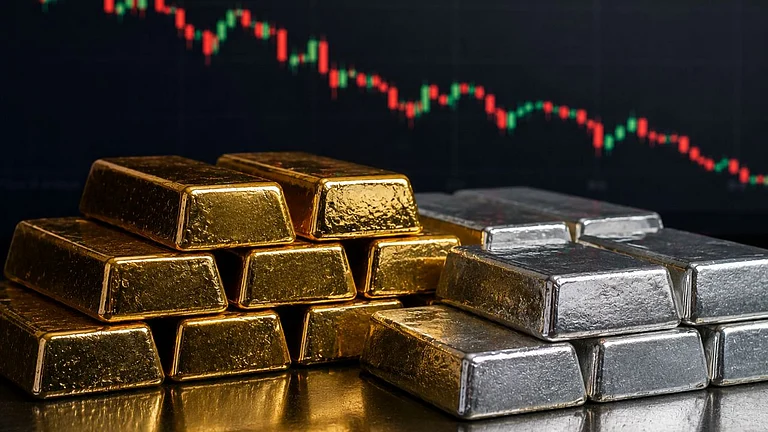
Closer home on the Multi-Commodity Exchange (MCX), Gold Futures with December 4, 2026 expiry, slipped 0.5 per cent to Rs 1,48,150 per 10 grams. While the decline in silver futures with December 4, 2026 expiry was greater as it fell 1.29 per cent to Rs 2,24,500 per 1 kilogram.
On a year-to-date basis, spot gold has declined 2.44 per cent and silver has declined 10.28 per cent as of September 28, according to a report by the World Gold Council (WGC).
Silver’s Price Surge Stops ‘Green’ Dream Run
After outpacing the returns delivered by gold in August, silver prices are currently witnessing a bigger drawdown than gold in September. According to the Alpha Strategist report by Motilal Oswal, while gold is being accumulated by institutions and sovereign nations that continue to buy it despite its price increasing, silver is running into resistance from the same industrial demand that contributed to its rally in the first place.
When the rally in silver prices started, solar energy, electric vehicle manufacturing and the rising adoption of AI were seen as triggers which would lead to an endless demand for silver. However, when raw materials become too costly, manufacturers start finding ways around them.
According to the report, industrial fabrication demand for silver is projected to decline by nearly 2 per cent to roughly 20,200 tonnes in 2026. One of the key reasons for this reduction in demand is the ‘thrifting’ and ‘recycling’ of silver, which is happening in the solar energy industry as silver prices soar. Thus, faced with the elevated silver prices, solar panel manufacturers have been actively engineering panels that use less silver paste per cell, or replacing silver with cheaper alternative metals altogether.
Despite a moderation in select industries, the industrial demand for silver remains strong from artificial intelligence data centres, microchips, and automotive electronics. While the overall silver market is projected to remain in a physical deficit for the sixth straight year, with total demand outpacing supply by about 2,000 tonnes,according to the Silver Institute, the solar slowdown exposes silver's vulnerability. Since industrial applications make up a significant portion of silver's total demand, when silver becomes too expensive, its commercial buyers actively look for ways to stop buying it.
Central Banks Keep Hoarding Gold
On the other hand, gold does not have the same kind of industrial demand and derives its primary value from monetary security, sovereign reserve backing, and its appeal as a hedge against volatility and a safe-haven asset.
Thus, when gold prices surged in August, gold buyers did not step back. Instead, global gold-backed exchange-traded funds (ETFs) recorded roughly $18 billion in net inflows during August alone, representing the second-largest monthly inflow on record. Total global gold ETF holdings reached an all-time peak of approximately 4,000 tonnes.
According to the report, the People's Bank of China continued its gold purchases for the 22nd consecutive month in August, adding 20 tonnes to boost its reserves to around 2,400 tonnes.
Poland has also been another major institutional buyer this year, actively working toward keeping 30 per cent of its entire foreign reserves in physical gold. Central banks are not worried about manufacturing margins or quarterly supply costs as they increase their gold hoard to mitigate the effects of currency fluctuations and geopolitical conflicts. This, in turn, makes gold demand enduring, structural, and largely resistant to high price tags.
What Should Investors Do
For everyday investors managing their own portfolios, the phenomenon of high prices of silver affecting its demand changes the beliefs and conventions they have held on to.

The gold-to-silver ratio, which indicates how many ounces of silver are needed to purchase an ounce of gold, has narrowed from 100 in April 2025 to around 66.6 by September 2026. On one hand, this indicates silver's ability to gain in sharp rallies, but it also highlights its cyclical swings.
According to the report, investors should continue to see gold as an anchor, making a modest allocation through Gold ETFs or Multi Asset Allocation for cushioning against stock market volatility and currency weakness. Silver, on the other hand, should not be treated as a direct replacement for gold, especially because its movement is tied to industrial cycles.





