





Summary of this article
Government starts talks to review LTCG and STT rules.
Investors demand tax cuts to revive negative market returns.
Changes must balance market growth against crucial tax revenues.
Market participants across portfolio sizes have raised the demand for a review of the Long Term Capital Gains Tax (LTCG) and Securities Transaction Tax (STT). Amid the rising demand for a review the government has also initiated consultations with several stakeholders such as investors, market functionaries, and tax experts to re-evaluate the taxes according to a report by the Economic Times which cited sources privy to the matter. Notably, the decision to reassess the taxation move also comes at a time when overseas investors have remained net sellers of Indian equities.
Finance Minister Hints at Ongoing Discussions
Earlier on October 13, speaking at the sidelines of an event held in Delhi, Finance Minister Nirmala Sitharaman also acknowledged the need for a healthy debate regarding the issue.
The discussions around LTCG and STT come at a time when the next Union Budget announcement is nearly three months away. As preparations for the upcoming budget gain momentum, Sitharaman also noted that the topic has surfaced frequently in her interactions with domestic and global investors, according to the report.



Market Pressures and Double Taxation Concerns
So far in 2026, the benchmark Nifty has delivered a negative return of 12.98 per cent. Amid the negative returns there is an increasing demand for relaxing taxes to revive the markets and lure back foreign capital. Thus market participants have also repeatedly raised concerns over the simultaneous imposition of LTCG tax and STT, labelling it as double taxation.
Currently, equity investments face a 12.5 per cent tax on long-term gains held over 12 months, which climbs to nearly 15 per cent with cesses and surcharges. Furthermore, a STT of 0.1 per cent applies to both buyers and sellers, alongside a 0.015 per cent stamp duty on buyers.
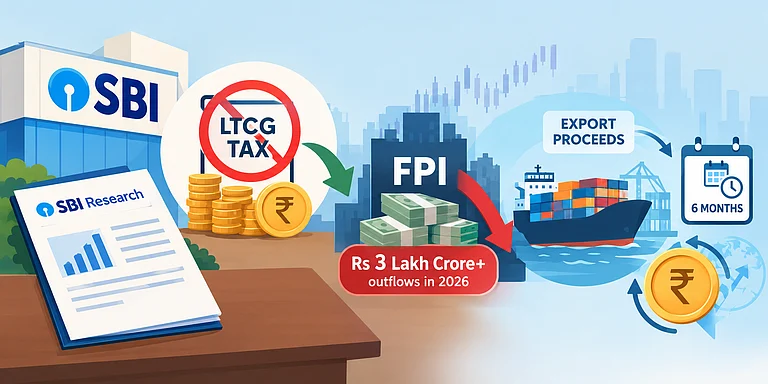
A recent proposal from State Bank of India Research has also recommended abolishing the LTCG tax on equity investments to anchor foreign capital flows and reduce market volatility. To promote stability and discourage frequent trading, the research note suggested extending the minimum holding period required for long-term classification from the current 12 months to two or three years.
Revenue Implications and State Shares
Even as demands for abolishing the taxes increase, any modification to these taxes has to also weigh the impact on government revenue. According to the report the total long-term capital gains collections for the financial year 2025 touched Rs 1.29 lakh crore, almost double the amount collected in the previous year. Similarly, securities transaction tax collections have surged by 52 percent to Rs 46,840 crore between April 1 and October 14. The funds are crucial to manage rising fertiliser subsidy bills due to the West Asia conflict and to finance massive social sector initiatives.
Push for Global Competitiveness and Tax Certainty
Suggestions have also emerged to eliminate the capital gains tax for foreign portfolio investors while slightly increasing the STT to make the transition revenue neutral. This could eliminate transaction friction and discourage excessive high-frequency trading. Furthermore, there is a push for a comprehensive review of the dual levy system.