







Summary of this article
FM Sitharaman has acknowledged the debate over STT and LTCG tax, but announced no changes
Lower STT could reduce trading costs, while LTCG cuts could improve post-tax returns
Revenue losses and concerns over speculative trading could limit scope for tax cuts
Finance Minister Nirmala Sitharaman has acknowledged the debate around Securities Transaction Tax (STT) and long-term capital gains (LTCG) tax on equities, raising questions about whether the government could review the tax burden on stock market investors.
Speaking at the Bloomberg New Economy Forum 2026, Sitharaman said it was too early to comment on possible changes, with preparations for the next Union Budget already under way. She acknowledged that investors in India and abroad had been discussing capital gains tax, transaction taxes and whether different asset classes should receive similar tax treatment.
“The debate on tax in the market, debate on STT, and also the question of treating all asset classes similarly, has been a very well-discussed topic,” the finance minister said.
Her remarks have brought the debate over the cost of investing in the stock market back into focus, especially after the government raised STT on derivatives in Budget 2026.
STT Cut Could Lower Trading Costs
STT is levied on stock market transactions, irrespective of whether an investor makes a profit or incurs a loss. A reduction could lower trading costs for retail investors, domestic institutions and foreign portfolio investors (FPIs).
From April 1, 2026, STT on futures rose to 0.05 per cent from 0.02 per cent. The rate on options premium increased to 0.15 per cent from 0.10 per cent, while STT on exercised options rose to 0.15 per cent from 0.125 per cent. Cash-market rates remained unchanged. Delivery trades attract STT of 0.1 per cent on both purchases and sales, while intraday trades attract 0.025 per cent on the sell side.
Manasvi Garg, CFA and founder of Moneyvesta, a wealth management firm, said a reduction could make India's derivatives market more competitive and help retain trading activity within the country.
Garg said FPIs, global trading firms and custodians had raised concerns about India's trading costs in discussions with Sebi and Finance Ministry officials in August 2026. They argued that “lower STT could make India's trading costs more competitive.”
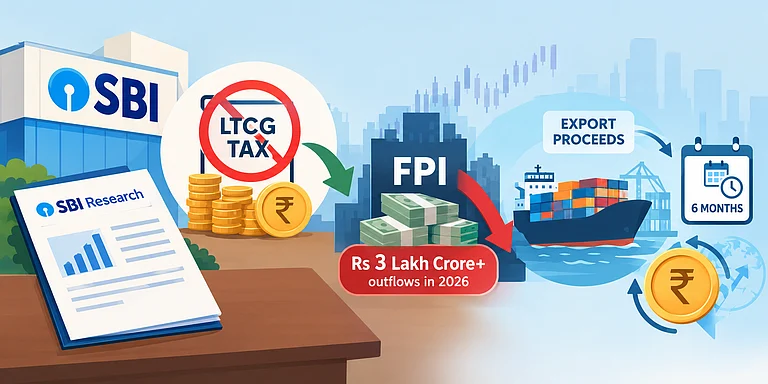
FPIs withdrew a record Rs 3.06 lakh crore from Indian equities in calendar 2026 up to October 13, according to NSDL data. However, Garg cautioned against attributing foreign investor selling entirely to STT. Higher US bond yields, a stronger dollar, elevated crude oil prices and investment flows towards artificial intelligence (AI)-focused markets have also weighed on Indian equities.
CA Ashish Niraj, partner at A S N & Company, Chartered Accountants, said India's 0.1 per cent STT on delivery trades is higher than the US rate of zero but lower than the UK's 0.5 per cent. China also charges 0.1 per cent STT on the sell side.
“India cannot be described as uniformly high-tax across every securities category,” Niraj said. However, he said the higher STT on derivatives could make India less competitive than major financial markets.
Niraj said investors should compare brokerage, exchange charges, stamp duty and other levies when assessing trading costs. A country with lower or zero STT may still have similar overall trading costs if its other charges are higher.
The government, meanwhile, has reasons to retain higher rates on derivatives. STT collections rose to Rs 40,214.36 crore between April 1 and September 17, 2026, up from Rs 26,305.72 crore in the year-ago period, according to Income Tax Department data. The government's FY27 Budget target is Rs 73,700 crore. STT collections were Rs 57,522 crore in FY26 and Rs 53,296 crore in FY25.
The tax also serves as a measure to discourage excessive speculation in derivatives. Sebi's FY26 study found that 87.7 per cent of individual futures and options (F&O) traders incurred net losses after costs during the year.

Niraj estimated that a 20 per cent cut in STT rates could cost the government around Rs 15,000 crore in revenue. To make up for this loss, the tax base would need to grow by 21-22 per cent, he said. With India's fiscal deficit at around 4.5 per cent of GDP, the government has limited room to absorb the revenue loss.
“Not sure that mere reduction in STT will automatically generate higher collections as various other factors are also there,” Niraj said.
Garg said any review should balance the need to attract foreign investment and improve market competitiveness with the government's objectives of limiting speculative trading and protecting revenue.
Puneet Singhania, director at Master Capital Services, said a phased reduction could be an option, with STT cut first and LTCG tax eased later if the fiscal position allows.
“Cutting STT would deepen liquidity, narrow spreads and make trading cheaper for everyone, from small retail to institutions,” Singhania said.
Will The Government Cut LTCG Tax
LTCG tax on listed equities is another issue under discussion. Investors currently pay 12.5 per cent tax on annual gains exceeding Rs 1.25 lakh from shares held for more than 12 months.
The government reintroduced LTCG tax on listed equities in April 2018 at 10 per cent and raised it to 12.5 per cent in the July 2024 Budget.
Singhania said India's LTCG tax rate was not unusually high compared with several major markets. However, investors also pay STT on transactions, adding to their overall tax burden.
“The real irritant is the stack,” Singhania said, referring to the combination of LTCG tax, STT and the 20 per cent tax on short-term capital gains.
Pranay Aggarwal, director and CEO of Stoxkart, said scrapping LTCG tax could improve post-tax returns for eligible investors and encourage long-term equity investment. Investors with annual gains below Rs 1.25 lakh would see little direct benefit, while those with larger taxable gains would benefit more.
Aggarwal said the impact on retail investment and foreign inflows would depend on market conditions, valuations and global liquidity. “The government would also need to assess the potential revenue implications against any indirect economic benefits,” he added.
Removing LTCG tax could make Indian equities more attractive to FPIs, particularly when compared with markets such as Hong Kong and Singapore, where capital gains are generally not taxed. However, tax rates are only one factor influencing foreign investment. “FPIs care more about earnings growth, rupee stability and valuations,” said Singhania.
Revenue Loss Could Limit Scope For Cuts
The biggest hurdle to scrapping LTCG tax is the revenue the government would give up. In a written reply to Lok Sabha Unstarred Question No. 166 on July 20, 2026, the Finance Ministry said LTCG tax revenue from equity transactions rose to Rs 1,29,158 crore in assessment year 2025-26 from Rs 72,249 crore in AY 2024-25.
Singhania said scrapping the tax “would leave a sizeable hole” in government revenue.
SBI Research's Ecowrap report dated October 12 recommended removing LTCG tax on equities while increasing the holding period to two or three years. The proposal aims to encourage longer-term investments and discourage short-term foreign money flows.
Singhania said reducing STT first and easing LTCG tax later, depending on the government's fiscal position, could be one way to approach the issue. “A phased approach could work: trim STT first, then ease LTCG once the fiscal position allows. Doing both together would send a strong signal that India wants to be a lower-friction, globally competitive market,” he said.


However, he also added that higher trading volumes and STT collections might recover only part of the revenue lost from scrapping LTCG tax.
Any reduction in STT or LTCG tax could benefit the stock market investors. However, the benefits would depend on the extent of the cut, the transactions covered and whether the government revises one or both taxes.





