





Summary of this article
Sensex, Nifty rise despite US tech sell-off and Fed hawkishness concerns
IT, banking lead gains, and broader markets lag as metals and autos decline
Crude oil softens amid Strait of Hormuz stability and easing geopolitical tensions
Sensex, Nifty Today: Benchmark indices traded higher after starting on a subdued note on June 24, 2026, as softening crude oil prices and improving sentiment around the ongoing US-Iran peace talks provided support.
At 11:16 AM, the BSE Sensex was up by 655 points, or 0.86 per cent, at 76,856. Likewise, the NSE Nifty 50 was up by 154 points, or 0.65 per cent, at 23,978.
The gains in the benchmark indices came even as weakness in US tech stocks and expectations of a more hawkish Federal Reserve weighed on investor sentiment.
The broader market, however, relatively underperformed, with the Nifty Midcap 100 and Nifty Smallcap 100 trading around flat-to-negative levels.
Banking and IT stocks were the primary drivers of the rally, while losses in metal and auto shares limited the upside.
Among the Nifty 50 constituents, Tech Mahindra, Dr Reddy's Laboratories, ICICI Bank and Infosys emerged as the top gainers, rising between 1 per cent and 3 per cent. Other notable gainers included Trent, Apollo Hospitals, InterGlobe Aviation, Adani Enterprises, HDFC Bank and Tata Consultancy Services.
On the downside, Bajaj Auto, SBI Life Insurance, HDFC Life Insurance, Tata Steel, JSW Steel, Hindalco, Maruti Suzuki, Bharti Airtel, Eicher Motors, Grasim Industries and Wipro were among the top losers, declining between 1 per cent and 3 per cent.
Asian, US Tech Stocks Fall
Asian equities continued to remain under pressure on June 24 after a sharp sell-off in US technology stocks rattled investor sentiment overnight. MSCI's broadest index of Asia-Pacific shares outside Japan was down nearly 4 per cent.
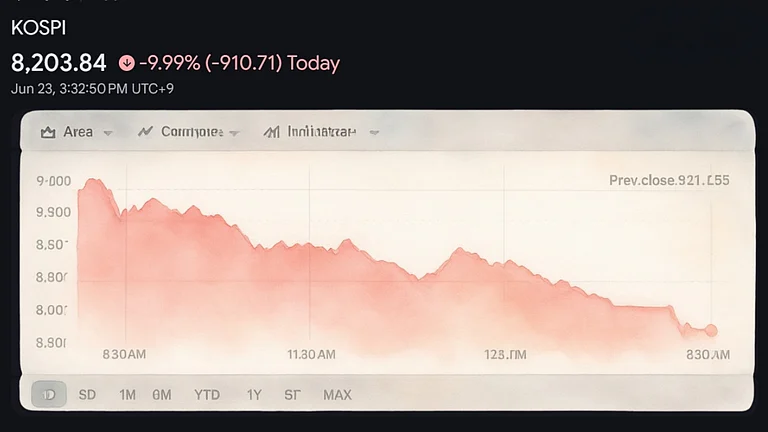
South Korea's KOSPI witnessed wild swings after the 10 per cent crash in the previous session. Japan's Nikkei 225 too moved between gains and losses during trading and was last seen marginally lower. China's CSI 300 and the Hong Kong-based Hang Seng also followed a to-and-fro movement, while Taiwan's TAIEX tumbled over 2 per cent.
The cautious mood followed a weak session on Wall Street, where technology and semiconductor stocks came under renewed pressure. The Nasdaq Composite fell 2.21 per cent, while the S&P 500 dropped 1.44 per cent to its lowest level in more than a week. The Dow Jones Industrial Average, however, showed relative resilience and closed lower by just 0.09 per cent.
Semiconductor companies emerged as the biggest losers during the Wall Street sell-off as investors reassessed valuations following several months of strong gains in the sector. Market participants remained wary of increasing debt-funded investments in artificial intelligence infrastructure, raising concerns about the sustainability of spending in the sector.
US Fed Rate Hike Expectations Weigh On Sentiment
At the same time, expectations that the US Federal Reserve could adopt a more hawkish policy stance later this year continued to weigh on risk appetite.
According to the Chicago Mercantile Exchange's FedWatch Tool, traders are increasingly pricing in the possibility of the US Fed going for a rate hike in the coming months. For the July meeting, markets assign a 36.30 per cent probability of a 25 basis point increase, which would take the policy rate to the 3.75-4.00 per cent range.
Expectations of further tightening rise for the September meeting, with a 50.90 per cent chance of a 25 basis point hike. At the same time, traders are assigning a 19.40 per cent probability to a larger 50 basis point increase that would push rates to the 4.00-4.25 per cent range.
For the October meeting, markets see a 45.30 per cent likelihood of a 25 basis point hike, while the probability of a 50 basis point increase stands at 27.80 per cent. There is also a 5.20 per cent chance of a larger 75 basis point hike, which would lift the benchmark rate to the 4.25-4.50 per cent range.
Relief From Easing Oil Prices Support Markets
Crude oil prices eased further as investors tracked developments around tanker movement and shipping activity through the Strait of Hormuz.
Shipping through the key waterway appears to be returning to normal, with more vessels now keeping their satellite tracking systems switched on, suggesting improved confidence among ship operators. The International Maritime Organization has also said it has received safety assurances, allowing hundreds of ships to exit the Persian Gulf.
As of the time of writing this report, the Brent crude oil futures slipped 0.76 per cent to $76.25 a barrel from previous close, and the US West Texas Intermediate (WTI) crude oil futures tumbled 0.82 per cent to $72.61 a barrel.





