






Summary of this article
Sensex and Nifty fell over 1 per cent, led by sell-off in banks, IT, and metals
Weak Asian cues, especially South Korea crash, triggered broad risk-off sentiment
Oil relief after Iran sanctions were lifted failed to offset broader market weakness
Benchmark indices closed sharply lower amid weekly Nifty expiry on June 23, dragged by bank, IT, and metal stocks. The NSE Nifty 50 lost 278.80 points, or 1.16 per cent, to settle at 23,824.10. Likewise, the BSE Sensex fell 893.39 points, or 1.16 per cent to close at 76,200.68.
Except pharma and healthcare, all sectoral indices ended in the red.
Nifty Metal was the worst hit, falling 3.22 per cent, followed by Nifty IT, which declined 2.23 per cent. Nifty Bank slipped 1.30 per cent to 57,183.75, weighed down largely by PSU banks. Nifty Oil & Gas, Financial Services, and Realty also declined around 1 per cent each.
Broader markets mirrored the weakness. The Nifty Midcap 100 dropped over 1 per cent, while the Nifty Smallcap 100 lost around 0.50 per cent, indicating risk-off sentiment across segments.
The fear gauge, India VIX, climbed over 8.50 per cent to nearly 14, signalling rising uncertainty in the market.
What Dragged The Market Lower
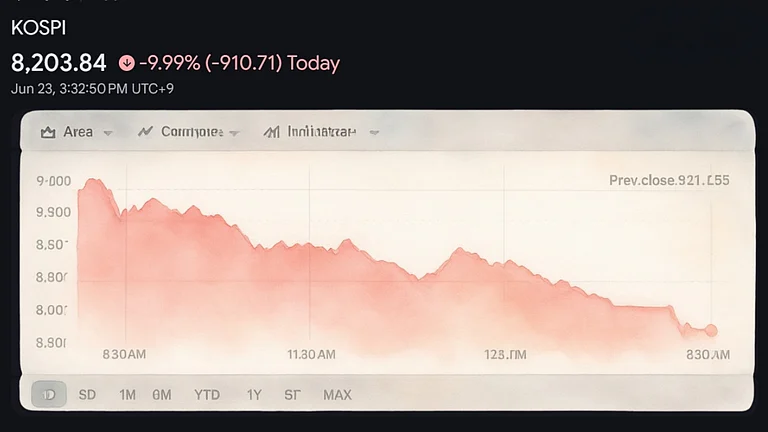
Weak Asian cues weigh on sentiment: Asian markets saw sharp cuts on June 23, setting a negative tone for domestic equities. South Korea’s benchmark KOSPI witnessed a steep sell-off after regulators flagged concerns over leveraged investment products, with heavy pressure in semiconductor and AI-linked stocks.
The Kospi closed at 8,203.84, down 910.71 points or 10 per cent from the previous session.
Other Asian indices also ended weaker. Japan’s Nikkei 225 fell 3.55 per cent, Hong Kong’s Hang Seng declined 1.82 per cent, China’s CSI 300 dropped 2.77 per cent, and Taiwan’s TAIEX slipped 1.34 per cent.
IT stocks come under renewed selling: IT stocks came under pressure again after a brief phase of stability. Shares of TCS, Infosys, Wipro, and HCLTech fell by at least 3 per cent each.
The latest bout of selling came after Accenture cut the upper end of its annual revenue growth guidance, raising fresh concerns about weaker discretionary spending by global clients.
Metals drag indices lower: The Nifty Metal index fell up to 3 per cent, tracking weakness in global metal prices. Sentiment was impacted after hopes of a US-Iran peace deal eased and expectations of a possible US rate hike resurfaced.
Profit booking after recent gains: Markets also saw profit-taking after a sharp run-up in recent sessions. The Nifty had ended higher in six of the last eight trading days, led by easing geopolitical tensions and softening crude oil prices following progress in US-Iran peace talks.
Weekly expiry adds to volatility: Tuesday’s weekly expiry of Nifty derivatives contracts added to intraday volatility. Expiry sessions typically see higher volatility as traders unwind positions, roll over contracts, and adjust exposure, amplifying index movements.
Markets Fall Despite US Lifts Oil Sanctions On Iran
Interestingly, the broader sell-off came even as global crude outlook softened after developments on Iranian oil exports.
After years of sanctions, the US has partially lifted restrictions on Iranian oil exports following recent talks aimed at easing tensions. A 60-day sanctions waiver issued by the US Treasury now allows Iran to resume crude sales along with related services such as shipping, insurance, and banking until August 21.
The waiver is part of a 60-day memorandum of understanding signed between Washington and Tehran on June 17.
Following the announcement, crude prices softened. Brent crude traded around $77 per barrel on June 22, down about 0.50 per cent from the previous session. The futures contract had earlier surged to as high as $126.41 per barrel amid conflict-related concerns. The US West Texas Intermediate also declined around 0.50 per cent to $73.50.



India, one of the world’s most import-dependent oil economies, meets nearly 85 per cent of its crude oil requirement through imports. Historically, Iran was a key supplier, accounting for 14 per cent of India’s crude imports in 2009, making it the second-largest source at the time.
However, with tightening sanctions, imports from Iran declined steadily and eventually stopped in 2019 under US pressure during Donald Trump’s first term.
Since then, India has diversified its energy basket, with Russia emerging as a major supplier after the Russia-Ukraine war. Currently, Russian crude accounts for roughly one-third to 40 per cent of India’s oil imports.
Lower global oil prices and the return of Iranian crude to markets could provide India with additional supply options and help stabilise import costs, which have a direct bearing on domestic inflation and fuel prices.





