

Summary of this article
Commercial growth in the region continues to be a key driver of housing demand.
With markets like Baner, Balewadi, Wakad, and Tathawade getting saturated, development activity has gradually spread to the nearby locations that offer larger parcels of land but continue to remain connected to major employment hubs.
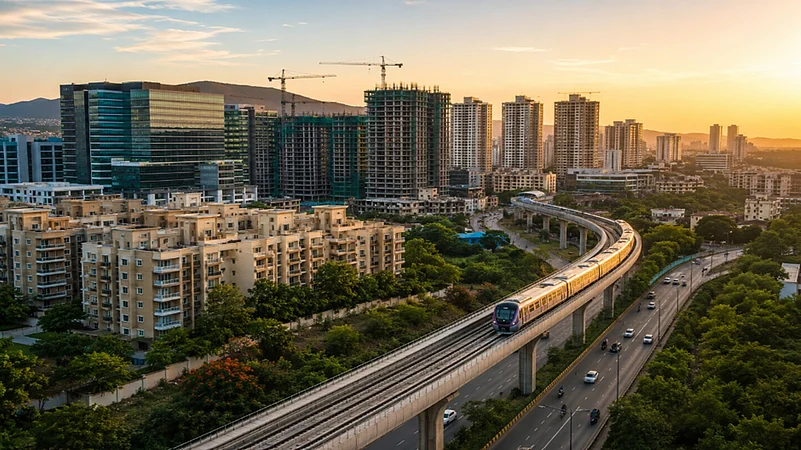
The Metro Line 3 corridor is anticipated to improve connectivity between Pune’s IT district and other parts of the city.
Western Pune is seeing growing real estate activity as the region strengthens its position as one of the city's key residential and commercial markets. The area's growth continues to be supported by the Hinjewadi IT hub, expanding office demand and improving connectivity, prompting developers to look beyond established locations such as Baner, Balewadi, Wakad and Tathawade towards emerging markets, including Maan and Punawale.
Commercial growth in the region continues to be a key driver of housing demand. Global capability centres (GCCs) leased 32.46 million sq ft across the top seven cities of India in 2025, according to a research report by ANAROCK. Pune accounted for 15 per cent of the total leasing activity or about 4.8 million sq ft, the second-highest share after Bengaluru’s 38 per cent. Pune’s growing footprint in the GCC ecosystem continues to fuel demand for both office space and housing across western Pune.
In the last decade, the Hinjewadi IT hub has been the main focus for residential demand in the region. With markets like Baner, Balewadi, Wakad, and Tathawade getting saturated, development activity has gradually spread to the nearby locations that offer larger parcels of land but continue to remain connected to major employment hubs.

The Metro Line 3 corridor is anticipated to improve connectivity between Pune’s IT district and other parts of the city. Industry stakeholders believe that better connectivity could support the residential demand across a wider catchment and encourage more balanced development across the western corridor.
Says Sachin Bhandari, CEO and Executive Director, VTP Realty, “The development of Metro Line 3 is going to be a transformative milestone for Pune’s real estate landscape, particularly across the western corridor. Enhanced connectivity between Hinjewadi and the city centre will significantly reduce travel time, improve accessibility, and elevate the overall livability quotient. Most importantly, it will add immense convenience for professionals, daily commuters, and the growing workforce travelling to and from the city.”
With areas like Baner and Balewadi already witnessing increasing congestion and urban clutter, Metro Line 3 is expected to provide much-needed relief to the road infrastructure, a long-awaited development for Pune residents.
“This connectivity boost will tremendously benefit commuters travelling towards the city centre. It will also enable residents from western Pune to experience and engage more seamlessly with the cultural and commercial heart of the city, including Shivajinagar, Deccan, Civil Court and surrounding areas,” adds Bhandari.
The changing profile of western Pune is also reflected in the range of projects being planned across the region. Alongside residential developments, the corridor continues to attract investment in retail, office and mixed-use projects, supported by demand from technology companies, engineering firms and service-sector businesses.
Several developers have launched projects in locations such as Punawale and Maan in recent years, reflecting growing interest in areas beyond western Pune's established residential hubs. Industry stakeholders note that improving infrastructure and expanding social amenities are encouraging developers to evaluate opportunities across a wider geography.
Sam Chopra, President and Country Head, eXp Realty India, says, “Western Pune's growth story is increasingly being shaped by the convergence of infrastructure, employment centres and evolving residential demand. Though Metro Line 3 will enhance accessibility across major micro-markets in Western Pune, more importantly, it will reinforce the connectivity between residential communities and work opportunities.”
“As cities grow, markets that offer a combination of strong economic activity, expanding social infrastructure, and improved connectivity tend to attract sustained interest from both homebuyers and developers. The momentum we are witnessing across Western Pune reflects a broader shift towards more integrated and well-connected urban corridors that are likely to drive the city's next phase of growth,” he adds.


While Baner, Balewadi and Wakad remain among Pune's most established residential markets, developers are increasingly looking at adjoining locations where land availability and infrastructure improvements are creating opportunities for larger projects. The result is a broader western growth corridor that continues to attract both residential and commercial investment.