The Central Board of Trustees (CBT) of the Employees’ Provident Fund Organisation (EPFO) has eased partial withdrawal rules for subscribers in October 2025. As of March 31, 2024, EPFO had around 325 million active accounts, with approximately 74 million contributing members in 2023-24. While the deposits in EPF are automated, withdrawals are restricted to specific purposes. Partial withdrawals (advances) are permitted during service, and full corpus withdrawal after retirement or under certain other specified conditions.
Although CBT has approved the changes in the withdrawal rules, there is no notification yet about the effective date for implementation. Meanwhile, subscribers are confused about these new rules. Here are clarifications for 10 frequently asked questions (FAQs).
1. What are the new limits and conditions for partial withdrawals?

3 September 2026
Get the latest issue of Outlook Money

Under the new rules, up to 75 per cent of the accumulated corpus in your EPF can be withdrawn after completing a minimum of 12 months of service. To streamline the withdrawal framework, the categories for partial withdrawals have been reduced from 13 to three.
2. What are the three new categories under which partial withdrawal is allowed?
The three categories are “Essential Needs” (illness, education, and wedding), “Housing Needs”, and “Special Circumstances”.
3. What components make up the 75 per cent amount that is eligible for partial withdrawal?
Partial withdrawal is allowed up to 75 per cent of the accumulated corpus. This includes the employee’s and employer’s shares, and accrued interest on both. This 75 per cent does not include the pension portion under the Employees’ Pension Scheme (EPS).

4. How many times can I make partial withdrawals from my EPF?
For education and wedding, members are allowed to make partial withdrawals up to 10 and five times, respectively, under the new rules. For medical treatment, housing, and other reasons, there’s no clarity yet.
5. Under what circumstances can I withdraw the full EPF amount?
You can withdraw the full EPF corpus in specific cases, such as retirement after attaining 55 years of age, permanent disability, incapacity to work, retrenchment, voluntary retirement, or if you are leaving India permanently. In case of retirement before 55 years of age, a subscriber may have to wait for 12 months to withdraw the full EPF amount. However, there is no clarity yet.
6. If I withdraw 75 per cent of the accumulated corpus, when will I get the remaining 25 per cent?
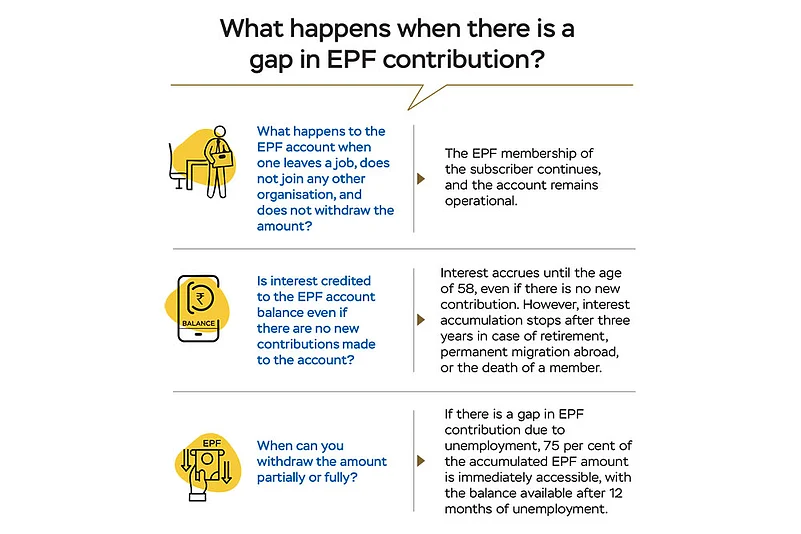
If a subscriber withdraws 75 per cent of the corpus during service through partial withdrawals, the remaining 25 per cent can be accessed immediately after retirement or after 12 months of continuous unemployment.
7. Can I also withdraw the full EPS amount after one year of a job loss?
Withdrawal from EPS is permitted only when a subscriber exits before 10 years of service. Under the new rule, it is permitted only after 36 months of unemployment. If your service is more than 10 years, you will get monthly pension only after retirement, subject to conditions.
8. What are the forms required for partial and full withdrawal, and pension claims?
EPFO has not yet provided clarification about the forms under the new rules. However, under the existing rules, subscribers are required to fill out these forms: Form 19: For full EPF withdrawal. Form 10C: For EPS withdrawal (if service is less than 10 years). Form 10D: For EPS monthly pension (if service is more than 10 years). Form 31: For partial withdrawal.
If your Universal Account Number (UAN) is active and the bank account and Aadhaar details are also updated, you can fill the Composite Claim form, which combines Form 19, Form 10C, and Form 31. Form 10D has to be filled separately.
9. Do I need to submit any documents for making partial withdrawal?
No document is required for making a partial withdrawal for routine claims. A subscriber is required to fill the relevant form for taking advances. A member has to ensure that their UAN is compliant with know your customer (KYC) norms, after which claims are processed automatically based on self-declaration.
Previously, subscribers had to submit various documents to substantiate their withdrawal claims, but, since the introduction of the Composite Claim Form in 2017, a subscriber only needs to self-certify, without attaching any supporting documents. The requirement to upload an image of a cancelled cheque leaf or bank passbook has also been done away with, effective April 2025.
10. Do I need to close the EPF account after I withdraw the full amount or is it closed automatically?
An EPF account remains active as long as contributions are received. It can be closed under only two circumstances:
(a) Upon a member’s death (when the corpus is transferred to the nominee).
(b) When the member withdraws the entire balance upon retirement or in other permitted scenarios.
The closure happens automatically; no separate procedure is needed.
versha@outlookindia.com
Curated with inputs from Ketan Das, business head, FinRight Technologies, Pratik Vaidya, chief vision officer and managing director, Karma Management Global Consulting Solutions, and Abhishek Kumar, founder, SahajMoney