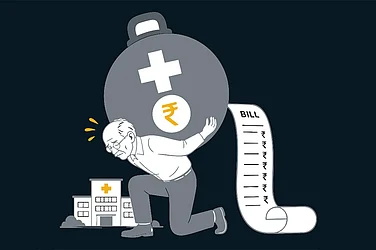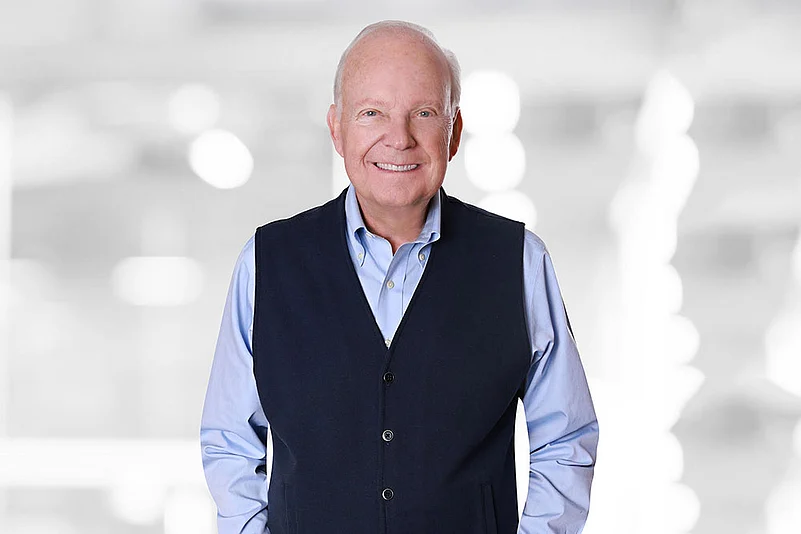

Retirement is not just about cavorting on the beach with a glass of wine, but also about coming to terms with loss and trauma, and then re-picking yourself to find a purpose, believes Riley Moynes, a former public educator and financial advisor and now TED speaker, podcaster and author of many books, including The Four Phases Of Retirement. In an interview with Nidhi Sinha, Editor, Outlook Money, as part of the Wealth Wizards series, he talks about the challenges seniors face as they stare at around 30 years of retirement years
Your major work focuses on the four phases of retirement. When did you start digging deeper into the issues of retirement?
For many years, I was an investment advisor and helped a number of clients prepare for their retirement. The emphasis was exclusively on the financial aspects of retirement, on estate planning, on Wills, powers of attorney, and those sorts of things. Of course, they’re critically important, but what I discovered when I stepped back from my work was that, after about a year or so, which I subsequently identified as being Phase 1 of retirement, I was kind of discombobulated. I didn’t understand what was going on. I was caught up the way most people are: thinking retirement was one thing, and it was for a short time, until it wasn’t.
I started looking for answers, and discovered that the literature focuses on the financial and the estate planning parts. But it wasn’t what I was looking for. So, I decided to approach individuals who I had been told had figured out retirement. One thing led to another, and what I thought would be a relatively short-term venture turned into more than three years of interviewing several hundred retirees. I had massive amount of information to make sense of, and that’s how the four phases evolved.
What makes you say that the financial part is not enough?
It’s not enough because retirement is one of life’s top 10 traumas. We don’t think of retirement as being traumatic, but it is right up there with the death of a spouse, divorce, changing jobs, and moving cities.
There are predictable and significant psychological changes and challenges that come with retirement that we have not been talking about, and my goal is to try to open that conversation.
You’ve talked about the importance of having a purpose. In India, retirees usually live close to their children or grandchildren, though that is changing now, and treat it as their purpose. Do you think it makes sense?
Everyone has to decide what their personal purpose in life is. Certainly, family and being a wonderful grandparent could be among those things, but not exclusively. That can be an aspect of a purposeful retirement, but my experience is that it’s not sufficient.
What separates the truly successful retirees from those who are not as successful is that the former offer services to others. That can be through grandparenting, but it can also be in so many other ways. I would encourage people to have several areas in which they provide services to others. That will make it more gratifying than to focus on one particular aspect of retirement.

3 September 2026
Get the latest issue of Outlook Money

Coming to your book on the four phases of retirement. You call the first the vacation phase. What are the biggest mistakes people make during this period?
The biggest challenge is that people assume that what I call Phase I or the vacation phase represents ideal retirement. It (retirement) has been represented in the press and in virtually all advertising, certainly in North America, as people cavorting along the beach at sunset with a glass of wine in their hands with a loved one. It involves travel, it involves doing nothing for the most part.
Harvard Business School produced an extended report on retirees. It was a 20-year longitudinal study where they interviewed over 15,000 retirees, and they went back every five years to update the questions as people moved through their lives. One of the quotes that stuck out for me (from the report) and I use that in my workshops is that the “unhappiest retirees” had not gone on to do anything beyond pleasing themselves.
For most people, Phase 1 lasts maximum two years. And then they find themselves bored, and they ask questions like: Is this all? Is that all there is to retirement? I was told that was the ideal, and I’m bored stiff.
That is a big challenge, because with people living longer in North America, and I’m sure in your part of the world as well (in India), it is not unusual for them to be spending one-third of their lives in retirement, perhaps 30 years.
In the 1950s, in North America, the average life expectancy was 68 years. So people could look forward to three years of retirement. But we have seen a sea change over the last several decades.
Now, retirement is very different and has to be approached very differently. We need to find activities that are meaningful to us. We need to be engaged, we need to provide service to others in some way or another, to feel good.
Retirement is one of life’s top 10 traumas, right up with the death of a spouse, divorce, job change and relocation. There are significant psychological changes that come with retirement, but which we avoid talking about
You call retirement traumatic. Does than happen in Phase II?
Phase II is a period when we suffer loss, and we feel lost. We suffer five significant losses that are directly related to retirement.
First, we lose our sense of structure. Sometimes during our lives, we may have felt that structure is an imposition. But I’ve become convinced that over the long term, we do need structure.
Second, many people lose their identity, or a part of their identity, because we often identify with the work that we do—domestically or outside the home. And that’s a loss that occurs when we retire.
Third, we lose relationships. Over a period of time, we may have built up some significant (work) relationships, many of which perhaps turn into long-term friendships. But when we walk away for the last time, we are just a guy or a gal on the street and nobody cares.
The fourth loss is that of purpose. Many of us take what we do seriously. We do our very best, and when we walk away, that sense of purpose can be lost as well.
The final loss is that of power for some who may have experienced that when they had taken on some responsibility. We don’t see these losses coming, but we experience all five simultaneously, which can be traumatic for us. These losses are directly related to retirement.
Also, Phase II can get worse because in addition to the five losses, there are the three Ds. There is decline, both physical and mental. This is not associated with retirement necessarily, but it’s a time of life that overlaps with retirement. The second D is depression. There is a 40 per cent likelihood, according to Mayo Clinic (finding), that after retirement, you will display signs of clinical depression. The third is divorce. In North America, people over 60 have experienced double the rate of divorce since 1990, and for those over age 65, the rate is triple.
So, Phase II is a difficult time that almost everyone experiences, to some degree, at some level of depth, and for some period of time.
Can something be done to soften the blow?
I believe that a successful retirement requires some work. It requires some introspection and we, as humans, are not very good at introspection, unless we are forced to. I try to force people to be introspective during our workshop, and encourage them to do two-three things. The first is to identify your unique ability, which I define as something that you do exceedingly well and love to do. The second is to look at just five successes, wins or victories that we have achieved during our lifetime.
Third, I ask them to look at the relationship between those two items. Is it not true that something that you have done exceedingly well has led to some success in the past? It’s critical to see that connection because that can provide the kind of dynamite that they can use going forward.
The final thing is to put it all together, and see if there is something in it for you, financial or psychic. If you can see the relationship between unique ability, past successes, and something that provides psychic reward, that is your sweet spot. That’s where you want to spend as much time as you possibly can in the Phase IV of your retirement.
That would follow Phase III, which is about trial and failure. What is it that can encourage people to experiment with themselves?
I think it’s the recognition that if you don’t do something that is meaningful to you, you may well stay in Phase II, which is fraught with danger. Retirees in Phase II gamble too much. They drink too much. They’re couch potatoes. They’ve suffered losses and may well be depressed.
You can either keep trying to identify the things that you love to do and do really well that have led to past success, and maybe is a key to your future, or not. If you don’t, you will stay in Phase II. If you ignore it, then, in effect, you’re saying, I’ve given up.
In my Phase III, I tried at least 12 things, almost all of which failed.
I have seen people who have done their best to move out of Phase III, and some have been successful, although I calculate that only about two-thirds of retirees break through to Phase IV.
Did failure in Phase III ever deter you from going ahead?
They didn’t work out the way that I had hoped they would. Was it discouraging at times? Yes, it was, because there were a couple of projects that I had invested a couple of years of my time into. But I also realised that I need something that makes me want to get up in the morning… that helps me feel that I’m doing something meaningful and significant. I think most people feel that way. I kept at it, and about 12 or 13 efforts later, it finally clicked.
A lot of seniors develop clinical mental issues. Is that a challenge for a third of people who you say are unable to break through Phase III?
I make two assumptions in my workshop and in my writing. One is relatively stable financial health and relatively stable medical and personal health. I’ve seen over and over again that lacking either or both of these two can make retirement look very different, and it’s sad.
Can family and friends play a role in helping retirees break through to Phase IV?
Absolutely. As I say, we are not very good at being introspective, and that’s where friends and family can be of real assistance and set retirees up for success. They may see what we are unable to see.
One of the key factors identified in Phase II is that people become isolated. It is really important to either establish something earlier or when you retire to recognise the need for social interaction, which is good for mental and physical health.
Is it necessary to go through all the phases before reaching Phase IV. Can people do something before retirement?
The answer to the first question is no. But only a very small group of people that I have identified have been able to avoid it. They fall into two groups.
The first are entrepreneurs, who have been doing that for the longest time, they love it, and what they hope to do is perhaps a little less of it over time. But they never consider themselves to have actually retired in the traditional sense. They have an ongoing interest, and they hardly experience Phases II and III.
The second group are people who have, during their domestic or working career, identified a hobby or a passion that they have committed themselves to over their lifetime. These people want to spend more time doing what they didn’t (in retirement). They tend to avoid Phase II and III as well.
But I believe that such people constitute only about 10 per cent of retirees.
Being forewarned is forearmed. If one is aware of some of the likely phases that you are to go through when you retire, then it provides an opportunity to prepare and to avoid Phases II and III.
nidhi@outlookindia.com