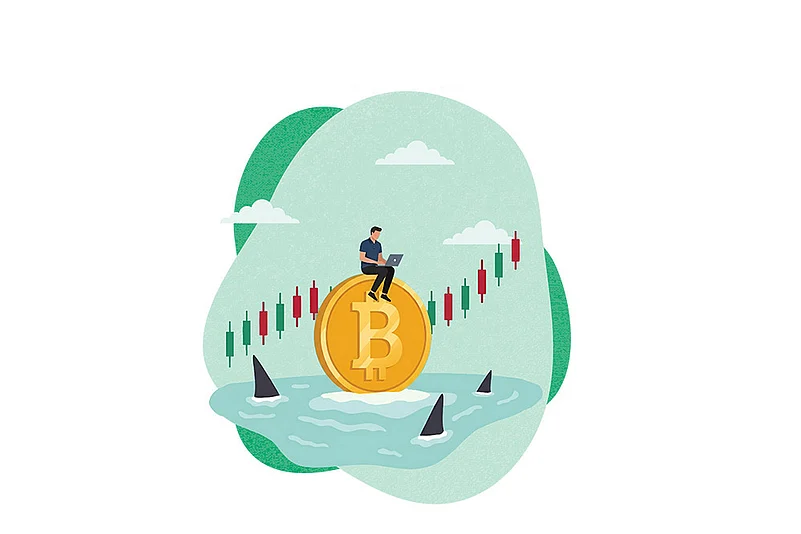
If you swear by ace investor Warren Buffett, follow author and entrepreneur Robert Kiyosaki’s X account with a religious passion and love the phrase “buy low, sell high”, you are someone who isn’t shy of taking risk in your investments.
Risk takers see opportunities in adversity when indices are red. Driven by the thrill of high returns, they take bold financial bets. Each market correction presents a buying opportunity rather than a reason to panic. Often, they lead, being the first ones to navigate uncharted waters, be it crypto or even initial public offerings (IPOs) with the high grey market premium (GMP) everyone warned against.
The high risk taker’s financial DNA is rooted in the belief of landing the best investment opportunities before anyone else. But the risk of being the first could also mean ending up with the worst investment opportunities.

1 October 2026
Get the latest issue of Outlook Money

What Works
The first thing that comes to mind when we talk of risk takers is equity investing, which comes with inherent risk but also almost unparalleled return potential. When done right with patience and a long term in mind, disciplined investment in equities can help achieve financial goals.
“Embracing calculated risk and considering the short-term volatility of asset classes like equities allows investors to capture the ‘risk premium’…. This premium is the extra return strictly necessary to multiply wealth exponentially and reach ambitious long-term goals,” says Harshit Patel, a certified financial planner (CFP) and founder of Invest Wissen.
What Doesn’t
A risk taker’s fearless approach to investing can, however, lead to several blind spots.
One, exposing the portfolio to too much risk can compromise short-term goals. If your capital is tied up in high-risk, high-reward assets, a sudden need for cash for an emergency may force you into selling holdings at a massive loss.
Patel advises risk takers to diversify their portfolios to have liquidity shock absorbers. Without a reliable emergency fund, a risk taker may be forced to sell high-return generating assets in an emergency to get money quickly. “High return portfolios inherently experience severe drawdowns during market corrections. If a risk taker faces a financial emergency during a market crash, lacking a liquid buffer forces them to sell high growth assets at rock bottom prices,” says Patel.
The downside risk of their portfolio alone can wipe out their corpus if the market doesn’t trade the way they expect it to. Market crashes are an inevitable reality, and lacking a safety net can be an invitation to a permanent financial disaster.
Two, the lure of quick gains, which comes with very high risk, can often lead to greed, which can come to bite you hard. After the breakout of the Covid-19 pandemic, the market saw a strong surge in participation: the total unique registered investors grew from 31 million in FY20 to 133.70 million as of July 2027 (FY27 YTD). However amid this boom, investors also made significant losses while chasing risk. According to data from the Securities and Exchange Board of India (Sebi), on the trading behaviour of individual traders in the equity derivatives segment, 87 per cent of investors made losses in the futures and options (F&O) space in FY26.
What Should You Do?
First, having all your eggs in one basket is not advisable. High-risk individuals who don’t diversify into other assets are not only unprepared for emergencies, but may also miss out on opportunities they so value, without ready capital that they can deploy during market dips.
Patel says that safe debt allocations serve as an excellent tactical tool to deploy into equity during deep dips.
Second, “buying low” is not always the best strategy because it’s practically impossible to catch the market bottom. Rather than bottom fishing, he suggests a staggered approach. For instance, when the US-Iran war broke out in March 2026, most petroleum stocks fell sharply during the first week. Investors jumped the gun, considering the decline as a value-buying opportunity. However, as the conflict continued, these stocks fell further and are trading lower by over 20 per cent from their pre-war levels.
Adds Patel: “If they believe in a correcting sector, they should use a systematic transfer plan (STP) to enter gradually. This averages out their purchase cost and completely removes the behavioural bias of trying to perfectly time the market bottom.”
Third, they can easily enter the dangerous territory which can put their financial future completely at stake. To prevent dangerous overexposure, Patel recommends investors must avoid catching falling knives by investing in stocks just because they are trading cheap. It is important to take your time to research well or seek advice.
For mature investors, who are able to take markets ups and downs in their stride, without giving in to panic selling, the risk-taking strategy can work if practised in moderation. The key learning is to be on the right side of risk.


Your Superpower
You are focused on wealth creation, and take market ups and downs in your stride for maximum growth in the long term. If you have something to fall back on, this strategy can help you fulfil your wealth creation goal
Your Blind Spots
You may be unprepared for short-term goals or emergencies
Without a back-up plan, downside risk can wipe out your corpus
Lack of diversification often does not allow portfolios to optimise returns