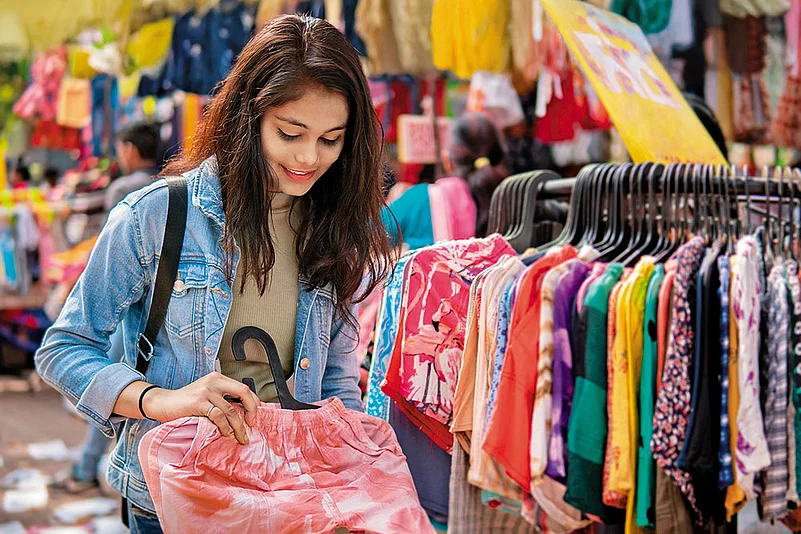
There’s a visible shift in how young people are combining fashion with money, at bustling street markets and on digital resale platfor ms. Thrift shopping, once primarily driven by necessity, has now emerged as a deliberate lifestyle choice for many in their 20s.
For Gen Z consumers, building a wardrobe is now a complex calculation that blends style and individuality with financial and environmental awareness. Thrift shopping, or buying pre-owned items, ticks all the boxes. The logic: owning fast-changing latest styles and vintage items at throwaway prices.
Numbers validate the trend. The second-hand apparel market in India is projected to grow from $5.20 billion in 2025 to $17.90 billion by 2031, at a compounded annual growth rate (CAGR) of 22.80 per cent, according to a September 2025 research by Mobility Foresights, a Bengaluru-based market research and consulting firm.

3 September 2026
Get the latest issue of Outlook Money

Vani Krishna, 20, a student at the National Institute of Fashion Technology (NIFT), Panchkula, near Chandigarh, describes the psychological appeal. “The whole idea of thrifting was introduced to me in my first year of college, but I did not understand it until I went to an open market near my college. It was the thrill and the excitement which made me go back again, hoping to pick good pieces from a pile of clothes, at a reasonable rate.”
The exchange of used garments is a tradition rooted in centuries of resource management, necessity, and cultural evolution. But the digital shift in the 21st century has been a turning point, with online platforms and social media revolutionising thrifting. Young consumers are clearly leading this market expansion, fuelled by affordability, environmental awareness, and curated offerings by online resale platforms or thrift stores.
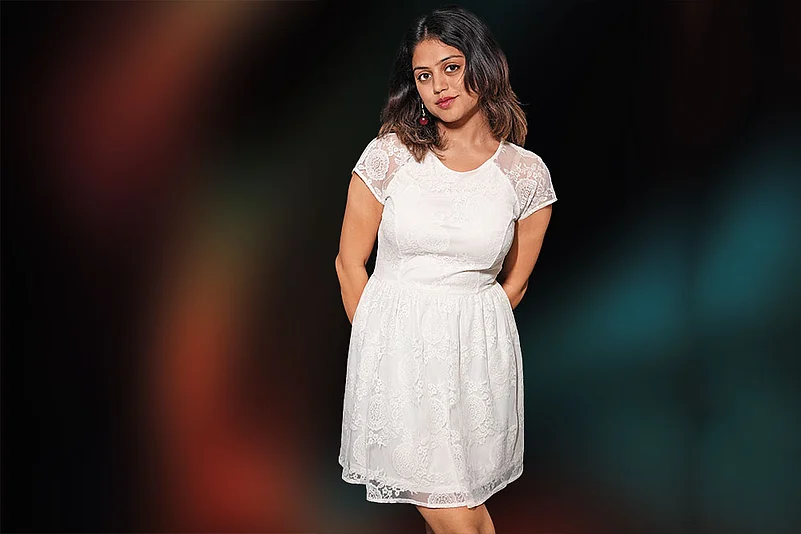

The Lure Of Thrift
While for most young people, thrifting is about low cost, style and the environmental impact of reusing items are also major driving factors.
For Aueshic Das, 26, a video editor from Delhi, who began thrifting during the pandemic, it’s about style differentiation. “I sometimes purchase even unplanned items if the design is exceptionally unique, especially when such pieces are no longer produced by mainstream fashion houses. These are mostly old items that have gone out of style.”
The desire for a unique style is often validated by digital trends. For instance, the 2025 Pinterest Autumn Trend report highlighted that searches for “vintage autumn aesthetic” were up 1,074 per cent and searches for “dream thrift finds” had skyrocketed by 550 per cent among Gen Z users on the platform.
Money, of course, matters. “Thrifting usually costs me about half as much, while letting me buy twice the number of items compared to regular shopping,” says Aueshic.
For many Gen Zs, thrifting aligns with their ethical values, a key differentiator from previous generations. “Buying pre-loved clothing reduces demand for new garments and lessens the environmental footprint,” says Vani.
For Rimpy Ganguly, 24, a client relations consultant from Noida, the initial motivation was purely ethical, which is a major driver for this segment’s growth. “I wanted to be a more mindful consumer. The idea of reusing instead of constantly buying new clothes appealed to me. Both sustainability and style matter to me,” she says.
The focus on circularity extends beyond apparel; according to the Pinterest report, searches for “second-hand kitchens” and “second-hand decor” have increased by 1,012 per cent and 283 per cent, respectively, showing a comprehensive commitment to reusing items across the household.
The Logic Of Thrift
While thrifting is becoming popular, it’s important to choose right. This involves evaluating quality, utility, and aesthetic alignment. Also, it matters if you are shopping from physical stores or online.
Ensure Quality: Vani, with her background in fashion studies, details her process. “Studying in a fashion college, the first glance goes at the fabric quality. If that is decent, then I check how well it’s been maintained (whether it’s without stains or holes).” All that ensures durability.

Look For Utility And Value: Sweta Verma, 26, a graphic designer from Delhi, employs a practical test of integration to assess the utility of an item. “I look at whether I can actually style the piece and match it with my current wardrobe pieces. If it’s versatile and I can wear it more than once or twice, I usually grab it. But I walk away if I know it’s just going to sit in my closet collecting dust, even if it’s cheap.” This approach ensures you make a mindful addition to your wardrobe.
Aueshic’s focuses on unique items. “I go for the really old items that have long gone out of style and hence aren’t in production anymore,” he says. For him, the value is in aesthetic uniqueness rather than affordability.
Physical Vs Online: Physical markets are essential to the thrifting ecosystem, primarily because they provide the lowest entry point for consumers with nil shipping cost. Even the Gen X and the millennials swore by local markets in their younger days.
But the story is a bit different when it comes to online thrift stores.
Rimpy says there’s a crucial distinction between the physical and online stories. “Sometimes new clothes (from some online sites) cost less than thrifted ones. Thrifting is quite expensive here compared to the West. So, it doesn’t really help me save money.”
The physical experience is generally favoured for its cost efficiency and buyers’ ability to inspect quality. Sweta emphasises the necessity of tangibility, “Seeing and touching the item makes all the difference for me.” Vani prefers physical thrift stores because she likes checking the quality. “Cost influences my choice; physical stores are usually cheaper and there’s no shipping, so I feel like I get better value for my money compared to online platforms,” she adds.
On the other hand, online platforms are prized for their highly curated selection of niche aesthetics. Aueshic prefers them because “most physical stores sell generic items of clothing as opposed to a more curated experience that I get from my favourite online thrift stores”.
Plus, it’s convenient. But the convenience comes with financial and quality risks. Aueshic recounts his disappointment when some items did not fit him as expected. While the size was mentioned online, it was difficult to estimate the exact fit without trying it on. To make matters worse, there was a no return policy in place. He adds that while most physical thrift stores also do not allow returns, many offer exchange options, which he has used a couple of times. Online thrift platforms, however, often do not provide either.

The Irony Of Thrift
It’s thrilling for the Gen Z to walk in style without burning a hole in their pockets.
But that also makes thrifting addictive and leads to repeat visits. Ironically, the “great deals” can easily translate into budgeting failure and overflowing wardrobes.
Sweta finds thrifting generally economical as it costs much less than shopping in the malls, but sometimes impulse overrides budgets. “Sometimes, I convince myself that a quirky skirt or a hand-embroidered piece won’t be available again, and suddenly my Rs 1,000 budget balloons to Rs 2,500,” she says, adding that it’s not a pattern. “It feels worth it when the items are unique and have stories behind them.”
Sweta’s experience shows that thrifting involves a constant negotiation with impulse shopping, triggered by low prices.
Dante De Gori, CEO of FPSB International, says thrifting must be approached with intention.
He warns that since individual items are inexpensive, there is a tendency to overlook the cumulative impact. “The affordability of items sometimes leads shoppers to buy more than they need. So, whether thrifting curbs or fuels impulsive spending depends largely on whether someone sets limits before they walk in,” he says.
But the lure is real. A shopkeeper from Sarojini Nagar, Delhi, one of the largest and most popular thrift markets in India, who didn’t want to be named, says, “People love thrifting because the clothes are affordable. You get stylish pieces for much less, and there’s always variety and uniqueness. Even people who come just to look around usually end up buying something, because the prices pull them in.”
Thrift And Thrive
At the core of thrifting lies financial discipline.
Mohini Mahadevia, a certified financial planner (CFP) and founder of SOLUFIN, a financial services and consultancy firm based in Mumbai, views thrifting as a powerful tool to “spend less, and spend smarter” to redirect funds toward higher-priority financial goals.
She says: “If thrifting as a consumption-approach continues to pick up pace, we will end up seeing a significant shift in how spending patterns look among the younger generation. We might just be able to see cash flows free up from under the pressure of having to buy the best, latest and desirable brands on a constant basis.” But thrifting should not become an excuse to buy more, she adds.
De Gori says, “When paired with clear spending boundaries, thrifting can absolutely contribute to healthier financial habits.”
He advises that thrifting purchases should be treated as a defined segment of discretionary spending, and should be tracked consistently to prevent the accumulation of small expenses. “Thrifting often begins as a short-term saving habit, but it’s true power lies in how it shapes long-term behaviour. It promotes mindful consumption, sharper price awareness, and the understanding that value doesn’t always come from buying new.”
Some seasoned thrifters are already practising it. Says Vani: “Thrifting has definitely changed how I budget. It made me more conscious of buying only what I truly like and need something, instead of spending on fast-fashion impulse buys. I set a small monthly limit for clothes and focus on affordable finds rather than frequent shopping.”
Sweta finds that even when she splurges, “it’s usually less than what I would spend at a branded fast-fashion store”.
Thrifting is proving to be a highly effective tool for young consumers to exercise financial control, build intentional budgets, and integrate their values and individuality into their spending habits. But caution is warranted if you are new to it.
Blueprint For Successful Thrifting
Start by knowing what your style is and what you actually need.
Find thrift stores whose offerings or curations match your aesthetics.
Don’t forget to compare prices of pieces that are non-exclusive between different stores.
Compare prices of items available in physical and online stores.
It’s advisable to check the quality, and physical stores can help you do that.
Pick up pieces that will go well with existing items in your wardrobe or setting.
Avoid overspending just because of the low prices. The costs will stack up.
Don’t give in to impulse, unless something is timeless and useful in the long run.