





Summary of this article
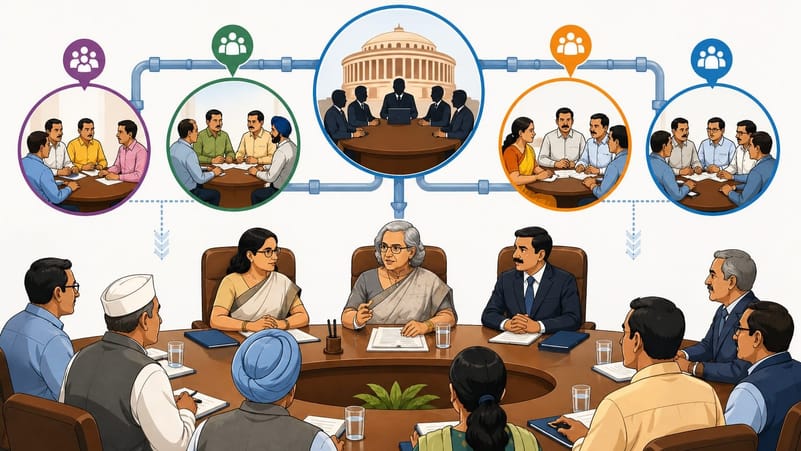
The 8th Central Pay Commission has begun formal consultations, meeting the NCJCM (staff side) in Delhi as part of a wider outreach to unions nationwide.
While all representations must be filed online by April 30, 2026, the panel is also holding in‑person discussions.
The Commission is holding meetings with stakeholders to better understand complex pay, pension, and allowance demands.
The 8th Central Pay Commission (CPC) has held a meeting with the National Council (Joint Consultative Machinery) (staff side) in Delhi on April 28, as part of its three-day schedule to hold discussions with different employee unions and associations. The 8th CPC has sought feedback, suggestions, and responses from different stakeholders online earlier, where online forms were made available on its portal for sending the response.
For employee and pensioner bodies, the last date to submit memoranda or representations is April 30, 2026. However, the Commission is also holding discussion meetings with different employee groups to understand their demands. The latest being with the NCJCM (Staff Side), where its secretary Shiv Gopal Mishra discussed employees’ demands and their proposal to the CPC.



Note that the 8th CPC has made it clear that it wouldn’t accept any response offline or through email, and only online responses will be accepted for consideration. However, it is holding discussions with stakeholders to engage with them and understand their perspective, as the question has been raised that the prescribed online response Form has a word limit, and employees’ issues cannot be explained within such a word limit.
The 8th CPC is tasked with providing its recommendations within 18 months from the date of its formation in November 2025. So, by May 2027, it has to prepare its recommendations around salary structure, pension, dearness allowance, dearness relief, work incentives, work conditions, and many more.
The CPS’s recommendations are crucial as they will impact around 50 lakh central government employees and approximately 60 lakh pensioners. This is the reason employees’ and pensioners’ associations want to engage in dialogue with the CPC and propose their demands.
Meetings In Other States And UTs
In a letter dated April 24, 2026, the 8th CPC issued a letter in this regard, “The Eighth Pay Commission has received a large number of requests for interaction with the Commission for 28th-30th April, 2026 meeting at Delhi. The Commission is scheduling meeting with maximum number of Unions/Associations during these dates. However, due to compressed schedule, all requests for interaction during these dates may not be accepted.”
“Please note that the Commission shall be holding more meetings at Delhi and at various other States/UT in due course in coming months, which shall be updated on the website of the Commission. Interested stakeholders outside Delhi NCR may seek appointment for interaction with the Commission in their State/UT or nearby State/UT at that stage,” the letter reads.

Fitment Factor And Other Demands
The Unions have raised the demands, such as increasing the family unit size from three to five, rationalisation of DA, extension of Central Government Health Scheme (CGHS) perks, a housing cost-aligned house rent allowance (HRA), and more. But one of the key issues for discussion remains the fitment factor, a multiplier used to revise the basic pay. It is because a higher multiplier will directly impact the basic pay and indirectly the allowances calculated on the basic, such as DA/DR, giving a steep rise in salary.
Recently, the Federation of National Postal Organisation (FNPO) submitted its memorandum, demanding a fitment factor between 3.0 and 3.25. The Bharatiya Pratiraksha Mazdoor Sangh (BPMS) in its memorandum asked for a fitment factor to be hiked to 4.0 from the current 2.57. At the same time, the NC-JCM has proposed a fitment factor of 3.83 in the 8th CPC recommendation. Where various employees’ unions are demanding different fitment factors, the Commission will finally decide on them and recommend one to the government.





