

Summary of this article
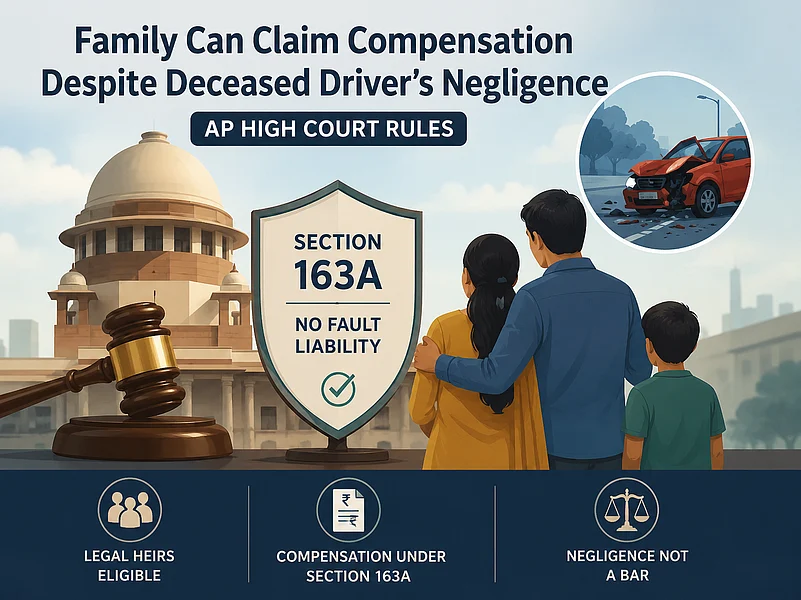
AP High Court allows compensation despite deceased driver's negligence.
Section 163A claims do not require proof of negligence.
Tribunal's order rejecting family's claim has been set aside.
The Andhra Pradesh High Court has clarified that the legal heirs of a deceased driver can claim compensation under Section 163A of the Motor Vehicles Act, 1988 even if the accident occurred due to the driver's own negligence. Claims under this provision are based on the principle of no-fault liability and do not require claimants to establish who caused the accident, the court said.
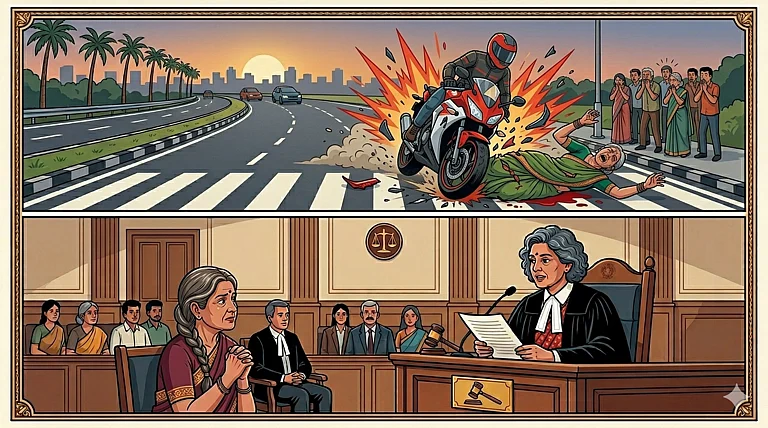
The order was passed while allowing an appeal filed by the family of a man who died in a road accident. The court has set aside an order of the Motor Accident Claims Tribunal, which had rejected the family’s compensation claim after holding that the deceased was responsible for the accident. The family had challenged the tribunal’s decision before the High Court.
Compensation Guidelines Under Section 163A
The High Court said that Section 163A of the Act provides a separate mechanism for compensation in cases of death or permanent disability arising from motor vehicle accidents. The provision has been introduced to ensure faster financial relief without requiring claimants to prove fault.
The court said that Section 163A specifically states that claimants are not required to prove any wrongful act, neglect or default on the part of the vehicle owner or any other person. Accordingly it held that the tribunal had erred in examining whether the deceased driver was negligent.
The court ruled that once a claim is filed under Section 163A, the question of negligence cannot be used to deny compensation. The court added that the tribunal had incorrectly rejected the claim solely because the deceased was responsible for the accident.
Allowing the appeal, the High Court set aside the tribunal’s order and directed that the claim be considered in accordance with Section 163A of the Motor Vehicles Act,1988.