

Summary of this article
Housing loan interest cannot reduce income for accident compensation.
Tax set-offs cannot be mechanically applied to compensation calculations.
Interest on compensation is payable from claim filing date.
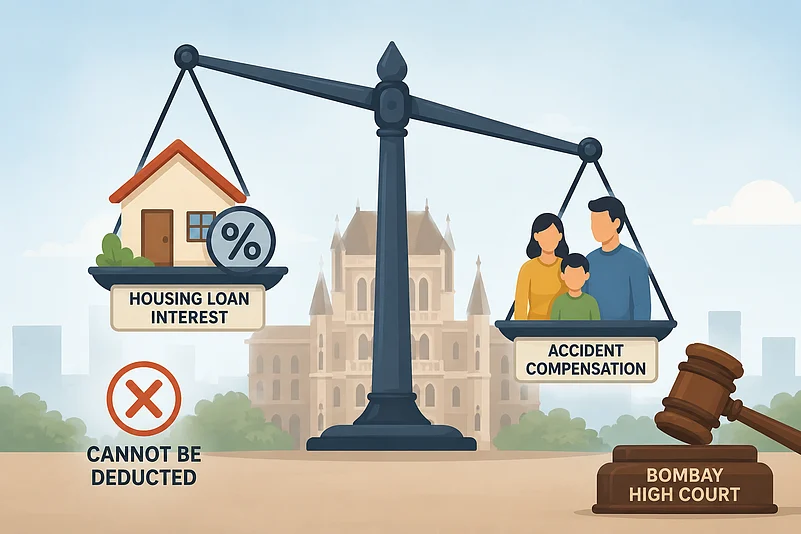
The Bombay High Court has held that a loss computed under the "Income from House Property" head of the Income-tax Act, 1961, cannot be set off against professional income while calculating compensation under the Motor Vehicles Act, 1988.

The court has observed that the Income-tax Act and the Motor Vehicles Act operate in different fields, and tax rules on setting off losses cannot be mechanically applied to reduce compensation payable to the dependants of a motor accident victim.
The judgement came in an appeal filed by the widow and children of a medical practitioner who died in a motor accident. The family had sought an enhancement of the compensation awarded by the Motor Accident Claims Tribunal.
Income Calculation Disputed
The Tribunal had calculated the deceased's income by taking the average income disclosed in his income-tax returns. It had then set off the loss under the "Income from House Property" head against his professional income. The loss represented interest paid on a housing loan.
The claimants argued that this deduction was not permissible while calculating compensation under the Motor Vehicles Act. They also challenged the Tribunal's decision to award interest only from the date on which the correct insurance company was impleaded, instead of from the date of filing the claim petition.
The insurance company then contended that only the disposable income left after payment of housing loan interest should be considered for determining compensation, as this was the amount that would have been available for the benefit of the deceased's dependants.
Tax Rules Cannot Lower Compensation
The High Court has held that the provisions of the Income-tax Act permitting set-off of losses are intended to determine tax liability and cannot be imported into the Motor Vehicles Act to reduce compensation.
The objective of the Motor Vehicles Act is to provide "just compensation" and place the dependants, as far as possible, in the financial position they would have occupied if the deceased had not died, the court observed.
The set-off provision is for the purpose of determining lower tax, but the same cannot be read to lower the compensation under the MV Act, the court has observed.
Professional Income To Be Considered
The court has further noted that income from assets such as house property and capital gains may continue even after the death of the earning member. Therefore, such income does not necessarily represent the financial contribution lost by the dependents.
For calculating compensation, the income earned through the deceased's personal skills or profession is relevant. In this case, the deceased's professional income was therefore considered without setting off the loss under the "Income from House Property" head.
Interest Payable From Claim Filing Date
Referring to Section 171 of the Motor Vehicles Act, the High Court has observed that interest is ordinarily payable from the date of filing the claim petition and not from the date on which the insurer was added to the proceedings.
The court has consequently revised the compensation calculation and enhanced the award by Rs 17,58,465, along with applicable interest. It has also directed that the interest be calculated from the date of filing of the claim petition.