

Summary of this article
Government outlines legal safeguards to protect children from digital addiction risks.
Data protection law requires parental consent for children's personal data.
Economic Survey flags mental health and financial risks from excessive digital use.
The government has referred to existing laws and recent regulatory measures aimed at addressing the risks of excessive digital use among children and young people. It has also cited the Economic Survey 2025-26, which has described digital addiction as a serious public health challenge.

The Ministry of Electronics and Information Technology (MeitY) provided the details in a written reply in the Lok Sabha on the ill effects of digital addiction among children.
The reply did not mention any specific government survey focused only on digital addiction among children. Instead, it has listed the legal framework and other measures aimed at encouraging safer and responsible use of digital platforms.
IT Rules Lay Down Safeguards For Children
The ministry has said that the Information Technology Act, 2000, and the Information Technology (Intermediary Guidelines and Digital Media Ethics Code) Rules, 2021, have created a framework for digital safety and responsible internet use.
Under the IT Rules, intermediaries have to follow due diligence requirements. They also have to inform users that they cannot host, display, upload, modify, publish, transmit, update or share information that is harmful to children or violates the law.
Recent changes to the IT Rules have also required social media platforms and other intermediaries to remove unlawful content within three hours of receiving a court order or a reasoned intimation from the government or its authorised agency.
Children Data Protection Rules
The ministry has also referred to the Digital Personal Data Protection Act, 2023, which provides a legal framework for the processing of digital personal data.
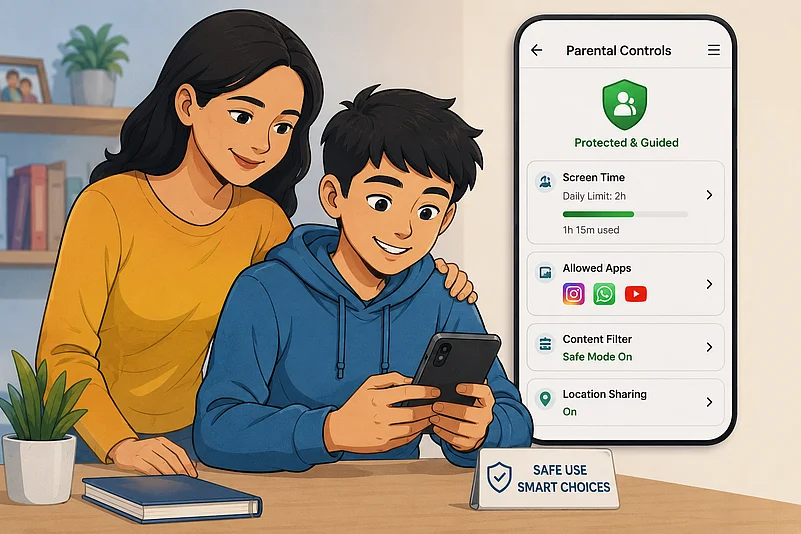
The act places safeguards for children's privacy online. It has made parental consent mandatory before any child's personal data is processed, and prohibits practices that may inflict a negative impact on their well-being. The parental control measures include tracking, behavioural monitoring and targeted advertising aimed at children.
Curbing Online Gaming And Harmful Content
The government has also pointed to the Promotion and Regulation of Online Gaming Act, 2025, as a step towards combating digital addiction and financial damages among youth. While e-sports and online social games are subject to promotion and regulation, the offering, operation and advertising of online money games are prohibited under this act.
Section 79(3)(b) of the IT Act allows the government to notify intermediaries to remove or disable access to unlawful content. The government has taken action against intermediaries and OTT platforms based on complaints.
According to the reply, 50 OTT platforms have been disabled for public access in India over the past two years for displaying obscene content and violating provisions of the IT Act, the Bharatiya Nyaya Sanhita (BNS) and the Indecent Representation of Women (Prohibition) Act, 1986.
Economic Survey Flags Impact Of Digital Addiction
The Economic Survey 2025-26 has described digital addiction as a serious public health challenge affecting children and young people, particularly those aged 15 to 29, who have near-universal access to smartphones and the internet.
The survey has highlighted the impact of excessive digital use on cognitive development, academic performance, workplace productivity, social connections and mental health. It has also pointed to anxiety, depression, sleep disorders, cyberbullying and financial losses linked to compulsive gaming, social media use and online gambling.
The government's reply did not mention any proposal to create offline youth hubs, moderated online spaces hosted by schools, simpler devices with usage limits, or family data plans that separate educational and recreational use.