





Summary of this article
Indian Railways increases penalties for several passenger rule violations.
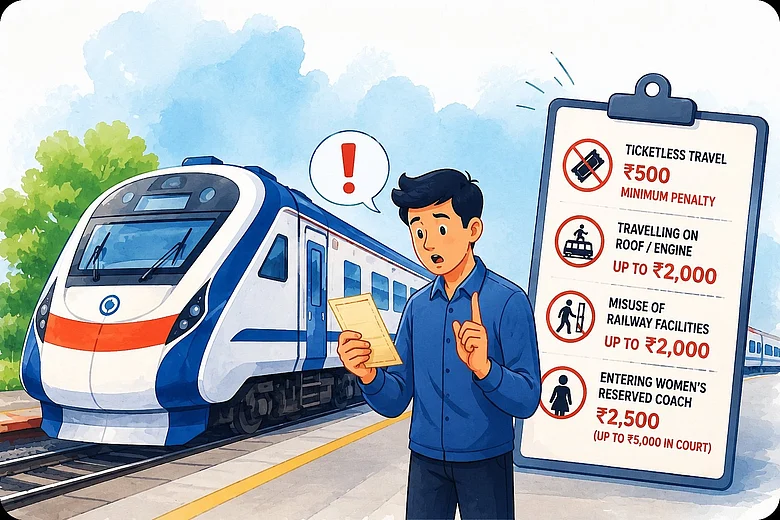
Ticketless travel now attracts minimum Rs 500 penalty and fare.
Women's coach violations and unsafe travel face steeper fines.
Ticketless train passengers will have to pay higher penalties for several railway offences after amendments to the Railways Act, 1989, came into effect from today, July 1, 2026 under the Jan Vishwas (Amendment of Provisions) Act, 2026.

The amendment has raised penalties for offences such as travelling without a valid ticket, wrongfully entering women's reserved coaches, travelling on train roofs or engines, and misusing railway facilities. At the same time, several minor offences have been shifted from criminal prosecution to civil penalties.
Ticketless Travel Attracts Minimum Rs 500 Penalty
Under the amended Section 137 of the Railways Act, passengers travelling without a valid ticket or pass will now be required to pay the applicable fare along with excess charges and a minimum penalty of Rs 500, or such higher amount as may be notified by the Central Government.
Earlier, ticketless travel could result in criminal proceedings. The revised law instead focuses on recovering fares and penalties through a civil mechanism.
Penalties Increased for Other Violations
The amendments also raise the penalty for travelling on train roofs, steps or locomotive engines under Section 60(3). The earlier maximum fine of Rs 500 has been increased to a civil penalty of up to Rs 2,000. If the penalty is not paid, the person may be produced before a court, which can impose a fine of up to Rs 2,000.
Similarly, the maximum fine for misusing railway accommodation or facilities under Section 87(3) has increased from Rs 150 to a civil penalty of up to Rs 2,000. Court proceedings will generally arise only if the penalty remains unpaid.
Women's Reserved Coaches
The amended Section 162 imposes a penalty of Rs 2,500 on a man who enters or continues to occupy a coach or berth reserved exclusively for women. Railway staff can remove the person from the compartment.
If the penalty is not paid, the matter may be taken to court, where the fine can go up to Rs 5,000. The amended provision also specifies that transgender persons are exempt from proceedings under this section.
The revised act has replaced criminal prosecution with administrative or civil penalties for many minor railway offences, at the same time increasing the amount of monetary penalties for such offences. Even though passengers violating railway rules will not be tried as criminals, they will have to pay higher penalties.





