



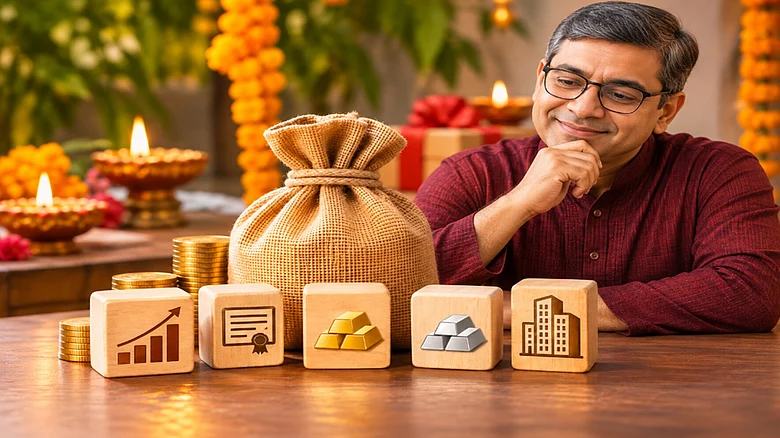


Summary of this article
Equity gets the largest allocation: Experts suggest investing 60 per cent of the Rs 5 lakh corpus in equity mutual funds for long-term wealth creation.
Diversification is key: Allocate 20 per cent to debt, 10 per cent to gold and silver, and 10 per cent to REITs and InvITs to balance growth, stability and income.
Avoid timing the market: Deploy the equity allocation gradually through an STP over four to six months and rebalance the portfolio annually.
Every festive season, investors ask the same question: where should a lump sum go? The instinct is to chase whatever has done best recently, whether that is a hot stock, a top-performing fund or the metal everyone is talking about.
With Rs 5 lakh today, the opposite approach would be to build a growth-oriented multi-asset portfolio. No single asset wins every year, and the current market rewards balance far more than bold bets.
Where Markets Stand Today
Says Nikunj Saraf, CEO, Choice Wealth: “Precious metals have gone through a sharp reset. On MCX, gold touched a record Rs 1.80 lakh per 10 grams in January and now trades around Rs 1.39 lakh, roughly 23 per cent lower. Silver has corrected even more sharply, from a peak of over Rs 4 lakh per kg to around Rs 1.8 lakh, a fall of more than 55 per cent. Globally, gold has slipped from nearly $5,600 an ounce to around $4,000. For a long-term investor, buying after such a correction is far more comfortable than buying at the top.”
Equities have recovered well from their recent lows. The Nifty is back above 25,000 after one of its strongest monthly rallies in years, helped by foreign buying and healthy quarterly earnings. Yet the index is still below where it began 2026. Prices have recovered, but the time correction is not yet complete. That is the phase in which markets consolidate while earnings catch up with prices.
Interest rates have turned. The RBI raised the repo rate by 25 basis points to 5.50 per cent in October and moved its stance to “calibrated tightening”, signalling that rate cuts are off the table for now. The 10-year G-sec yield has risen to about 7.2–7.3 per cent, close to a three-year high. For fixed-income investors, this means yields are attractive again after a long period of falling rates.

How To Allocate Rs 5 Lakh
Equity – 60 per cent (Rs 3,00,000): flexi-cap fund Rs 1.5 lakh, large & mid-cap fund Rs 1 lakh, multi-cap fund Rs 50,000
Debt – 20 per cent (Rs 1,00,000): corporate bond or target maturity fund Rs 60,000, arbitrage or liquid fund Rs 40,000
Gold – 6 per cent (Rs 30,000): gold ETF or fund of funds
Silver – 4 per cent (Rs 20,000): silver ETF or fund of funds
REITs & InvITs: 10 per cent (Rs 50,000): listed REITs and InvITs, or a REIT/InvIT fund
The Logic Behind Each Allocation
Equity, at 60 per cent, is the growth engine of this portfolio.
“Over long periods, it has historically beaten inflation by the widest margin of any asset class, and valuations today are reasonable for an investor with a horizon of five years or more. A flexi-cap fund lets the fund manager move across market caps as opportunities shift. A large and mid-cap fund balances stability with growth, and a multi-cap fund gives exposure to smaller companies. Because the time correction is still unfolding, investing this amount in one go may not be advisable. A systematic transfer plan from a liquid fund over four to six months averages the purchase cost and removes the stress of timing the market,” says Saraf.
Debt, at 20 per cent, brings stability and income. With the RBI now in a tightening cycle, investors can lock in higher yields. More hikes are possible, however, long-duration funds should be avoided for now, because their prices fall when yields rise. Corporate bond funds and target maturity funds at the short-to-medium end of the curve offer good yields with lower interest-rate risk. The Rs 40,000 in an arbitrage or liquid fund has a second purpose: it is ready money that can be moved into equity when markets go through a sharp dip.
Gold and silver, at 10 per cent, act as the portfolio’s insurance. “Gold has historically held its value through currency weakness, geopolitical stress and equity sell-offs, which is why it gets the larger share. Silver offers extra upside from its growing industrial use in solar panels and electronics, but it is far more volatile, so its weight is smaller. After the sharp correction from January’s peaks, both metals offer a much better entry point for long-term investors. ETFs or fund of funds are the most efficient route, because they avoid making charges, storage worries and purity concerns,” adds Saraf.
REITs and InvITs, at 10 per cent, are the diversifier that most portfolios lack. REITs own rent-earning office and retail properties and typically yield 6–8 per cent. InvITs own infrastructure such as roads and power transmission lines and often yield more. Their returns come from contracted rents and from toll or tariff income, so they do not move in step with stocks or bonds. This low correlation smooths overall portfolio returns, while the regular payouts provide steady cash flow.
Discipline Matters More Than Timing
A good allocation is only half the job. The portfolio should be reviewed once a year and rebalanced. When one asset class runs well ahead of its target weight, it should be trimmed and added to the one that has lagged. This makes investors book profits in rallies and buy into weakness, which is exactly what most people fail to do on their own. That discipline, rather than predicting the market, is what turns a festive investment into lasting wealth.