





Summary of this article
Infrastructure boost: The proposed eight-laning, strategic underpasses and connectivity to Greater SPR are expected to ease traffic and improve access to key residential and commercial hubs.
Savills-CREDAI said the average capital values of completed homes across the combined GCER-SPR micro-market doubled to Rs 22,000 per sq. ft. in 2025, from Rs 11,000 per sq. ft. in 2021.
Increasing demand for premium housing: Improved connectivity, developed social infrastructure and proximity to business districts are making GCER more attractive to luxury home buyers, professionals and long-term investors.
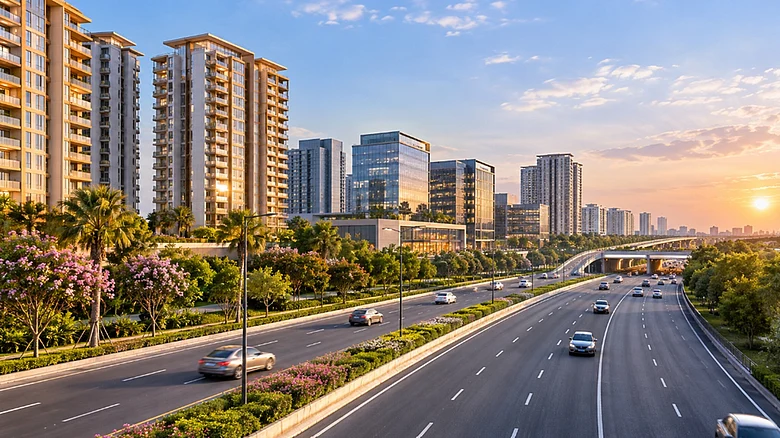
Golf Course Extension Road (GCER) has moved well beyond its early identity as a peripheral stretch to emerge as one of Gurugram’s most strategically important corridors. Changing corporate preferences, stronger commercial fundamentals and the growing mix of residential, commercial, institutional and retail developments have driven this transformation. With road widening, proposed underpasses and progress on the Greater Southern Peripheral Road (Greater SPR), the corridor is entering another phase of growth.
Workplace strategy has changed. Organisations now seek districts that offer more than office space, favouring locations that support employee wellbeing, shorten commutes and provide seamless access to housing, healthcare, education and retail.
GCER’s master-planned growth has let these components develop in parallel, with premium communities, international schools, tertiary healthcare and emerging high-street retail close to office clusters. This integration gives GCER an urban coherence that older micro-markets struggle to replicate.
Santhosh Kumar, vice chairman, Anarock Group, says, “Golf Course Extension Road has emerged as the most sought-after luxury corridor in Gurugram. Spacious housing units with high-end amenities close to the business hubs attract senior executives, entrepreneurs, NRIs and expatriates. Since 2019, average prices in Gurugram have more than doubled and could reach about INR 13,350 per sq ft in 2026. Premium projects in the corridor are far above average.”

Commenting on the region’s fast development, Sudhanshu Dutt, CEO, Elevate Homes, says, “Infrastructure development remains a critical determinant of real estate growth, and the ongoing progress on Golf Course Extension Road (GCER) is a significant step in strengthening Gurugram’s southern corridor. The proposed eight-laning, strategic underpasses, and planned connectivity enhancements are expected to improve traffic movement, reduce commute times and strengthen access to key commercial and social hubs. The progress is particularly encouraging for locations such as Sector 63A and adjoining areas, where improved road networks will further enhance accessibility and residential appeal. Such infrastructure investments will play a pivotal role in supporting long-term residential growth, strengthening buyer and investor confidence and reinforcing the Golf Course Extension Road's position as the most preferred residential destination.”
Moreover, residential performance reflects this development. Property values have more than doubled in five years and rental yields have strengthened, supported by steady absorption across premium and upper mid-income segments. Demand also appears largely end-user driven, which suggests depth rather than speculation. Luxury and ultra-luxury housing is a growing share of NCR launches, led by Gurugram, and analysts credit corridors such as GCER, where planning quality and product depth match affluent buyers’ expectations. Long-term studies also identify GCER as one of the few micro-markets positioned for sustained appreciation on structural demand.
The Savills India Research Delhi-NCR Residential Market Watch, Year-End 2025, published with CREDAI, shows average capital values for completed homes across the combined GCER and SPR micro-market rising from Rs 11,000 per sq ft in 2021 to Rs 22,000 in 2025. Under-construction homes moved from Rs 16,000 to Rs 21,500, and plot values grew at a 21 per cent compound annual rate.
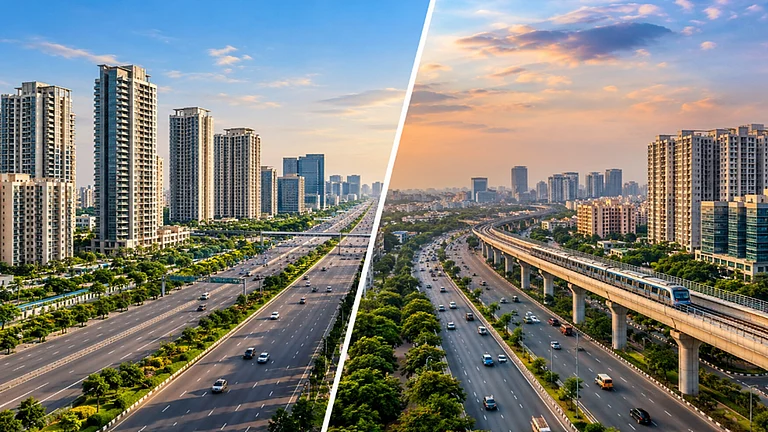
In a city where infrastructure and real estate have often moved at different speeds, better connectivity now matters even more. The proposed eight-lane upgrade of GCER is expected to ease traffic on all key arterial routes, with wider carriageways absorbing rising vehicle volumes across the corridor. Proposed underpasses along Sohna Road are equally important. Planned connectivity across the highway should improve movement between neighbourhoods and reduce dependence on existing junctions, making daily travel more convenient.
Deepak Sangwan, chairman, Origen Realty, says, “The ongoing infrastructure upgrades across Gurugram are strengthening the city’s real estate micro-markets by improving connectivity and enhancing the overall urban infrastructure. The proposed eight-laning of Golf Course Extension Road and strategic underpasses are important developments that will facilitate smoother traffic movement and improve access to key residential and commercial destinations.”
“This development will also strengthen the Dwarka Expressway residential market as the access will become faster for office commuters to Golf Course Extension business areas, due to reduction in traffic congestion. For established locations such as Sector 88A, improved connectivity with major arterial roads and neighbouring growth corridors will further strengthen their residential proposition. As infrastructure development progresses, these improvements will support greater convenience for residents, reinforce end-user confidence and contribute to the sustained growth of Gurugram’s residential real estate market,” he adds.
Greater SPR adds another dimension. The proposed network will strengthen links between GCER, Sohna Road, NH-48 and other parts of Gurugram, while the Haryana government’s plans, including the elevated corridor on SPR, reflect a wider push across the southern and eastern growth areas. With proposed transit linkages and stronger integration with key expressways, these projects form one mobility network. That makes workplaces, schools, healthcare and retail easier to reach and expands GCER’s influence within the NCR.
The GCER belt has also drawn interest for its proximity to mature premium localities, social infrastructure and commercial hubs, but long-term popularity will depend on accessibility. As Greater SPR progresses, the GCER belt could gain easier access to Sohna Road and NH-48, which would suit families and professionals.
“Gurugram’s urban transformation is increasingly being shaped by infrastructure development, with improved connectivity and expanding social amenities driving the evolution of key residential corridors such as Golf Course Extension Road. These developments are enhancing the liveability and attractiveness of the micro-market, making it an increasingly preferred residential destination. As the city’s infrastructure continues to evolve, the focus will be on creating well-connected neighbourhoods that seamlessly integrate residential, commercial and lifestyle conveniences, shaping Gurugram’s next phase of urban growth,” says Robin Mangla, president, M3M India.
Moreover, buyers now seek more than familiar addresses for larger homes, modern conveniences and everyday amenities. The Savills India Residential Market Outlook 2026 cites infrastructure expansion, a growing business ecosystem and demand for quality housing as drivers for Gurugram, and notes appetite for branded residences and wellness-led, integrated lifestyle developments.
Developers are responding with well-planned communities, landscaped open spaces and good property management. Better connectivity also supports demand for offices, retail and hospitality, and helps create self-sustaining neighbourhoods.
Manik Malik, president and CEO, BPTP Limited, says, "Gurugram’s premium housing market is no longer operating in a speculative cycle, but has clearly transitioned into a phase of structural, end-user-led growth. Capital appreciation today is being underwritten by real fundamentals infrastructure delivery, evolving social ecosystems, and a clear shift in buyer preference towards high-quality, wellness-driven, future-ready living environments. Corridors such as Dwarka Expressway, Golf Course Extension Road and SPR are not just emerging, they are steadily institutionalising as core residential markets, backed by sustained residential absorption, commercial traction and improving connectivity. As these micro-markets mature, demand is expected to remain resilient and far more discerning, with both end-users and long-term capital increasingly aligning towards well-planned, credible developments rather than opportunistic plays.”



Kumar says developers continue to queue up high-end launches, indicating confidence in the depth of demand. “Future growth will be determined by social infrastructure, road connectivity and quality of delivery. With supply skewed toward premium and luxury homes, buyers can expect steady but more selective appreciation, with the best-connected and best-delivered projects retaining their value most resiliently,” he adds.
The transformation of GCER is indicative of a larger shift in Gurugram’s growth. As the infrastructure moves beyond the existing corridors, the GCER belt and its adjoining neighbourhoods could be key to the residential story of the city. The next phase will be about better-connected neighbourhoods that offer convenience, accessibility and a higher quality of everyday living.





