

Summary of this article
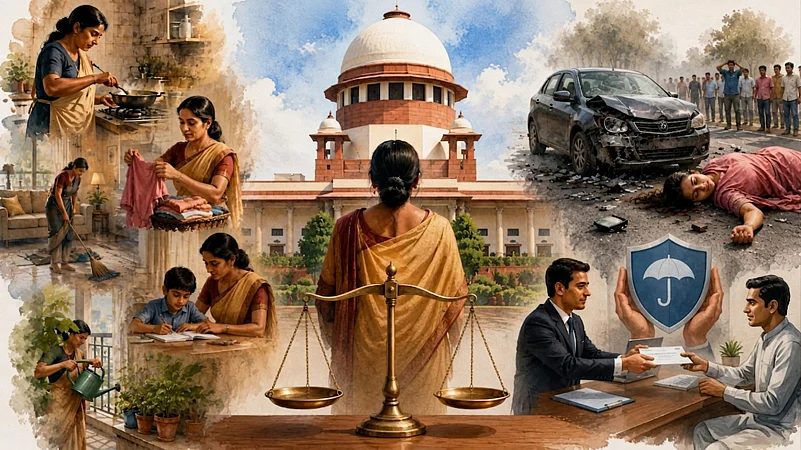
The Supreme Court of India has delivered a landmark ruling recognising homemakers as “nation builders”.
It valued their unpaid domestic work at a minimum of Rs 30,000 per month for motor accident compensation.
Stemming from a 2001 Punjab case, the judgment rejects earlier notional income benchmarks and insists on realistic compensation for families who lose a homemaker.
In a historic move, the Supreme Court of India has ruled that the unpaid domestic work performed by homemakers must be recognised as the work of “nation builders”. Now moving beyond a symbolic appreciation, a bench comprising Justice Sanjay Karol and N Kotishwar Singh, while hearing a motor insurance claim in a road accident fatality, ruled that a homemaker’s domestic contribution should be considered at a minimum of Rs 30,000 per month, while calculating the compensation.
The groundbreaking ruling is set to fundamentally change how motor accident claims are adjudicated across the country. For decades, the judiciary had equated the notional income of a homemaker with the wages of a skilled or unskilled labourer. However, the apex court has rejected this approach in this judgment. The Court emphasised that compensation under the Motor Vehicles Act must be just compensation, with a realistic assessment of loss rather than a pittance.


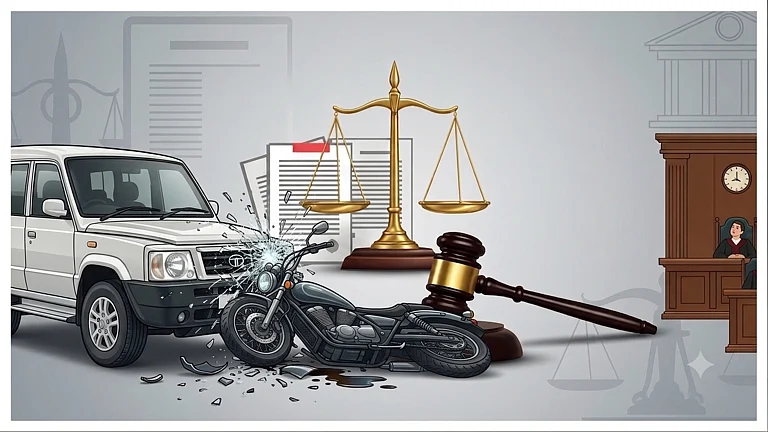

This ruling came in a long-pending appeal. The matter originated from a tragic road accident in Punjab in 2001, according to a Hindustan Times report. A woman named Reshma dies, leaving behind her husband and three children who sought relief under the Motor Accident Claims Tribunal. In 2003, they were ordered an initial award, but the case remained trapped in the legal system for more than two decades. It came to an end in December 2024, when the Punjab and Haryana High Court reached a decision.
The Supreme Court, while hearing the case, expressed deep concern over such inordinate delays, noting that such delays defeat the welfare-oriented purpose of the Act, because the families are forced to wait decades to get justice. Further, the Court issued a directive stating that the motor accident compensation claims should ordinarily be decided within one year. The Chief Justices of all High Courts have been requested to monitor these cases and issue directions about the new time frame.

The judgment recognises the value of domestic labour and sets a precedent for future rulings. While hearing, the Court referred to the previous cases, such as Kirti Vs Oriental Insurance Co Ltd (2021) and Arun Kumar Agrawal (2010), which also have cautioned against treating homemakers’ services as valueless due to the absence of a formal salary. However, in this ruling, the Court has taken a definitive step in quantifying homemakers’ contribution at a minimum of Rs 30,000 per month, to be considered while calculating the compensation in such claims in accordance with the standardised principles established in the Pranay Sethi (2007) case.

Although the case went on for more than two decades, it received a landmark judgment, setting a precedent, a clear message that domestic labour is invisible in Indian families, but is a vital pillar in the national economy, and has to be recognised. The ruling ensures that when a family loses a homemaker, the legal system acknowledges the irreplaceable loss.