





Summary of this article
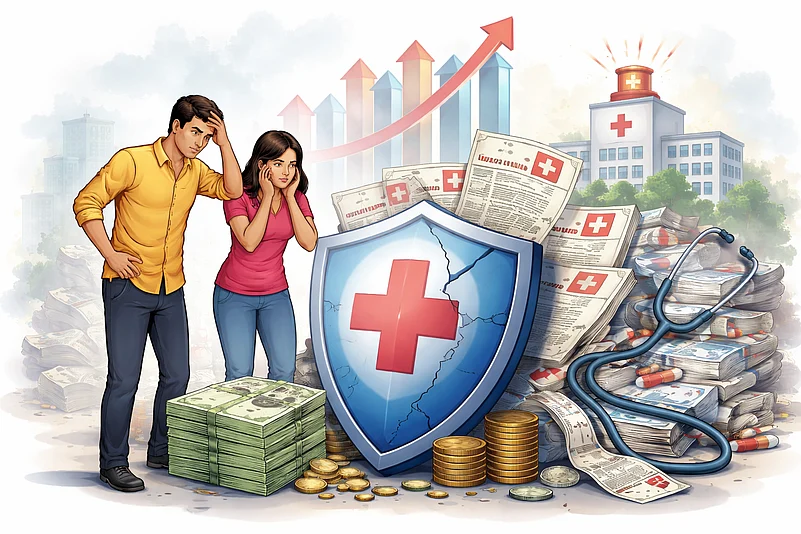
Rs 10 lakh health cover no longer adequate amid rising medical costs
Hospitalisation costs now include tests, follow-ups, repeat care
Family needs, age, lifestyle make coverage stretch quickly
Experts suggest using it as base cover, add top-up for safety
For a long time, Rs 10 lakh was the number people repeated without thinking too much about it. It sounded solid, responsible, something that meant you had planned ahead. Agents suggested it, families settled on it, and policy documents carried it as a reassuring figure.
That comfort is starting to wear thin.
Not because Rs 10 lakh has suddenly become meaningless, but because the world around it has changed. Hospital bills do not look the same anymore. Treatments are more advanced, but also more expensive. And most importantly, medical care is no longer a one-time expense that begins and ends with a hospital stay.

3 September 2026
Get the latest issue of Outlook Money

The Bill Doesn’t End at Discharge
One of the biggest gaps in how people think about insurance is this: they imagine a single event. You fall ill, you get admitted, you get treated, you leave. Insurance pays, and the matter closes.
In reality, it rarely works like that.
There are tests before admission, often repeated ones. There are consultations, sometimes across multiple specialists. After discharge, there are medicines, follow-ups, and in many cases, a return to the hospital if recovery does not go as planned. Each step costs money, and not all of it fits neatly within what people expect insurance to cover, according to a recent report by Mint.
So when a policyholder says, “I have Rs 10 lakh cover, I should be fine,” they are often thinking of only the most visible part of the expense.
In cities, especially, the numbers escalate quickly. A procedure that might have seemed manageable a few years ago now comes with a bill that eats into the cover far faster than expected. And if the illness is serious, cardiac, cancer-related, or requiring intensive care, the margin disappears almost immediately.
When Life Gets More Complicated, So Does “Enough”
The idea of adequacy shifts the moment life becomes less individual.
A single person in their twenties may still find Rs 10 lakh workable. But add parents, a spouse, or children, and the same amount begins to stretch uncomfortably. In a family floater plan, one hospitalisation can take up a large share of the cover, leaving little room for anything else in the same year.
Then there is age. Health risks do not stay constant. They build, often quietly, until they demand attention and expense. The cover you chose years ago may not match the risks you carry today, but it often goes unchanged because increasing it feels like something that can wait.
It usually does, until it cannot.
There is also a more subtle shift. People are less willing now to compromise on where they get treated. They want access to better hospitals, faster care, and experienced doctors. These choices, entirely understandable in moments of vulnerability, come with higher costs. A modest cover starts to feel restrictive in those situations.
Looking At Insurance Differently
Perhaps the problem lies in how the question is framed. Instead of asking whether Rs 10 lakh is enough, it may be more useful to ask: enough for what?
For smaller, routine hospitalisations, it may still hold up. But as a safeguard against larger, more complex medical events, it increasingly looks incomplete.
This is why many are beginning to treat it as a base rather than the full plan. Adding a higher cover through a super top-up is one way to build that extra layer without making premiums unmanageable. It changes the structure, from a single limit to a broader safety net.
Just as important is the willingness to revisit decisions. Insurance is often bought once and then ignored. But healthcare costs do not stand still, and neither do personal circumstances.
The Bottom Line
Rs 10 lakh has not become irrelevant. It has simply lost its ability to be the final answer.
What it offers today is a starting point, a first layer of protection. Relying on it entirely, however, can create a gap between expectation and reality, one that only becomes visible at the worst possible time.
And that, more than the number itself, is the real risk.





