






Summary of this article
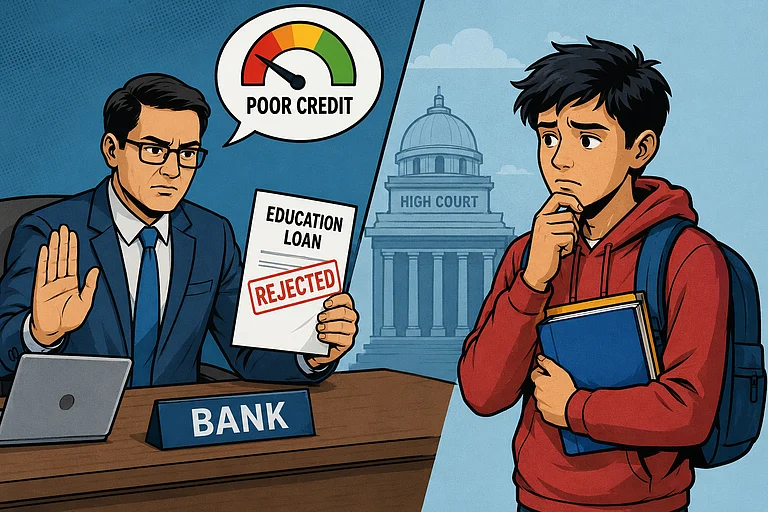
The Karnataka High Court held that a parent’s poor CIBIL score cannot be the sole reason to reject a student’s education loan.
The court said education loans must be assessed differently from commercial loans, with emphasis on academic merit and future earning potential.
It directed the bank to reconsider the loan application within two weeks, ignoring the father’s CIBIL score.
The Karnataka High Court has ruled that the parent’s poor credit history cannot be the sole ground to deny an education loan to a borrower. Justice Sachin Shankar Magadum, presiding judge in the Dharwad Bench, emphasised that educational loans are different from commercial and consumer loans. The court highlighted that these loans are crucial to promote human capital and fulfil the constitutional promise of equal opportunity.
The case pertains to a 19-year-old student (son) and his father, who is an agriculturist from Belagavi, Karnataka. The son had applied for an education loan of Rs 12.50 lakh (Rs 12,56,090) from the Karnataka Vikas Grameen Bank (now Karnataka Grameen Bank) to pursue a Bachelor of Engineering (B.E.) in Artificial Intelligence at an institution in Bengaluru. However, the bank rejected his application, per the Live Law report. The bank justified the rejection, saying that his father had been classified as a defaulter and his (father’s) CIBIL score is low.
Note that CIBIL or the Credit Information Bureau (India) is a credit rating agency approved by the Reserve Bank of India, which assigns a score based on one’s borrowing and repayment habits.




Arguments
The son's counsel argued that the loan application rejection is arbitrary and irrational and doesn’t consider the humanitarian and welfare-oriented nature of education loans. They contended that such loans should not be equated with commercial transactions. They further argued that his father’s credit history should not pose a hurdle in the child’s right to education.
Conversely, the counsel representing the bank maintained that the low CIBIL score made the loan application ineligible under the standard eligibility criteria.

Court Observation
Justice Magadum observed that the bank had rejected the application ‘mechanically’ without giving it a thought. He highlighted that such an approach defeats the public policy goal of democratising higher education. The court noted that a student has no control over their family’s financial condition and it is inappropriate to penalise them for it.
“Such an interpretation would perpetuate economic inequality across generations and would virtually penalise a student for circumstances over which he has absolutely no control. The creditworthiness of a parent cannot eclipse the educational aspirations and constitutional rights of the student,” the court said.
While the court acknowledged that CIBIL score is relevant for loans, including commercial and housing loans, it cannot be applied with equal rigidity to education loans. The court noted that the real security against an education loan is the student’s future earning capacity. So, it is an investment in human capital rather than a mere financial transaction.

Court Judgment
The High Court quashed the bank’s rejection endorsement and allowed the writ petition in part. It directed the bank to reconsider the loan application irrespective of the father’s CIBIL score within two weeks by evaluating the student’s eligibility based on his academic merit and employability.
In addition to this, the court also directed the bank to check whether the loan could cover the tuition fee already paid for the first academic year.





