





Summary of this article
Tier-3 cities lead unlimited health insurance purchases at 41.71 per cent
Tier-2 and Tier-3 markets now drive nearly two-thirds demand
Surat saw 45 per cent growth in average premium ticket size
Buyers should check exclusions, sub-limits, co-payments, and hospital network
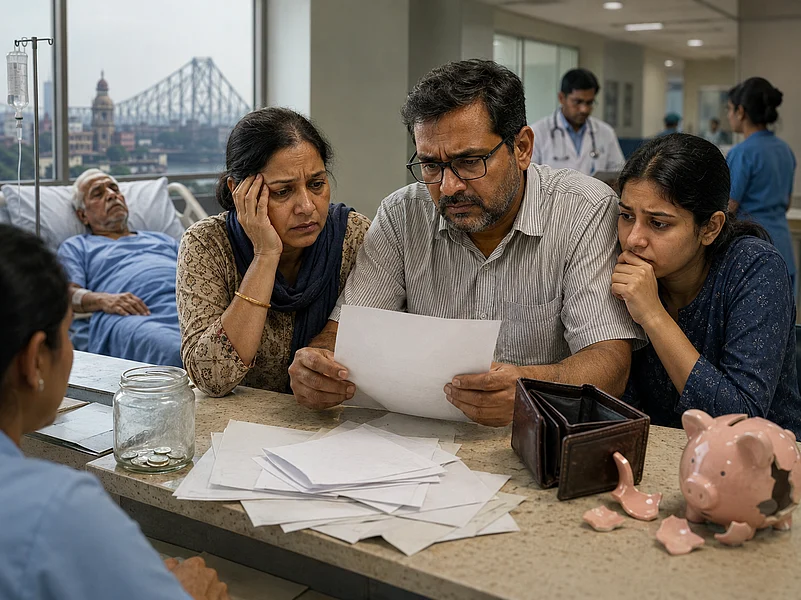
A 75-year-old man suffered a cerebral stroke and needed intensive care. But his family could not find an ICU bed at two government hospitals in Kolkata. They had to move him to a private hospital, where more than 20 days of treatment left the family with a bill of about Rs 10 lakh.
The family, which runs a small business, borrowed from friends and relatives to meet the hospital expenses. They are still trying to repay the debt.
The episode reflects a wider concern in West Bengal: households continue to bear a heavy share of medical expenses despite the presence of state-backed health schemes, free diagnostic services and fair-price medicine outlets.

1 October 2026
Get the latest issue of Outlook Money

Households Continue To Bear The Burden
National Health Accounts Estimates for 2022-23 show that households in West Bengal spent Rs 41,409 crore from their own pockets on healthcare. This accounted for 62.3 per cent of the state’s total health expenditure, with the per capita out-of-pocket spending at Rs 4,183, according to a recent report by The Telegraph.
Out-of-pocket expenditure includes direct payments made by patients and their families for hospitalisation, doctor consultations, medicines, diagnostic tests, transport, blood, oxygen and other medical needs not fully covered through insurance or public services.
The figures show that West Bengal’s burden had eased for a brief period before moving up again. Out-of-pocket spending accounted for 68.7 per cent of total health expenditure in 2018-19. It declined to 65.1 per cent in 2020-21 and further to 58.3 per cent in 2021-22, before rising again in the latest estimates.
The comparison with other states is stark. Karnataka reported household spending of Rs 13,933 crore, or 29.2 per cent of its total health expenditure, while Odisha recorded Rs 10,329 crore, equivalent to 42.4 per cent.
For families without comprehensive health insurance or sufficient savings, such spending can quickly turn into debt. A medical crisis often forces them to rely on personal loans, borrow from relatives, sell investments or use money set aside for education and retirement.
Public Hospitals Under Pressure
Health department officials have linked the high private spending to poor service quality and underuse of government facilities. They say patients are often compelled to seek private treatment after being unable to access beds, doctors or timely care at public hospitals.
Doctors’ bodies, however, have disputed the suggestion that the problem is primarily about staff discipline. They have pointed instead to shortages of hospital beds, doctors, nurses and support staff.
According to the Service Doctors’ Forum, West Bengal has around 0.9 hospital beds for every 1,000 people, far below the level needed to meet demand. Government facilities may have more beds than private hospitals, but the total capacity remains inadequate for a large population.
The state government has said it plans to expand access to low-cost generic medicines, discounted implants and surgical consumables, while also strengthening ambulance services. It has also announced a zero-refusal approach for genuine admissions at government hospitals.
For households, however, the real test will be whether these measures reduce the need to rush to private hospitals during emergencies. Until public facilities can provide dependable and timely treatment, medical bills will remain a serious financial risk for many families.
FAQs
1. Why do families still face high medical bills despite government health schemes?
State health schemes may not cover every treatment, hospital or expense. A shortage of beds and timely care at public hospitals can also force families to seek costly private treatment.
2. What is out-of-pocket healthcare spending?
It is the money patients pay directly from their own savings or borrowings for hospital bills, medicines, tests, transport and other treatment-related expenses not fully covered by insurance.
3. How can households prepare for a medical emergency?
A comprehensive health insurance policy, an emergency fund and awareness of nearby cashless hospitals can reduce the need to borrow heavily when a sudden hospitalisation arises.





