

Summary of this article
The conflict in Iran has triggered one of the sharpest shocks to global aviation in years, with airspace closures across the Middle East and hubs in Dubai, Abu Dhabi and Doha shut or severely restricted at various points, leaving passengers stranded from Bali to Frankfurt.
India has felt the ripple effects. At the weekend, more than 100 international flights were cancelled across Delhi and Mumbai as carriers adjusted schedules and crew rosters around the disrupted corridors.
The episode has exposed a gap in how premium cards serve family travellers.
It may be time for a reset in premium travel benefits for affluent Indians after days of aviation turmoil linked to the war in Iran, with Kotak Mahindra Bank arguing that lounge access must extend to the whole family rather than the individual cardholder.
“We’ve seen multiple times in recent weeks that lounge has gone from a good-to-have to a must-have, not just for individuals but for entire families that love to travel abroad together,” says Rohit Bhasin, Chief Marketing Officer, Kotak Mahindra Bank.
“Affluent globe-trotting Indians want certainty and shelter for their families when their schedules unravel. They have earned that comfort and expect their cards to deliver it,” he adds.
The conflict in Iran has triggered one of the sharpest shocks to global aviation in years, with airspace closures across the Middle East and hubs in Dubai, Abu Dhabi and Doha shut or severely restricted at various points, leaving passengers stranded from Bali to Frankfurt. Flight‑tracking data showed skies over Iran, Iraq, Kuwait, Israel, Bahrain, the UAE and Qatar largely empty as airlines rerouted or cancelled services, lengthening journeys and pushing up fuel costs.
India has felt the ripple effects. At the weekend, more than 100 international flights were cancelled across Delhi and Mumbai as carriers adjusted schedules and crew rosters around the disrupted corridors, while operators cautioned of ongoing delays on west‑bound routes. Air India has since announced fuel surcharges and a mix of scheduled and non‑scheduled flights to manage flows to and from the Gulf as airspace partially reopens.
The Indian Globetrotter Deserves More
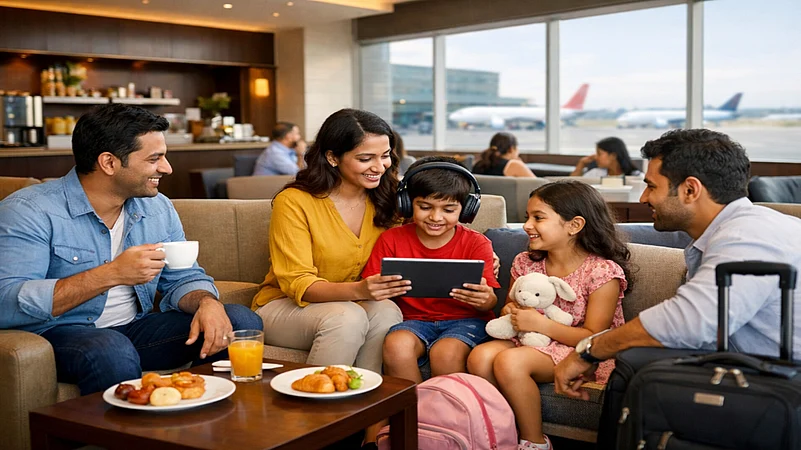
According to Kotak, the episode has exposed a gap in how premium cards serve family travellers. “It is no longer enough to promise the principal cardholder a seat and a sandwich. When flights are diverted, families need a quiet room, Wi‑Fi, food and support together,” Bhasin says. “Customers should not be left to depend on airline meal vouchers or ad‑hoc airport goodwill during irregular operations.”
Data suggest demand for lounges among Indian travellers is already high. A 2024 survey reported that 76 per cent of Indian passengers use lounges when available, with strong preferences for food, family provisions and leisure facilities, revealing that access must be provided to companions, not just solo business flyers.
Adhil Shetty, CEO, Bankbazaar.com, says, “As travel volumes continue to rise, we are seeing a clear shift in what customers value from credit cards. Benefits are no longer judged only on access, but on how effectively they reduce friction across the journey. Lounge access, in that sense, is steadily moving from a discretionary perk to a functional necessity.”
Travel volumes are part of the story. Scheduled domestic air passenger traffic in India touched roughly 142.8 lakh passengers in October 2025, a year-on-year increase of 4.5 per cent. Load factors are consistently near 85 per cent. Planes are more packed, airports are busier, and there’s much less slack in the system when things go awry. Flight delays and cancellations have an outsized and immediate impact on airports and airlines across networks.
“We’ve seen examples of this over the past few months. Operational glitches from airlines, airspace constraints amid geopolitical conflict, and tightened turnaround times have contributed to increased delays, cancellations and diversions. For passengers, it can mean extended hours of anxious waiting at airports with limited seating space, erratic access to food and water, and very little visibility into when your flight will depart. Crowded airports see these facilities stretched thin when multiple flights are affected concurrently,” observes Shetty.
This is where a well-equipped lounge can provide a welcome consistency. A known place to sleep, grab a bite, charge your devices and take a break while you regroup on your travel plans.
Bhasin says the lesson for premium cards is straightforward: build for household resilience. “Customers have worked hard to reach this stage in life. They expect their benefits to extend to the people they travel with - spouse, children, parents - without friction or uncertainty. Wherever possible with our cards, we are making family‑first lounge access the default, not a paid exception,” he adds.
Customers today are increasingly valuing benefits that extend to accompanying members, and it is encouraging to see issuers already responding with more flexible and thoughtful propositions. As travel itself evolves, there is a strong opportunity for the industry to build on this momentum by making these benefits more seamless and predictable, ensuring that comfort and continuity remain integral to the overall travel experience.