





Summary of this article
Major metro cities are witnessing a blurring of the boundaries between traditional office leases and managed environments, as more corporates prioritize agility, speed, and consistency over rigid, long-term commitments.
India's growing emergence as a choice for international businesses, including innovative environments and new companies, means the need for high-quality, adaptable workspaces will continue to increase.
While flexible workspaces were traditionally viewed as merely a convenient alternative, by 2026 they will become the default way for companies to create and grow their businesses.
India’s office leasing story is being rewritten by the growing dominance of flexible and professionally-run workspaces, which have moved far beyond their earlier image as temporary or experimental setups. They are now central to how companies design and execute their real estate strategies.
In major cities and emerging business hubs alike, businesses are actively favouring agile, plug‑and‑play environments that can scale with demand, rather than locking themselves into rigid, long‑term leases. No wonder major metro cities are witnessing a blurring of the boundaries between traditional office leases and managed environments, as more corporates prioritise agility, speed, and consistency over rigid, long-term commitments.
Gaurav Bhatia, Senior Vice President-Leasing, Brookfield Properties, says, “Managed workspaces have firmly established themselves as a preferred choice, with flexible and managed workspace operators now accounting for over 15 per cent of overall office leasing in India. This reflects how deeply embedded the model has become in corporate real estate strategies. Across sectors such as Global Capability Centres (GCCs), IT-BPM, Banking, Financial Services and Insurance (BFSI), and manufacturing, organisations are increasingly leveraging managed workspaces to enable rapid expansion, support market entry, and drive portfolio consolidation while ensuring consistency in quality, location, and cost efficiency. Strong demand outweighed new office supply, leading to a 210‑basis point year‑on‑year decline in overall vacancy, which has been the steepest annual fall on record. Managed workspaces are no longer seen as short‑term or transitional solutions. This momentum is expected to strengthen further in 2026, reinforcing India’s position as a global hub for enterprise and innovation.”
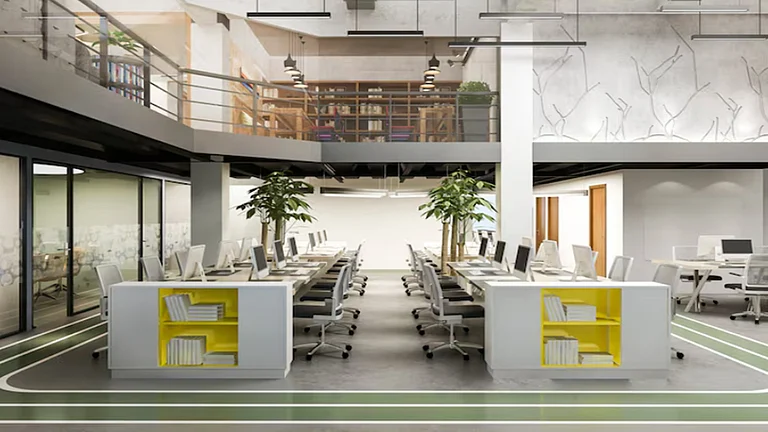
Why Corporations Are Shifting To Managed Spaces
There are many reasons for corporates shifting to managed spaces. GCCs and IT‑BPM companies can quickly grow their workforce by being able to build a facility without having to first build a building. With the tight labour market, these types of companies can enter a new market or expand within their current market without waiting on construction or fit-out times.
As far as the BFSI industry is concerned, companies typically want their offices to be secure, governable, and consistent with their brand. Current managed office space providers are now able to provide all these elements through a dedicated floor, secure access systems and regulatory-compliant infrastructure. Even manufacturing firms are now utilising managed spaces for regional sales offices, innovation laboratories, and testing centres where they need a professional environment without having to incur the costs of directly managing real estate.
Impact On Lease Volumes And Vacancy
In a market where speculative construction can sometimes outrun absorption, this level of vacancy compression is a sign that the demand engine remains robust. Managed workspace operators, with their ability to optimise and redeploy existing inventory, are helping landlords absorb demand more efficiently and maintain healthier occupancy levels across buildings.
Redefining The Role Of ‘Temporary’ Spaces
Perhaps the most important shift lies in perception. Flexible workspace operators can act as anchor tenants, committing to multi‑year leases while providing the end‑user flexibility to adjust headcount.
What 2026 And Beyond Could Look Like
India's growing emergence as a choice for international businesses, including innovative environments and new companies, means the need for high-quality, adaptable workspaces will continue to increase. From 2026 onwards, flexible and managed workspaces will move beyond being viewed as a 'nice-to-have' alternative for setting up and scaling organisations, and towards becoming the de facto method for doing this within the global economy.
As organisations enter or expand in India, they will increasingly seek locations that provide an environment that contains a strong infrastructure, professional support services, and a variety of space configurations that can quickly adapt as the number of employees and/or a business’s strategy changes.
This shift is being driven by changing expectations of workers. Workers today are more interested in mobility, collaboration, and seamless technology use than ever before, and managed workspaces can meet all these requirements. As companies work to re-position their office space by responding to a hybrid working model, continued regional growth, and increased digital transformation, flexible, professionally-managed workspaces will become a critical and effective means of enabling agility, while maintaining quality and brand alignment.



Manas Mehrotra, Founder, 315Work Avenue, says coworking spaces have emerged as a significant factor in the evolution of India’s commercial realty market, with flexible and future-ready workspaces becoming an essential part of work culture. Flexibility, health and wellness, and technology-enabled efficiency have now become central to modern work culture, and are the defining features of modern workspaces, leading multinational companies, corporates, and GCCs to increasingly prefer coworking spaces. Today, large corporations opt for spaces that are as efficient and secure as their own offices, mirror their brand identity, while offering the flexibility of a shared space.
“Sustainability is now an integral feature of modern work culture and is being increasingly adopted by coworking spaces. Instead of short-term leases, enterprises are looking for strategic multi-year partnerships that offer flexibility and scalability without capex. Flex spaces have now become a core part of the strategy of enterprises’ real estate planning, with factors like hybrid work, cost optimisation, agile work environments, and the need for a scalable environment driving this demand. The overall outlook for India’s coworking market is extremely positive as it is poised to remain a major growth engine for India’s commercial real estate market,” he adds.





