





Summary of this article
The Supreme Court of India has ruled that a married daughter is eligible for a compassionate appointment.
A daughter caring for her natal family cannot be denied a livelihood benefit solely due to her marital status.
The Court held that excluding married daughters from compassionate appointments is gender-biased and unconstitutional.
Breaking the gender stereotype pattern of thinking, the Supreme Court of India ruled that marital status cannot be used to deny women the right to livelihood under a welfare-oriented scheme. In the judgment delivered on June 2, 2026, the Court ruled in favour of the appellant, a married daughter taking care of her natal family in Amethi, Uttar Pradesh.
The legal battle is related to the allotment of a fair price shop in a village in the district of Amethi. The shop was allotted to Smt. Badrun Nisha (mother of the appellant) in October 2012. The mother passed away in March 2024, and then her daughter (Kulsum Nisha), the appellant, sought to take over the dealership under the ‘dependent quota’ as she remained the sole earning member for the household that includes her four sisters, of whom one is visually impaired. The appellant is married in the same village and supported her mother even after marriage in running the shop and the household. For the appellant, this was not a matter of inheritance but a means for survival.


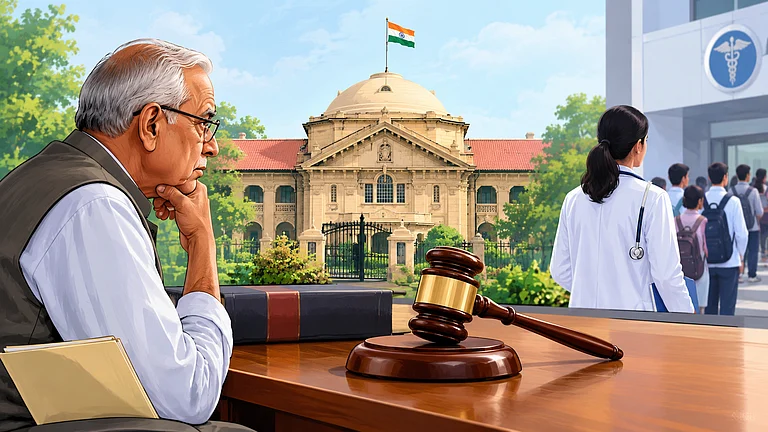


However, her application was rejected in July 2024 by the Sub-Divisional Magistrate (SDM) of Tiloi, who based the judgment on a government order (G.O.) no. 6 of 2019, under which the only unmarried, widowed, and legally separated daughters are included, but married daughters are kept excluded from the definition of ‘family’. She appealed against the order to the Deputy Commissioner, who also affirmed the SDM order in January 2025.
The appellant challenged the order by filing a writ petition to the Allahabad High Court, where the High Court, in March 2025, held that she is not entitled to the compassionate appointment as a dealer to run the fair price shop and dismissed her petition.

Arguments
The appellant’s counsel argued that the exclusion of a married daughter from the beneficial allotment scheme violates the fundamental rights under Articles 14, 15(1), 19(1)(g), and 21 of the Constitution of India. The counsel also highlighted the ‘conflict of opinion’ amongst the different High Courts regarding the eligibility of married daughters for welfare schemes, and urged for uniformity in the application of fundamental rights.
On the other hand, the counsel representing the State of Uttar Pradesh argued that the argument of discrimination involving Articles 14, 15, and 19(1)(g) of the Constitution is ‘misconceived’. The counsel also contended that a married daughter typically shifts to her in-laws’ home, and thus, doesn’t fulfil the requirement of being a ‘local resident’, a requirement to make her eligible for the benefit.

Court Observation
The court observed, “The impugned provision proceeds on the assumption that upon marriage a daughter ceases to be a member of, or dependent upon, her parental family. Such an assumption is constitutionally impermissible. Marriage neither extinguishes the bond between a daughter and her parental family nor furnishes a valid basis to presume absence of dependency.”
The court pointed out that in contemporary societies, many married daughter are residing with their parents, sometimes supporting them or sometimes remaining dependent on them. And, there may be married sons who are not dependent on their parents, yet are included in the definition of family.
“Dependency is a question of fact and cannot be conclusively determined by reference to marital status alone,” held the Court.
As the scheme does not exclude a married son from the ‘family’ definition, the exclusion of a married daughter reflects only a gender-based stereotype. The Court held, “The distinction is founded upon a gender-based stereotype that a daughter, upon marriage, becomes a member of another family and loses all ties with her natal family. Such a presumption is incompatible with the constitutional guarantee of equality and perpetuates historical notions of gender inequality which the Constitution seeks to eradicate.”
Even the ‘local residence’ requirement is also untenable, as the residence is an independent eligibility criterion and must be determined for each case separately, instead of blanket exclusion of married daughters, held the Court.
The Court held, “The exclusion is founded solely upon marital status and gender stereotypes and consequently, violates Articles 14 and 15(1) of the Constitution of India.”
Further, it applied the ‘Doctrine of Purposive Construction’, a legal principle to attach an amendment to the legal provision. Since the purpose of the dependent quota is to provide immediate financial support to a grieving family, excluding a dependent daughter was deemed irrational and self-defeating.
The Court ruled that the term ‘daughter’ in the Uttar Pradesh Essential Commodities Order must be interpreted to include married daughters, subject to conditions that they meet the other criteria.
The Landmark Court Judgment
The ruling overruled the previous contrary views and aligns with the progressive decisions from the Bombay, Karnataka, and Calcutta High Courts. The apex Court quashed the previous orders passed by the Allahabad High Court, the Deputy Commissioner, and the SDM, and directed the competent authority to issue the allotment order in favour of the appellant within four weeks.





