





Summary of this article
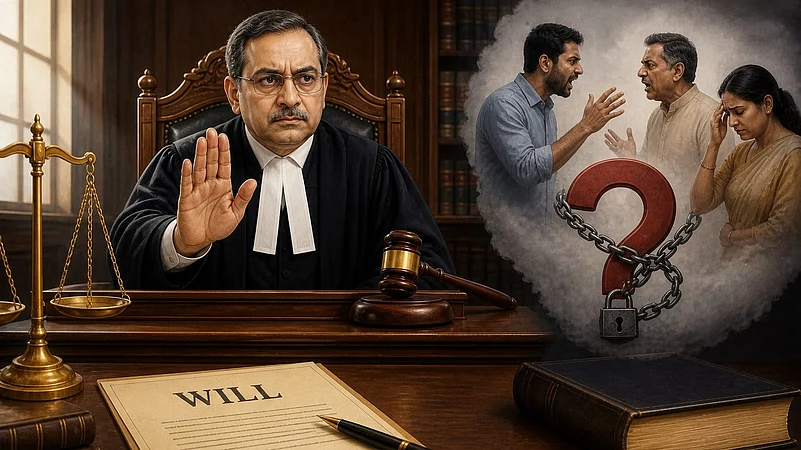
The Gujarat High Court has ruled that mere registration is not enough to validate a Will if its execution is shrouded in suspicion.
In a four-decade-old dispute over a 1981 Will, the court found contradictions in witness testimonies, the testator’s illness, and unexplained exclusion of an heir.
The court set aside the earlier grant of probate.
The Last Will is considered the last wish of a deceased person, but what if the Will is written under unnatural circumstances? In one of the suspicious Will cases, the Gujarat High Court overturned a decades-old grant of probate, saying that the validity of a Will is not determined just by the proof of signatures, but also by the successful removal of suspicion around its execution.
In a recent judgment, Justice J.C. Doshi held that the burden to prove the validity of a Will is on the person who presents the Will, and failure to do so can raise doubt.
While hearing the case, the court emphasised that when a document is shrouded with unnatural circumstances, such as severe illness, unexplained omission of heir, contradicting testimonies, then a mere registration of a Will cannot keep it out of suspicion.


Case Background
This legal battle is over four decades old. In July 1981, Shri Ramchandra (father) died, who allegedly wrote a Will one week before his death. After his death, his son Bhaskar Pednekar filed for probate of the Will, in which he was named as the sole executor and beneficiary of a property in Bapunagar, Ahmedabad, and his brother Harishchandra was excluded from inheritance.
Harishchandra resisted the Will and called it a fraud and a fabricated document. He even contended that their father, who was suffering from jaw and tongue cancer at the time of the execution of the Will, lacked the sound and disposing state of mind. Both brothers are deceased now, and their legal heirs represented them in the case.
Arguments
The counsel of the appellant (Harishchandra represented through his legal heirs) argued that the Will was shrouded in several suspicions because at the time of executing the Will, the deceased was gravely ill, suffering from cancer, and had undergone a surgery to remove a malignant tumour just a few months prior. His physical condition at the time raised doubt about his 10-kilometre walk from Bapunagar to Narol Court to meet an advocate and speak while suffering from a malignant tumour in the tongue and jaw.
The counsel also contended that the Will did not mention any other family members, and other known movable and immovable assets.
The counsel of the respondent (Bhaskar represented through his legal heirs) one the other hand, argued that the Will was executed out of free will in front of an independent witness, as per the requirements under the Indian Succession Act, 1925. The counsel argued that physical health issues did not mean a lack of mental capacity to write a Will.

Court Observation
While hearing, the court observed serious contradictions in the evidence provided by the plaintiff (Bhaskar), the attesting witness, and the scribe (the person who physically writes a Will). The court observed conflicting testimonies regarding their arrival and physical presence during the Will execution.
“The oral evidence of both the witnesses – propounder as well as attesting witness are intended to prove execution of unprivileged Will as per section 63(c) of the Act, 1925, read with section 68 of the Evidence Act. However, plain reading of them stipulates that there is a contradiction regarding the sequence of arrival and the presence of the parties at the time of execution of Will. Such contradictions go to the root of the matter and create doubt on the execution of the Will,” the court noted.
Court Judgment
Noting the doubtful circumstances, the High Court allowed the appeal. It held, “In case on hand, several non-normal circumstances remained unexplained, turn to suspicious circumstances. In absence of removal of all these doubts, plaintiff cannot avail benefit of testamentary disposition. Thus, the appeal deserves merit.”
The court ruled that the respondent failed to dispel the suspicious circumstances surrounding the execution of the Will. It quashed the 1995 decision by the trial court that had granted probate to the beneficiary of the Will, and dismissed the probate proceedings.
FAQs
Who can write a Will?
A person aged 18 and above, having sound mind is eligible to write a Will. A Will is valid when it is written freely, without any coercion, undue pressure, or fraud.
What is a Probate?
It is a legal process of validating a deceased person’s Will in the court.
Is Probate mandatory?
In December 2025, the government has removed the mandatory probate of a Will. Earlier, probate of a Will was mandatory in few states (Mumbai, Chennai and Kolkata) for Hindu, Buddhists, Sikhs, Jains and Parsis.





