



Summary of this article
A foreign education goal is ultimately a dollar-denominated liability, making currency risk as important as investment returns.
Saving only in rupees can leave families with a painful funding gap if the rupee weakens and overseas education costs rise.
Matching part of the education corpus with dollar-linked assets can help families prepare for the cost of studying abroad.
What if a dollar costs Rs 150 by the time your child gets admission to a foreign university? It sounds extreme. But USD-INR was around 60 in 2014 and is around 95 today. If it keeps sliding at 5 per cent a year, a dollar would be around Rs 150 arrives within the next 10 years. A $300,000 degree would then need Rs 4.50 crore. If your child goes abroad in the next 5-10 years that is the number your savings must catch. No one can predict the USD-INR exchange rate. But a family that plans for this currency risk loses nothing if it never plays out, and a family that ignores it pays for it exactly once, at the worst possible time.
Says Sougata Basu, founder and CEO, CashRich, an Association of Mutual Funds in India (Amfi)-registered wealth management platform: “A family I know in Mumbai started saving for their son’s education in 2014. The father, a mid-level executive, did what most careful Indian parents do. He opened fixed deposits (FDs) and put away money every month, year after year, for 11 years.”
However, the FDs paid around 7 per cent. He was in the 30 per cent tax bracket. So, his real take-home return was closer to 4.90 per cent. He did not think much about it. The money was safe, the bank was solid, and the corpus grew every year.
In 2025, his son got admission to a good US university. That is when the family discovered a problem no bank statement had ever shown them.

“A 4-year US degree that cost around $180,000 in 2014 now costs upwards of $300,000. US college costs have been increasing 4-5 per cent a year, in dollars. Meanwhile, the rupee fell from 61 to a dollar in 2014 to around 95 today. That is a loss of roughly 36 per cent of purchasing power,” says Basu.
An individual putting Rs 50,000 a month into FDs from 2014, earning 4.90 per cent after tax, would have built around Rs 1 crore by 2025. If it is converted to dollars, it is about $105,000 against a $300,000 bill.
The family took an education loan at over 10 per cent interest to cover the gap. The son will likely spend his first working years repaying it. The parents saved diligently for 11 years and still ended up borrowing. Not because they were careless, but because they saved in the wrong currency.


Would Real Estate Have Worked?
Many families keep a second flat for education fund. The numbers are sobering here, too.
“A flat bought for Rs 2 crore in 2014 may sell for around Rs 3 crore today (that’s an optimistic case). A 50 per cent gain in rupees. In dollar terms, that same flat went from about $328,000 to about $316,000. That is a loss in dollar terms even before taking into account the selling costs. Now subtract stamp duty, home loan interest payments, property tax, monthly maintenance, brokerage, and capital gains tax. Even after counting rental income, most owners are still left with a loss in dollar terms,” adds Basu.
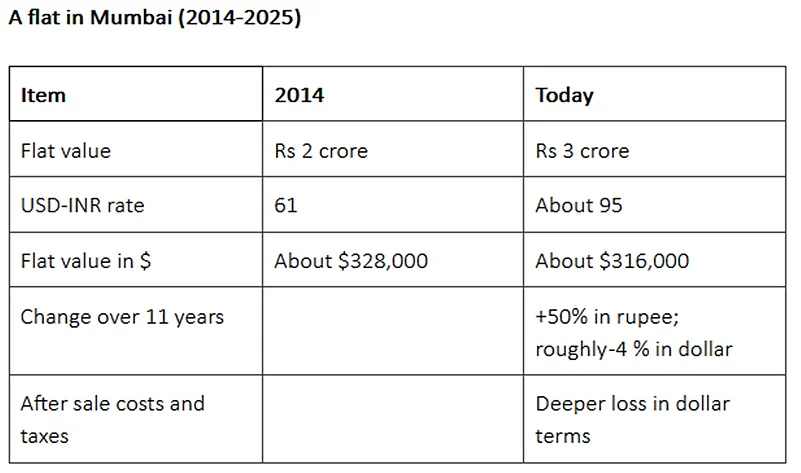
The apartment grew in rupees. The goal grew in dollars. They never met.
Equity SIPs Help, But Only Partly
A monthly systematic investment plan (SIP) in an Indian index fund would have done far better than the FD. The Nifty 50 has delivered roughly 11-12 per cent a year over the past decade. The same Rs 50,000 per month in an SIP would have grown to around Rs 1.60 crore, roughly 60 per cent more than the FD route.
“But here is the part most investors miss. An SIP into an S&P 500 index fund over the same period would have returned roughly 15 per cent a year in rupee terms. Of that, 2-3 per cent points came purely from USD-INR depreciation. The same Rs 50,000 a month would have grown to around Rs 2 crore, and more importantly, that wealth would be sitting in dollars, the currency the education fee bill arrives in,” says Basu.
These are sample calculations, and past returns are not a promise of future ones. But the structural point holds. If the expense is in dollars, some of the savings should be in dollars, too.

A Regulated Way To Own Dollars
Until recently, dollar investing from India was messy. Many international mutual funds kept closing to new money because of industry-wide limits on overseas exposure. That has changed with GIFT City.
GIFT City, in Gujarat, is India's International Financial Services Centre, regulated by IFSCA. Funds launched here let resident Indians invest in global equities in dollars through the RBI’s Liberalised Remittance Scheme (LRS), which permits up to $250,000 per person per annum. The entire process runs through your Indian bank account. No foreign brokerage, no overseas tax filing.
Adds Basu: “Established Indian fund houses have already launched products there. DSP has brought India’s first retail global equity fund from GIFT City, with a minimum investment of $5,000. PPFAS offers low-cost index funds. More are on the way. These funds are professionally managed, diversified, and denominated in dollars, so when the rupee weakens, your corpus in rupee terms rises with it,” adds Basu.
The Broker Question Nobody Asks
There are also several apps that let Indians buy US stocks directly. Some are convenient. But before investing through any of them, ask one question: who is the broker behind the app, and which regulator do I go to if something goes wrong?




Many of these platforms route your money to a foreign broker that is not regulated in India. In good times, this detail feels academic. In a crisis, it becomes very important. During the global financial crisis in 2008, we were taught that even large firms like Lehman Brothers can collapse. Investors discovered overnight that the safety of their assets depended entirely on who held them and under which jurisdiction.
“This is where GIFT City funds stand apart. They are regulated in India, by an Indian regulator, on Indian soil. If you invest in a DSP or a Tata Mutual Fund based in Gujarat, your grievance mechanism sits within India’s regulatory system, in a language and legal framework you understand. For a goal as important as a child's education, that matters as much as the return,” adds Basu.
The Family CFO View
Every large company has a chief financial officer (CFO) who matches assets to liabilities. If a payment is due in dollars, the CFO holds dollars against it. Families rarely think this way, yet a foreign degree is exactly such a liability: large amount, long term, and priced in a foreign currency.
“The family I described did everything right by the old playbook. Save early, save regularly, and keep it safe. The investment process itself was the problem. Currency risk is an important risk that shows up quietly, compounding at 3 per cent a year, and affects the entire net worth of the family (not just the income for that year),” says Basu.
If your child plans to study abroad in 2032 or later, the question is worth asking today. Your savings are growing. But are they growing in the currency of your child’s dream?





