



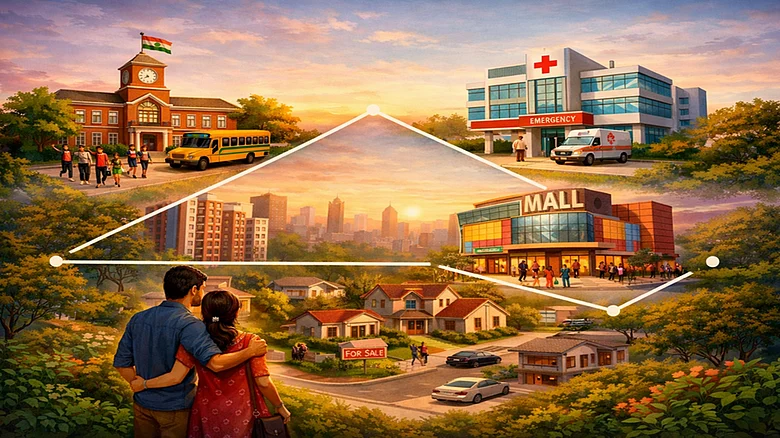

Summary of this article
Malls or high streets aren’t just about shopping, they signal convenience, social life, and a neighbourhood that’s lived-in and complete.
Buyers pay for top schools, reputed hospitals, and integrated mixed-use zones that reduce chaos.
For both homebuyers and investors, the most reliable growth pockets are not just where connectivity is improving, but where social infrastructure is already visible on the ground.
In Indian cities, home buying is increasingly shaped by a simple but powerful idea: the school–hospital–mall triangle. Connectivity and job access are still the first filter, but social infrastructure is what often turns ‘shortlisted projects’ into ‘booked’ ones, especially for end-users.
Why This Triangle Matters:
For families, a nearby good school functions as an essential daily-life improvement because it reduces their travel needs, minimises their organisational tasks and establishes consistent daily schedules. Hospitals which operate as multi-speciality centres provide patients with the advantage of receiving emergency care without needing to cross city roads during their healthcare visits.
Malls or high streets aren’t just about shopping; they signal convenience, social life, and a neighbourhood that’s lived-in and complete. When all three are within easy reach, the location starts feeling complete.

What It Does To Pricing And Demand:
Social infrastructure tends to create sticky demand. Families are less price-sensitive when daily life becomes easier and predictable, which supports stronger resale liquidity and rental depth. “Over time, this translates into a pricing premium for localities that have everything within 10-15 minutes. Importantly, this premium is often reinforced by infrastructure-led distance compression: once commute barriers fall, buyers begin optimising for liveability,” says Purvang Mashru, Senior Quantitative Research Analyst at 1 Finance.
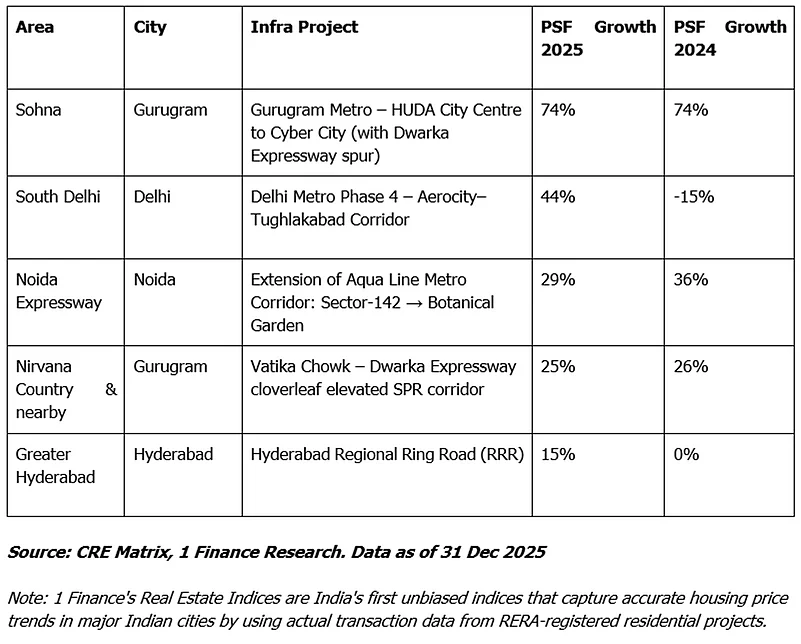
Delhi-NCR shows this clearly. Years of metro and expressway expansion have widened the set of neighbourhoods people consider livable, and prices have responded. In 2025, Delhi-NCR’s average price rose from Rs 23,8891 per sq ft (Q4 2024) to Rs 27,390 per sq ft (Q4 2025), with strong gains across adjacent markets too. A quick snapshot of how key corridors have aligned with a sharp YoY PSF growth:

Metros vs Emerging Cities:
“In metros, the triangle often exists but varies by quality and crowding. Buyers pay for top schools, reputed hospitals, and integrated mixed-use zones that reduce chaos. In emerging cities, the shift is often more dramatic: one strong hospital chain, a credible school ecosystem, or a mall-grade anchor can change the perception of an entire corridor because it signals urban maturation,” says Mashru.
The catch is that markets price in promises early, but only reward delivery over time. Navi Mumbai’s airport story is a reminder - announcements can lift sentiment fast, delays can flatten it. So, for both homebuyers and investors, the most reliable growth pockets are not just where connectivity is improving, but where social infrastructure is already visible on the ground.





