





Summary of this article
Being educated or skilled does not disentitle a wife from maintenance; actual, sufficient income is the test.
Maintenance is need-based and aims to ensure a standard of living comparable to the matrimonial home.
A working wife may still receive maintenance if her earnings are inadequate or unstable.
Maintenance can be reduced or cancelled only on proven grounds such as financial self-sufficiency, adultery, or material change in circumstances.
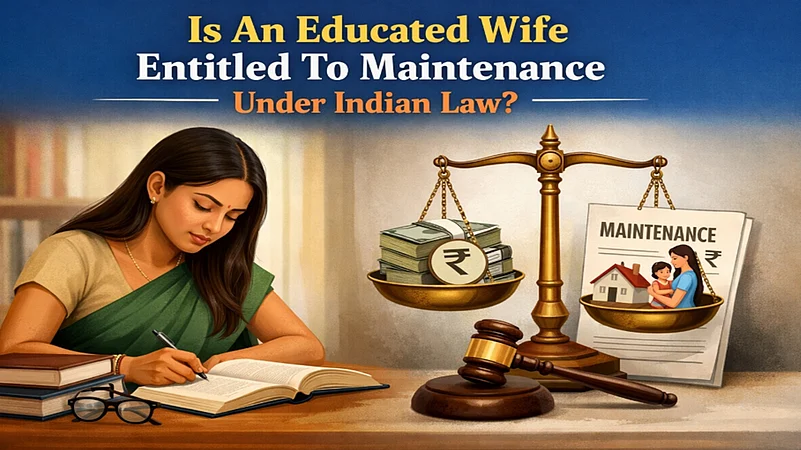
In a significant reaffirmation of women’s rights under maintenance law, the Allahabad High Court, in Suman Verma and another vs. State of U.P. and another, has held that a wife cannot be denied maintenance under Section 125 of the CrPC solely on the ground that she is highly educated or possesses vocational skills.
The bench observed that the wife's mere potential to earn is distinct from actual gainful employment. It emphasised that it is a reality faced by many women: despite their education, they find it difficult to join the workforce after years of domestic duties and childcare responsibilities.
How Courts Decide The Quantum Of Maintenance
Legal experts note that there is no standard formula for fixing maintenance, with courts assessing and determining the amount on a case-by-case basis. “Discretion is granted to the courts to determine the quantum of maintenance. The main aim of this exercise is to make sure that the woman can live a dignified lifestyle that is similar to the one they had when they was married. At the same time, the maintenance must not be too high to make it unfair for the husband,” says Shankey Agarwal, partner, BMR Legal.
The courts look at multiple factors, such as the husband’s income, the wife's age, health, education, employment experience, and whether she has any money or support of her own. Further, the length of the marriage, any debts, and the family's way of life are important factors to consider.

Impact Of Child Custody And Wife’s Income
Courts recognise the financial obligations arising out of upbringing, education, healthcare and day-to-day expenses of child/children which may be looked after by the wife, and hence, the quantum of maintenance is enhanced in such cases. However, the mere fact of the wife earning an income does not automatically absolve the husband of any financial obligations, points out Manmeet Kaur, partner, Karanjawala & Co.
A working wife, thus, is not automatically disentitled to maintenance. “Courts examine whether her income is sufficient to maintain a standard of living comparable to the matrimonial home. If her earnings are inadequate or unstable, the husband may still be directed to pay maintenance,” observes Athira T S, associate partner, King Stubb & Kasiva, Advocates and Attorneys.
However, if the wife’s income is substantially higher and sufficient for her sustenance, courts may deny or reduce maintenance. “Maintenance is not punitive; it is need-based. Where financial dependency is absent, the obligation on the husband may not arise,” adds Athira.
How Courts Assess Income, Lifestyle and Disclosures
Courts look at documents that show real money flow and real living. They rely on bank statements, income tax returns, salary slips, financials, etc. They also look at other evidence, such as immovable property, rental income, investments, vehicles, credit card usage, etc.
“If the spouse is self-employed or doesn't have a permanent job, the courts typically use lifestyle factors to determine their true net worth. If one side tries to hide income or gives inadequate information, the court can make an adverse inference,” observes Agarwal.
Kaur points out that parties may also be called upon to file affidavits regarding their income and earning sources. “False statements made therein may amount to perjury and invite imposition of costs and penalties along with other punitive measures,” she adds.
When Maintenance May Be Reduced or Waived
A husband is not invariably liable to pay maintenance. Courts may cancel or reduce it in defined circumstances, including where the wife is found to be living in adultery or unreasonably refuses to cohabit despite the husband’s willingness to maintain her. “Maintenance may also be modified if there is a material change in circumstances - such as a substantial decline in the husband’s income, the wife attaining financial self-sufficiency, or the husband incurring unavoidable additional responsibilities, including the care of elderly parents or children from another marriage,” notes Nidhi Singh, partner at IndiaLaw LLP.
Soumen Mohanty, Partner, AQUILAW, points out that a husband can seek reduction or cancellation of maintenance, but only on legally-recognised grounds and typically by moving the court under Section 127 CrPC/146 BNSS, which permits alteration of a maintenance order upon a material change in circumstances.
One clear ground is where the wife has an independent income that is actually sufficient to maintain herself in a manner broadly consistent with the matrimonial standard of living; courts do not deny maintenance merely because she is educated or capable of earning. “The focus is on real, adequate earnings, not theoretical potential. In this context, courts have emphasised that the wife’s income must be enough for dignified sustenance, not bare subsistence. For instance, Mamta Jaiswal v. Rajesh Jaiswal, 2000 SCC OnLine MP 147 highlights that the court must examine whether the wife’s means are sufficient for a life of dignity,” says Mohanty.
Another ground is a genuine deterioration in the husband’s ability to pay, such as a bona fide job loss, serious illness/ disability, or proved insolvency, provided the hardship is not self-created to evade liability. Mere assertions are not enough, and strict proof is expected.
“Separately, Section 125(4) CrPC/ 144(4) BNSS creates substantive bars to entitlement, such as maintenance is not payable if the wife is living in adultery, or if she refuses to live with the husband without sufficient reason and if the wife is living separately by mutual consent. Importantly, “sufficient reason” is assessed on facts and commonly includes cruelty, domestic violence, dowry-related harassment, or serious mental abuse, which would justify separate residence and preserve her entitlement,” adds Mohanty.
Overall, courts treat reduction/ cancellation as an exception: the husband must demonstrate, with credible evidence, either that the wife is already adequately maintained from her own income or that there has been a real, substantial change making the existing order unjust.
Effect Of Wife’s Remarriage On Maintenance
Once a divorced wife remarries, the former husband’s legal obligation to pay her maintenance ceases immediately.
“Section 144 of the BNSS defines ‘wife’ for maintenance purposes to include a divorced woman only so long as she has not remarried. On establishing proof of the remarriage, the husband may approach the court to have the maintenance order formally cancelled,” informs Singh.
This, however, does not affect the husband’s continuing obligation to maintain any children from the first marriage, which subsists irrespective of the wife’s subsequent marital status.
Remedies If Maintenance Is Delayed Or Unpaid
If a husband stops or delays payment of maintenance, the law provides a strong enforcement framework to ensure that the wife is not left without support.




“She may file an execution application under Section 125(3) of the CrPC (now Section 145 of the BNSS), which must be moved within one year from the date the amount became due. The court may then issue a warrant to recover the arrears as if they were a fine, including by attaching the husband’s bank accounts, salary, or other property. Where non-payment continues without sufficient cause, the Magistrate may order imprisonment for up to one month for each month of default, or until payment is made—though such imprisonment does not extinguish the arrears, which remain payable,” says Singh.
Additionally, in pending proceedings, a court may strike off the husband’s defence for failure to comply with interim maintenance orders, effectively barring him from being heard until the outstanding dues are cleared.





