Summary of this article
Annuities ensure steady post-retirement income.
Longevity and inflation risks need planning.
Innovation and competition to benefit retirees.
When it comes to retirement planning, the conversation usually dwells on building a corpus. But an equally important aspect is decumulation or more specifically, how to get regular income after retirement. This is where annuities come in.
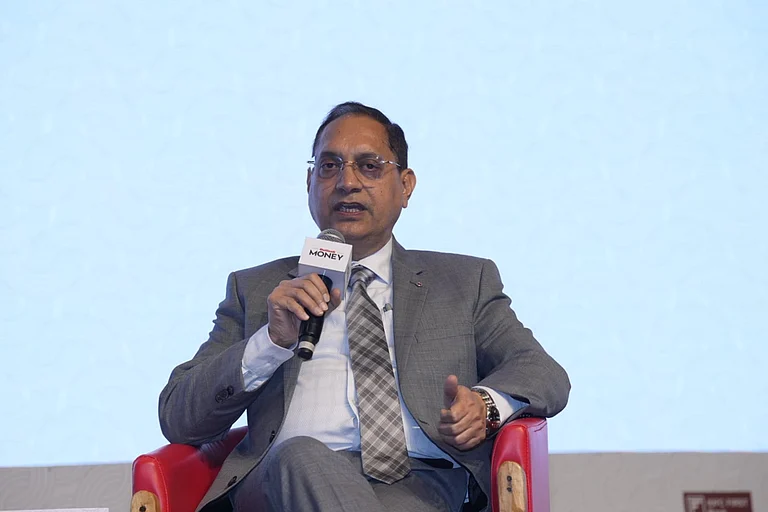
At a panel discussion on innovation in insurance annuities at the Outlook Money 40After40 Retirement Expo on February 20, 2026 the panellists discussed the nuances of annuities and how they can give one a regular income after retirement. The panellists included Vibha Padalkar, MD & CEO, HDFC Life insurance; Sumit Madan, MD and CEO, Axis Max Life Insurance; and Ashish Vohra, ED & CEO, IndusInd Nippon Life Insurance, and was moderated by Nidhi Sinha, Editor, Outlook Money.
Incidentally, annuities often come under the lens for lower returns and also because of low awareness. So, simplifying annuity so that it becomes more transparent for customers could

Annuities are Simple Products
Padalkar said that annuities are probably the simplest of products that exist today. The only aspect that is not understood enough is the longevity risk, and that is maybe because India is a relatively young country.
“The impact of longevity risk, the fact that due to healthcare, better nutrition when we were growing up and so on, and general rising affluence means that all of us are living longer. And that’s a good thing to have. However, at the same time we have a lot of socio-economic changes. Probably people in their 50s and 60s in this room today are unlikely to live with their kids, which was not a generation ago. With that changing it means that one needs to estimate how much you're going to need,” she said.
She said that inflation added with healthcare costs would significantly eat into one’s savings. Annuities can help as they provide regular cashflow in retirement, she said.
“If you place some of that lump sum to an insurer to buy an annuity and you get a fixed amount, maybe your spouse gets a fixed amount and so on more or less until one is alive. So it’s a proxy for salary after retirement.” she added.
She said that earlier people did not understand the need for a retirement corpus. That has now changed. They know they need it, but don’t know much or which instrument to rely on.
“So it's a good progression towards being a pension society,” she said.
Don’t Look at IRR
Padalkar said that as far as one’s pension is concerned, one should not get too hung up on the internal rate of returns (IRRs). The reason is that if one were to look at IRRs over the next five years and say that’s what he/she wants, that won’t take care of reinvestment risk.
“In all probability, interest rates are going to move southward. If you look at the next 10, 15, 20 years or 30 years, that one is going to be alive and require the funds post retirement at the age of 58 or 60. Another thing that people say is that they get taxed twice again post retirement. My advice is usually it will be a lower marginal tax rate, on a net basis. You need that income coming in like a salary until one is alive and one’s spouse is alive. So let us not mix up the concept of returns with longevity risk,” she added.
“One can have other instruments, one should have other instruments giving liquidity returns and so on, but maybe you are living in a property that you own, and there are maintenance costs which are fairly onerous or will continue to be inflation adjusted. It’s those sorts of things for which you need a steady income to come in.
Planning Matters
Vohra said that the issue of longevity is critical while planning for retirement. He gave the personal example of his father, a 92-year-old cancer survivor who recently told him he finished 34 years of retired life, a year more than his working life of 33 years.
“That line stuck with me. This is longevity expressed in a very different manner. I don’t think we think of life like this. At least I didn’t think of life like that to say that I’m going to work and then I might have a retired life that’s going to be maybe significantly longer,” he said.
Padalkar said that the challenge in India is that people start planning for retirement rather late, which was also reflected in the India Retirement Survey. “I think most of the planning normally starts when you are in your late 40s or early 50s and like in a typical cricket match then the run rate only goes up and it's not easy to maintain the run rate,” she said.
Madan added that the moment one starts earning, one should start planning in terms of one’s savings, investments, and retirement.
Vohra said that Indians do save, but what they possibly lack is structured planning for retirement.
Choose the Right Product
Sumit Madan said that most people look for a product with the highest return and minimal risk. But such a product does not exist. “Such a product is called disappointment and the product is probably called a fraud. So do not fall for that,” he said.
He added that IRR may not be the best benchmark when looking at some of these product asset applications. The key lies in choosing the right product.
“Should you invest all your money into a product which may just give you 5, 6, 7 per cent? The answer is NO. Should you invest all your money in a riskier asset where you must still expect a double digit kind of a return? The answer is again NO. Finding the right balance, depending on the profile of the customer and the suitability of the products is always the right way forward,” Madan said.
Madan said that the concept of variable annuity is now gaining traction, which allows one to invest money into the markets as well.
Annuities Bundled with Long-Term Products
Vohra said the market for annuities in India is still evolving and it is less than $1 trillion compared to the market in the US, where it is $40 trillion. Another insight he presented was how innovation that had happened in annuities in Japan.
“Annuities are now getting bundled with long-term care solutions. Essentially, life insurance companies are trying to cover the whole spectrum called “I will provide you income as long as you live at a guaranteed rate or a guaranteed plus risk rate, whatever your risk appetite is, how you select out of my product basket”. But money is not going to be enough. You are going to be dealing with something called health issues. You will need long-term care. You may need sanatorium hospitalisation, you may need counselling,”
“So some of the products that Nippon Life is now manufacturing relate to dementia, because they are now thinking of people at 90, who are not able to remember and deal with everything. So dementia counselling becomes an important component of long-term care which gets bundled with annuities,” he added.
Competition Will Benefit Market
Vohra added that increase in competition by way of more offerings will provide customers more options to pick from.
“When there is more competition, it helps the category expand. I think it is quite possible in the end, if there is more choice for customers, it is good. There are some other products which are not called annuities, which is the fixed tenure income that you get for a 10, 20, 30, 40 year kind of a play,” he added.
Madan added that India is a large market and the National Pension System (NPS) and annuity are actually complementing each other.
“The larger objective in a customer's mind is not about a life insurance company or senior living, it’s not about a banking fixed deposit or a savings account either. In his mind it’s a solution, it’s a financial solution and I think that’s how all the companies will have to start thinking. When you talk about senior citizens one has to talk about the ecosystem around retirement and that’s the innovation that will happen. So you will have bundled products where for example you may go as in manipulations, keep on changing but probably you'll partner more,” Madan added.
Make Annuities a Part of Retirement Portfolio
Padalkar said annuities should be a part of one’s retirement portfolio, but one should not strictly look into retirement with a focus revolving around annuity. There’s no strict mathematical formula to it. Maybe a rough portion of a third of one’s corpus would do.
“We should go beyond just annuity, that’s one part of it. But looking at elder care, that’s the other spectrum, with many things in between. You move to another town after retirement, you move home, hometown, but you don't know anyone over there. So, you find like-minded people, and so on. There are many solutions to that golden era which might be one third of our lives. So, one-third, one-third, one-third,” she said
Awareness Increasing
Madan said they recently did a survey with Gen Z and found that awareness around retirement planning is increasing. “That awareness now needs to translate into action. I think that’s where the missing block is to simply answer your question, the one should start planning for retirement the moment you start earning, just start putting in some money. More than retirement, it's great financial security. We keep on discussing financial independence,” he said.
Padalkar said she was often dismayed when younger employees asked about deduction for provident fund (PF) or gratuity, which was certainly not the right approach to planning.
Role of Intermediaries
Padalkar said it’s no use having a great idea, great product and not being able to reach the customer.
“India is a complex and large country. We are fairly nascent. We just talked in the past hour about awareness, need and how socio economic changes are happening. If we lose steam wherein we can't get the last mile we are going to lose the clock. So the need of the hour today is for us to get there. So it is again a partnership between the manufacturer and the distributor so that we get to the customer,” she said
Madan said the role of intermediary largely needs to be looked into two lenses. One is distribution and one is awareness or expertise. As such, intermediaries will continue to play a great role in terms with both the sides of distribution and awareness, she added.
“Too much information also leads to more confusion and that’s where the expertise of an intermediary can be very handy when it comes to making a certain decision towards a financial product,” he added.