






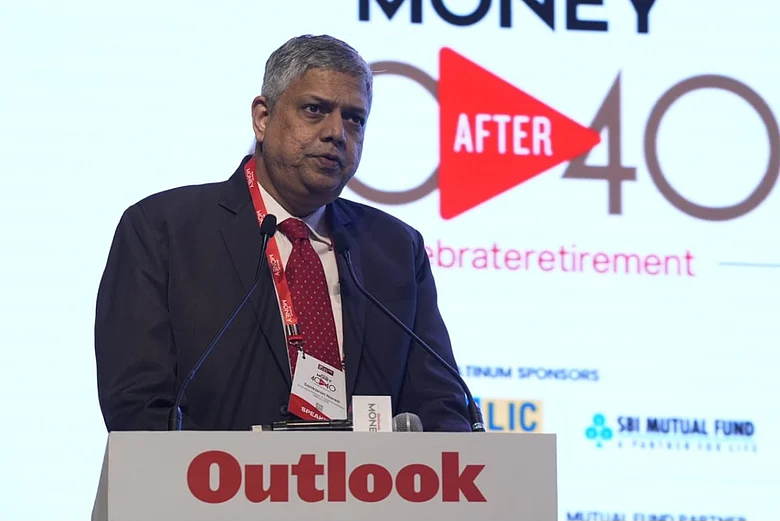

The more popular an asset class becomes, the less likely it is to offer value, said Sankaran Naren, Executive Director and Chief Investment Officer (CIO), ICICI Prudential AMC, at the Outlook Money 40 After 40 Retirement Expo on February 20, 2026.
He said markets have repeatedly shown what volatility really means. The periods between 1999 and 2001 and again between 2007 and 2009 tested investors’ patience. In both cases, value investing, written off at market peaks, proved its strength during corrections. “In 1999, people believed value investing was dead. By 2001–02, they realised it was back,” Naren said.
He referred to a note written by former Merrill Lynch strategist Richard Bernstein, who argued that once an asset class attracts too much money, it ceases to be valuable. Conversely, when an asset class sees little interest and low flows, that is often where value lies. “A lot of money comes in at the top and goes out at the bottom. And at the bottom, it is almost impossible to collect money,” Naren said.

Following the Money: The Anti-Value Signal
Naren illustrated his point using examples from mutual fund history.
He said in 2007, infrastructure funds saw assets under management (AUM) surge from about Rs 3,500 crore in December 2005 to Rs 25,000 crore. Soon after, performance faltered. Similarly, small- and mid-cap funds saw AUM jump from roughly Rs 13,000 crore in 2013 to Rs 67,000 crore by 2017. The subsequent years, particularly 2017 to 2020, were difficult for the segment.
“Any sector which gets too much money becomes anti-value,” he said.
The most striking example today, he said, is precious metals. AUM in gold and silver rose from around Rs 25,000 crore in 2022 to about Rs 4 lakh crore by January 2026. For the first time, inflows into gold and silver exchange-traded funds (ETFs) in January 2026 exceeded equity mutual fund inflows. Yet that month coincided with some of the highest prices for precious metals in the past decade.
“Investors say they buy cheap and sell costly. But when gold and silver were costliest, that is when the maximum money came in,” he said.
While equity valuations today are not exactly cheap, large-caps trade around 20 times median earnings, Naren said, adding that equities look relatively inexpensive when compared to gold and silver. “On a relative basis, Nifty has become cheaper compared to gold and silver. Yet flows have gone into precious metals,” he said, adding that this behaviour is the exact opposite of value investing.
Value is Not Just about Equities
Naren emphasised that value investing is not confined to equities. It applies across asset classes, including real estate. He said the framework for valuing real estate is straightforward: compare rental yields with home loan rates. When the gap between home loan rates and rental yields narrows to around 3-3.50 per cent, real estate tends to be attractive. When that gap widens to 7 per cent or more, the asset class becomes expensive.
“In 2003, Mumbai real estate was cheap. Home loan rates were around 7-7.50 per cent, rental yields were 3-4 per cent, and the gap was modest. By 2013, home loan rates rose to about 10 per cent while rental yields fell to 2-2.50 per cent, widening the gap and signalling expensive valuations. Prices had nearly doubled over the decade. Again in 2020, with home loan rates back to around 7-7.50 per cent and rental yields near 4 per cent, the gap narrowed and real estate offered value,” he said.
“You can do value investing in every asset class, not just equity,” he added.
The Psychological Test of Value Investing
The biggest hurdle, Naren said, was psychological. Value investing required buying after long stretches of weak or negative returns.
“US equities delivered near-nil returns between 2000 and 2012. Investing in US equities in 2012 would have been value investing. Instead, many investors entered in 2021–24 after strong performance, which he described as “anti-value investing”. Similarly, from 1993 to 2003, both Indian equities and real estate delivered muted returns. That period, in hindsight, offered value opportunities. You have to have the guts to buy after a big negative or low-return phase. That is very difficult psychologically,” he said.

Debt Deserves Attention
Naren acknowledged that the present time presents a unique challenge. Historically, when most asset classes appeared expensive, gold tended to be cheap. But this time, even gold looks expensive. In such a scenario, he suggested that debt may deserve attention. Retail flows into debt mutual funds have been negligible over the past 4-5 years.
“Value investing is about investing in asset classes that have done badly and are not getting flows. Today, no one wants to look at debt. Everyone wants to look at silver. But silver behaves like a small-cap asset class, without earnings, book value, dividend yield, or cash flow, but traded globally. That makes it inherently volatile. At this point in time, from a very long-term perspective, silver appears to be among the more unsafe asset classes,” Naren said.
For long-term investors, his message was clear: value lies not where the excitement is, but where patience is required.





