







Summary of this article
The EPS Pension formula is (Pensionable Salary × Service Years) ÷ 70.
The salary cap for EPS is Rs 15,000. It is mandatory for lower earners, optional for others with conditions.
The minimum Rs 1,000 pension unchanged since 2014; employee unions demand hike to Rs 7,500.
The employee pension scheme (EPS) is part of the Employees’ Provident Fund Organisation's (EPFO) package, which includes employee provident fund (EPF), EPS, and Employees Deposit Linked Insurance Scheme (EDLI). Note that employees contribute (12 per cent of salary) only to the EPF, but employers contribute to all three schemes. They contribute 3.67 per cent of the salary to EPF and 8.33 per cent to the EPS, to match an employee’s 12 per cent contribution. In addition to this, they contribute 0.50 per cent of their salary to the EDLI. Here, the EPF earns interest that is reviewed and determined annually. In this cycle, the EPF corpus keeps growing at the interest rates approved by the Ministry of Finance, but does the EPS also earn the same interest?
Does EPS Balance Earn Interest?
Pratik Vaidya, managing director, Karma Management Global, explains, “No. EPS should not be understood as earning interest until retirement, the way EPF does. This is where the biggest misunderstanding usually happens. EPS does not operate like EPF, so employees should not think of it as a member-wise pension pot earning annual interest at a declared rate. EPF earns annual interest. EPS does not work as a visible individual interest-accruing account in that same manner.”




Ketan Das, Business Head, FinRight Technologies, states, “EPS doesn't earn any interest, neither before retirement nor after.”
As a pension is not an accumulated amount but a guarantee for a regular cash flow after retirement, the amount does not depend on the accumulated contributions. Instead, the pension amount depends on the number of years one has worked and the amount of salary.
How Is Pension Calculated Under EPS-95?
It is calculated based on a formula:
Monthly Pension = (Pensionable Salary × Years of Service) ÷ 70
Vaidya shares an example to clarify. “If a pensionable salary is taken at Rs 15,000 and the member has 35 years of pensionable service, the monthly pension works out to about Rs 7,500. If the same person has 20 years of service, the pension comes to roughly Rs 4,286.”
He further says, “This is also why the higher pension issue became such a major national debate. Following the Supreme Court’s judgment on November 4, 2022, certain eligible employees were allowed an opportunity to seek a pension on actual salary exceeding the wage ceiling, subject to the conditions under the judgment and EPFO’s subsequent process. So, if an eligible employee’s pensionable salary is Rs 30,000 with 35 years of service, the same formula can produce a pension of about Rs 15,000 per month. If pensionable salary is Rs 50,000 with 35 years of service, it can work out to roughly Rs 25,000 per month.”
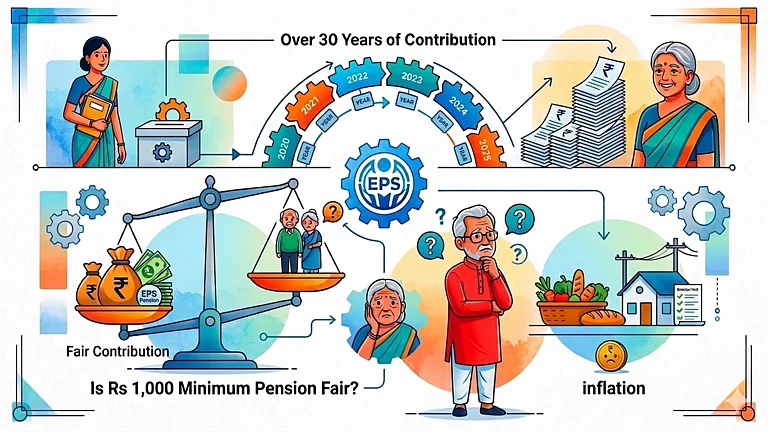
The EPS was launched in 1995, and in 2014, the government set the minimum pension under the scheme at Rs 1,000. However, various employee unions have been voicing their demands to raise the minimum pension (Rs 1,000), as it is inadequate even to meet the basic needs. The question has been raised in the parliament as well by different parliamentarians, and recently, the parliamentary committee has also suggested a review and hike in the minimum pension.
Is EPS Membership Mandatory For All Employees?
Says Das: “If the employee has previously been a member of EPS, the employer will continue deducting EPS contributions, as per the rule: 'Once a member of EPS, always a member of EPS.’ However, for first-time employees, eligibility depends on their salary. If their salary is Rs 15,000 or less, they qualify to become an EPS member. However, prior to September 1, 2014, all employees were enrolled as EPS members by default.”
EPS is not mandatory for those earning more than Rs 15,000.
A lot of confusion comes from people using the word “balance” for EPS. That word works for EPF. It does not fully work for EPS. With EPS, the better way to think is in terms of service record, pension eligibility, scheme certificate, and pensionable salary, says Vaidya.
So, next time, when calculating your pension cash flow, don’t think of the interest or the final EPS corpus. But think about the pensionable salary and the years of work to calculate how much pension you would get under EPS.





