







Summary of this article
The government is considering raising the Employees’ Pension Scheme (EPS) minimum pension, a long-pending demand of unions.
EPS covers workers in PSUs, private firms, and cooperatives, among others.
The pension is calculated based on a formula using pensionable salary and years of service.
The government is contemplating a hike in the minimum pension under the Employees’ Pension Scheme (EPS), a long-held demand by the employees’ unions. EPS is among the three schemes offered by the Employees’ Provident Fund Organisation (EPFO), along with the Employees’ Provident Fund (EPF) and the Employee Deposit-Linked Insurance (EDLI). At present, a minimum of Rs 1,000 is offered under EPS, which was fixed in 2014.
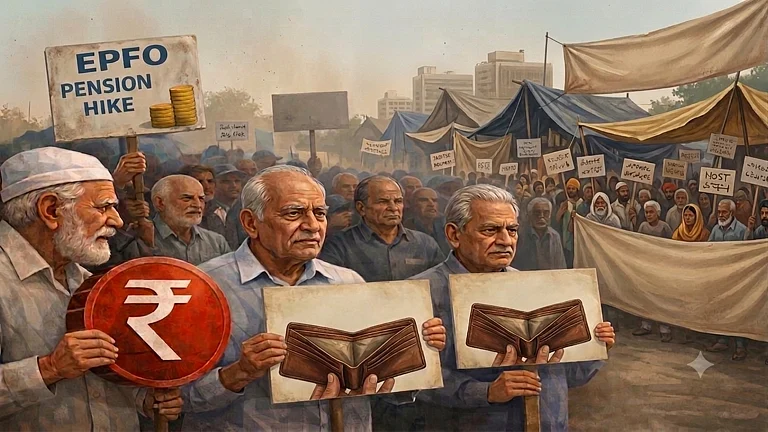
However, due to rising inflation and increasing costs, employee unions have been demanding a hike since long. Reportedly, the labour and employment ministry is now considering raising the minimum pension amount.
When Is One Eligible For EPS
EPS covers employees in public sector undertakings (PSUs) of the central and state governments, private sector companies, and mills and cooperatives, among others. The scheme is mandatory for employees earning up to Rs 15,000 per month and optional for others. Until August 31, 2014, all employees, irrespective of their salary, were enrolled under the scheme, but beyond this date, it is mandatory only for those earning up to Rs 15,000.



To receive an EPS pension, one needs to work in an EPFO-covered organisation for at least 10 years. Upon turning 58 years of age, pension under EPS starts. However, the pension amount is not based on the amount of contribution, but on a formula. In case of the death of the employee, there are provisions of widow pension, children pension, orphan pension, and permanent total disability pension.
Formula And Who Will Benefit?
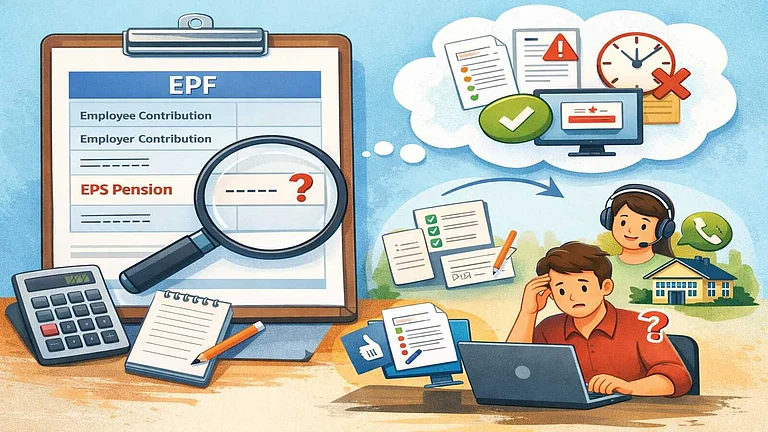
If a person is eligible for EPS, a minimum of Rs 1,000 will be paid to the employee. However, it could be higher based on the pensionable salary and the number of years of service.
The formula to calculate pension under EPS is:
Monthly Pension = (Pensionable Salary × Years of Service) ÷ 70
*Pensionable salary is the average of last 60 month's salary (basic pay + dearness allowance)
Let’s take an example to understand who will benefit from the hike if it is 7.5 times (Rs 7,500) per month.
. If an employee’s pensionable salary is Rs 15,000 (this is the capping) and the number of working years is 10: the monthly pension will be calculated as follows
(Rs 15,000 x 10) ÷ 70 = Rs 2,143
If the number of years increases, the pension increases, too.
. For 20 years of service in the same example, the pension would be Rs 4,286, for 30 years of service, it would be Rs 6,429, and for 35 years it would be Rs 7,500 per month.
Notably, if the government increases the minimum pension to Rs 7,500, anyone who has retired at a monthly pensionable salary of Rs 15,000 after working for 35 years will receive a pension at par with the minimum pension (Rs 7,500), meaning he or she would receive no benefit from the hike.

. Let’s take another example. Let’s say someone has retired at a pensionable salary of Rs 10,000 per month. Then after 35 years of working, the pension as per the formula would be Rs 5,000. In this case, the actual pension would be less than the minimum pension of Rs 7,500. Such an employee would gain Rs 2,500 in case of a hike in pension. So, anyone whose actual pension comes out to be less than Rs 7,500 will stand to gain, whereas those with higher pensions will not benefit.
Higher Contribution To EPS
Someone who had applied for a higher contribution towards EPS will also not gain anything from the hike. For instance, a person earning a Rs 26,250 pensionable salary will have contributed enough in 20 years to receive Rs 7,500—(Rs 26250 x 20) ÷ 70 as pension, and further contributions will only increase the actual pension.
Simply put, the hike in pension will support those whose contribution will be less than the minimum pension or those who worked for fewer years.

Pension Hike Demands And Recommendations
The National Agitation Committee (NAC), representing around 8.10 million pensioners, has been voicing concerns about their meagre pension under EPS and has demanded a hike to Rs 7,500. But, it is not only the employees’ unions and pensioners’ associations who have been asking for a hike.
In December 2018, the High-Empowered Monitoring Committee (HEMC) recommended an increase in the minimum monthly pension, restoration of the commuted value of the pension, linking the pension to the cost-of-living index, among other suggestions. In March 2026, the Parliamentary Standing Committee on Labour, Textiles, and Skill Development also stated that the existing minimum pension is inadequate to meet the basic needs of pensioners.
How Many People Are Getting Pension Under EPS?
According to the government's reply in the Lok Sabha in February 2026, there are around 8.20 million pensioners under EPS, of which around 4.70 million are getting a pension of less than Rs 9,000 per month. However, according to the NAC, the situation is worse, as pensioners are getting an average monthly pension of Rs 1,171, despite contributing for 30 years.





