







Summary of this article
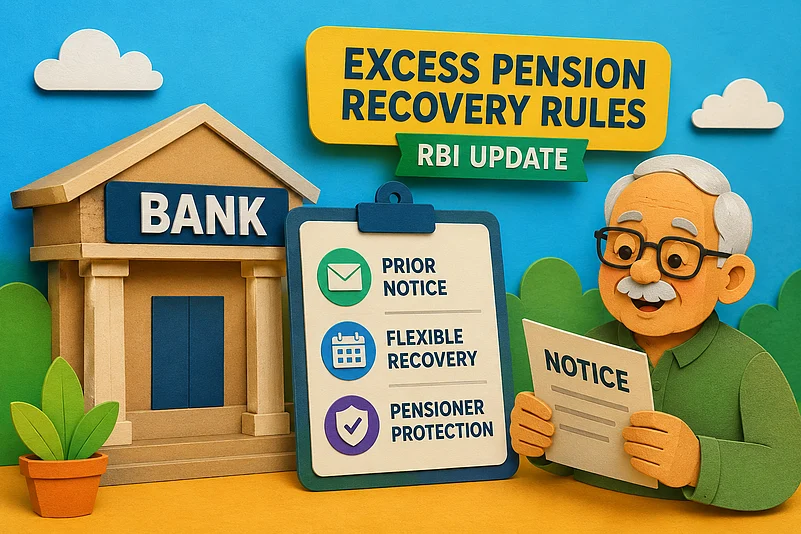
Banks must give notice before recovering excess pension payments.
Pensioners can choose instalments or other repayment methods.
Recovery rules now include safeguards and defined timelines.
The Reserve Bank of India (RBI) has amended its directions on the disbursement of government pensions. The central bank has also introduced safeguards for pensioners when banks seek to recover excess or wrongful pension payments.

These updates, issued on June 24, 2026, amend RBI's previous directions on pension disbursement that came into effect on April 30, 2026.
Banks To Issue Notices Before Recovery
Banks now must give notice to the pensioner before carrying out the recovery process of excess pensions. Recovery cannot be conducted without a government pensioner's explicit knowledge and consent.
The RBI has stated that any recovery must comply with applicable service rules and legal principles. Banks may also obtain a letter of undertaking from pensioners stating that any excess pension credited to their account will be refunded upon receiving a suitable notice from the bank.
The amendment also lays down a detailed procedure that banks must follow when excess pension payments arise because of errors attributable to the bank.
Rules For Bank-Attributed Errors
According to RBI, when excess or wrongful pension payments occur due to clerical mistakes, calculation errors or incorrect application of instructions by a bank, the entire excess amount must be credited back to the government account immediately after the error is detected.
Banks have also been directed to establish a board-approved policy for recovering such payments. The policy must include a cut-off period beyond which recovery will not be pursued and should be supported by operating procedures and monitoring mechanisms.
The RBI has noted that pensioners must be informed in writing as soon as an excess payment is identified. The notice should contain details of the excess amount, the nature of the error, the proposed recovery method and an opportunity for the pensioner to make a representation.
Multiple Recovery Options Allowed
The new framework provides different methods through which banks can recover excess pension payments.
One option allows recovery from the surplus balance available in the account while protecting a minimum amount. The other one allows deductions from monthly pension payments, subject to an agreed percentage limit (10-25 per cent). Pensioners can also choose to repay the amount through a lump-sum payment or customised instalments.
The central bank has clarified that recovery should not be initiated after the defined cut-off period, unless fraud or misrepresentation by the pensioner is established, or recovery is required under a law or court order.
Recovery In Case Of Errors By The Government
The directions also considered cases where excess pension payments have been disbursed due to errors attributable to the government.
In such situations, banks will recover the amount based on instructions received from the concerned government authority. The RBI stated that banks may presume that the government has complied with all legal requirements, including court orders, before issuing such instructions.
However, if recovery is proposed from the pensioner's account balance instead of future pension payments, banks must have the customer's express authorisation and retain the record.
The amended directions came into effect immediately from the date of issuance and are applicable to all agency banks responsible for disbursing government pensions.





