




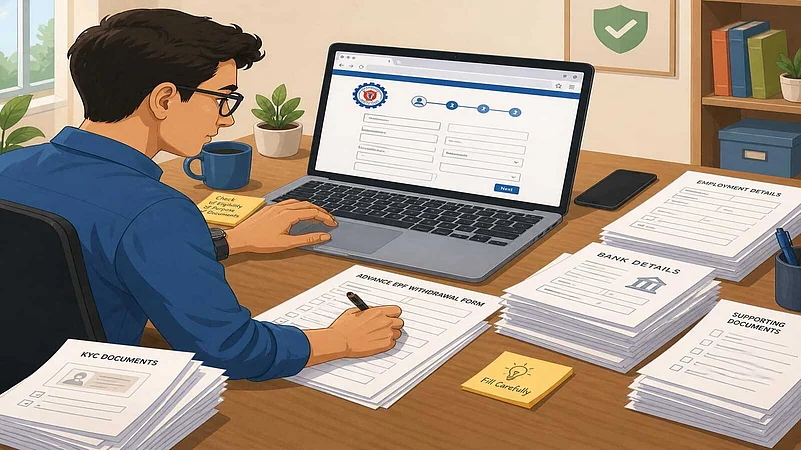


Summary of this article
TDS on EPF withdrawal applies when withdrawals are more than Rs 50,000, made before five years of service, or when PAN is missing or mismatched.
The new unified self-declaration Form 121, is a tool to get TDS exemption, subject to conditions.
Subscribers need to be careful when filing the form to avoid rejection.
The Employees’ Provident Fund Organisation (EPFO) offers an advance withdrawal facility for certain reasons, such as medical emergencies, job loss, or other such exigencies. While EPFO savings are meant for the social security of its subscribers after retirement, the advance withdrawal is to safeguard them against urgent needs. However, subscribers need to be careful while withdrawing money regarding the tax deducted at source (TDS). TDS is deducted under three circumstances: on a withdrawal of more than Rs 50,000, withdrawal before completing five years of service, or when PAN details are missing or do not match. The result is a lower amount in hand after withdrawal.

Let's check it in detail:




When Is TDS Deducted On EPF Withdrawal?
CA Ashish Niraj, Partner, A S N & Company, clarifies, “If EPF is withdrawn after 5 years of continuous employment, no TDS is deducted. If EPF is withdrawn within 5 years, 10 per cent TDS is required to be deducted where the aggregate amount of such payment is Rs 50,000 or more. Also, if you fail to provide PAN, then TDS is 30 per cent plus surcharge as applicable.”
However, it can be avoided when the subscriber does not fall in the taxable category.
For that, a self-declaration needs to be provided by the subscribers, confirming that their total income for the financial year is less than the taxable threshold, and thus, they should be exempted from TDS deduction. Earlier, this declaration could be given through Form 15 (for the general public) and Form H (for senior citizens). Effective April 1, 2026, with the implementation of the Income-tax Act, 2025, these forms have been replaced with one unified form, ‘Form 121’ for all people irrespective of their age.
The new form simplifies the process and is expected to result in faster validation and fewer rejections of EPF withdrawal requests.
What Is Form 121, And How To Fill It?
Form 121 serves as a formal self-declaration for subscribers to submit to the EPFO, requesting no TDS deduction from the withdrawal due to the total income falling below the taxable threshold. The form has two distinct sections: Part A and Part B.
Part A must be filled by the EPF subscriber, where the subscriber needs to provide personal details, such as PAN, estimated annual income, and a declaration of zero tax liability. While filing this section, the subscriber needs to fill in all the details accurately to avoid rejection.
Note that the new form has made the process easier, but the compliance has been made stricter. Wrong or mismatched information will result in invalidation of the Form.
Part B of the Form is for EPFO. It assigns a Unique Identification Number (UIN) to every Form 121 received, and then it compiles the declaration every month and uploads it to the Income Tax Department’s website.
Who Should File Form 121 EPFO?
“If your income is below the taxable limit, then NO TDS will be deducted by EPFO if you submit the self-declaration Form 121,” says Niraj.
In certain cases, there will also be no TDS even if EPF is withdrawn within five years, and an employee is terminated because of ill health, business closure of the employer, or any reason beyond the employee's control, he adds.

What Should Subscribers Do To Avoid TDS On EPF Withdrawal?
To protect immediate liquidity, subscribers need to avoid TDS deduction. Because once deducted, these can only be recovered through a tax refund after filing an income tax return (ITR).
Niraj says, “To avoid TDS, you should transfer the EPF Balance to the new employer's account, instead of withdrawing it. It maintains service continuity. In case of an emergency, try to withdraw an amount below Rs 50,000 to avoid TDS. Also, as TDS is not deducted after five years, try to defer withdrawal until five years are completed.”
However, if withdrawal is necessary, utilise the TDS exemption rule as per the provision. Fill Form 121 timely; ensure that the PAN, Aadhaar, and KYC details are accurately filled, and match the EPFO records. Further, submit a physically signed form or upload a scanned copy of Form 121, as the process is not yet fully digitised. Be attentive, submit the form before making a withdrawal, and preferably at the beginning of a financial year.





