

Summary of this article
In mutual funds, capital gains are classified according to their holding period.
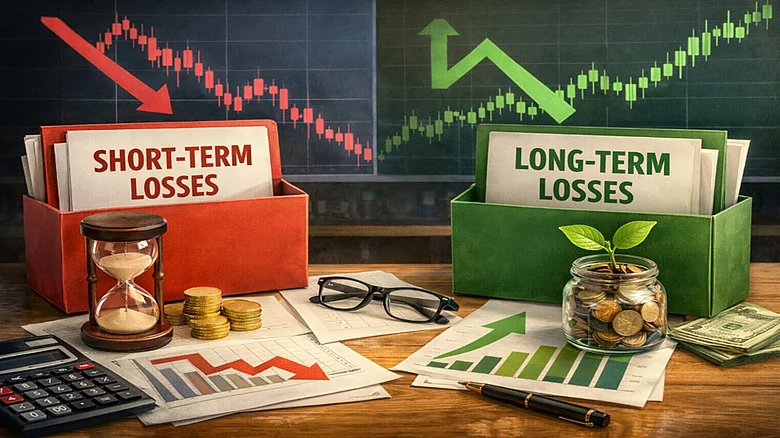
Short-term capital loss (STCL) is much more flexible than long-term capital loss (LTCL), because STCL can be set-off against both short-term capital gain (STCG) and long-term capital gain (LTGC).
Many funds impose exit loads, especially within the first year. When booking short-term losses, a high exit load can offset or completely negate the benefit.
Tax-loss harvesting has become a popular technique for enhancing after-tax returns. While investors can benefit from booking losses to offset realised gains, the tax benefit depends on how the loss is classified for tax purposes as short-term or long-term capital loss.
In mutual funds, capital gains are classified according to their holding period. In the case of equity mutual funds, capital gains/losses that are within 12 months are classified as short-term, and capital gains/losses beyond 12 months are classified as long-term.
Short-term capital loss (STCL) is much more flexible than long-term capital loss (LTCL), because STCL can be set-off against both short-term capital gain (STCG) and long-term capital gain (LTGC). This makes STCL very valuable due to its versatility. LTCL, on the other hand, can only be adjusted against LTGC, which makes it have less versatility in comparison to STCL.

“As an investor, it is important to understand how transactions work. Generally, mutual fund redemptions follow the FIFO (First In, First Out) method. This means that the earliest units you purchased are sold first. Therefore, even if you have recently purchased units with a loss, if the first units purchased were profitable, you are likely to realise a profit rather than a loss, undermining the intention of tax loss harvesting,” says Rajani Tandale, Senior Vice President, Mutual Fund at 1 Finance.
Another important factor is the exit load. Many funds impose exit loads, especially within the first year. When booking short-term losses, a high exit load can offset or completely negate the benefit. Always compare the potential tax savings with the cost of exiting.
Identifying whether units are short-term or long-term isn’t always simple, more so in SIPs, where investments occur periodically at different prices. Therefore, tracking and executing on your investments can be problematic. So, it is generally a good idea to consult a professional for help to avoid making errors.
Also, any capital loss will not be offset against your normal income but may be carried forward for up to 8 years if properly declared.
“Finally, tax-loss harvesting for your mutual funds should not be done in isolation; rather, it should be done in conjunction with the goals of rebalancing your investment portfolio, consolidation, or enhancing the quality of your funds,” says Tandale.
So, tax-loss harvesting will work best when there is a defined strategy and consideration given to balancing tax efficiencies, seniority, and investment quality in the long run.