The Finsafe India report finds that Indian employees are investing more in markets, but many still lack basic preparedness and financial knowledge.
Job-loss anxiety is rising, with 55 per cent saying they are unprepared for expenses if they lose their job.
The report recommends that employers move beyond awareness campaigns and provide personalised financial learning on debt, insurance, and retirement to the employees.
Invest First, Learn Later Phenomenon Growing, 55 Per Cent Of Employees Unprepared For Job Loss Expenses: Report
Indian workforce participation in financial markets has grown more than their actual preparedness in terms of their understanding of markets, investments, the significance of emergency funds, and so on, and it can severely impact their financial resilience

Summary
Advertisement
Indians’ investment participation is rising faster than their preparedness, reveals the newly released report titled 'State of Financial Wellbeing at the Workplace’ for FY 2025–26, conducted by Finsafe India. The report reveals a disconnect between the financial actions and the actual preparedness of Indian employees. It highlights the investor paradox, where professionals are more aware of and eager to participate in financial markets than in previous years, yet in many cases lack an understanding of the market.
Optimism Bias
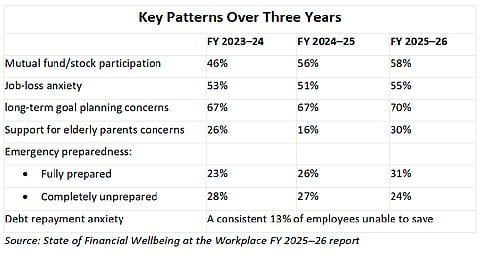
The report finds that 58 per cent of employees are actively investing in mutual funds or stocks, but 37 per cent admit that they are unsure about where to invest their money. This reflects that modern-day employees are aspiring to grow wealth and want to learn more about it, but at the same time are concerned about managing debt and family responsibilities.
They are alarmingly interested in trendy investments, like cryptocurrency. According to the data, interest in cryptocurrency has jumped from 42 per cent last year to 52 per cent this year. This ‘optimism bias’ is making them chase these risky fads without building a foundation. The report highlights the growth of the “invest first, learn later” phenomenon among employees.
Advertisement
The report notes that this behaviour is validated by the Securities and Exchange Board of India (SEBI) data as well, which found that 71 per cent of individual intraday traders booked a net loss in FY2022-23 despite a surge in participation.

Financial Anxieties
The report notes significant financial anxieties regarding job security and family obligations. Job-loss anxiety remains high, with 55 per cent of employees reporting that they are unprepared for expenses in case of job loss. This number has increased by 4 per cent from last year’s 51 per cent. For these people, the loss of a job is not a mere individual event, but has a cascading risk.
The sandwich generation, which is facing the challenge of supporting their elderly parents, has grown to 30 per cent from 16 per cent the previous year. The long-term goals, like children's education and retirement planning, remain the top concerns for 70 per cent of the workforce. These responsibilities often leave many professionals vulnerable, the report underscores.
Advertisement
Gap In Financial Resilience
Emergency resilience emerges as a significant gap in the Indian workplace. Only 31 per cent of employees are ‘fully prepared’ with adequate insurance coverage and an emergency fund. Around 45 per cent of the workforce relies only on employer-provided health insurance, leaving them vulnerable to healthcare expenses in case of no job. The report also warns that these flat-sum group insurance policies are usually inadequate for serious illnesses, especially when medical inflation hovers around 12-14 per cent annually. Notably, one-fourth of the workforce remains completely unprepared for any financial shock.
Saving behaviours reflect a sharp contrast among employees. The findings show that “Progress exists. It is simply not shared equally”. As per the data, high savers (those who save over 40 per cent of their income) have grown from 19 per cent to 24 per cent. At the same time, 13 per cent of employees remain unable to save anything at all due to their loans. This 13 per cent has remained unchanged for three consecutive years, which means that the standard awareness campaigns are failing to reach people trapped in debt cycles.
Advertisement
Recommendations
The report brings to notice a consistent pattern that emerged from the responses, that ‘investing participation continues to outpace preparedness’.
To address this, the report recommends that employers move beyond simple awareness sessions and focus on building employees’ actual financial capability. It suggests that organisations should act as a trusted source of financial information by providing structured, personalised learning journeys that can help employees build a stable financial foundation before they chase growth.
They need to address the specific needs of different age groups of employees, such as debt management for early-career employees and elder care for mid-career employees. This is how organisations can create a more productive and resilient workforce.

The report points out that the Indian workforce is financially active and ambitious, but it is still building its foundations for future goals. Thus, the challenge lies in closing the gap between their participation in the financial market and actual preparedness for their future well-being.
Advertisement
The study has been conducted annually since 2023-24. This year’s study collected responses from over 4,500 (4,532) working professionals across India. The demography included a diverse range of employees, including early- and mid-career, who seek to balance their cash flow, to advanced investors interested in estate planning, and tracked their market participation and financial security.
Show comments
Published At: