Time, health, and peace are life's true valuable currencies.
Corporate life teaches patience, humour, and strategic communication skills.
Plan wisely, invest smartly, balance family, finance, and ageing.
Time, Health, And Peace Are The Real Currencies In Life, Says Author And TEDx Speaker Punit Pania
Using humour and personal stories, author, TEDx speaker and founder, Punit Pania reflected on career, finance and planning for life after 40

Summary
Advertisement
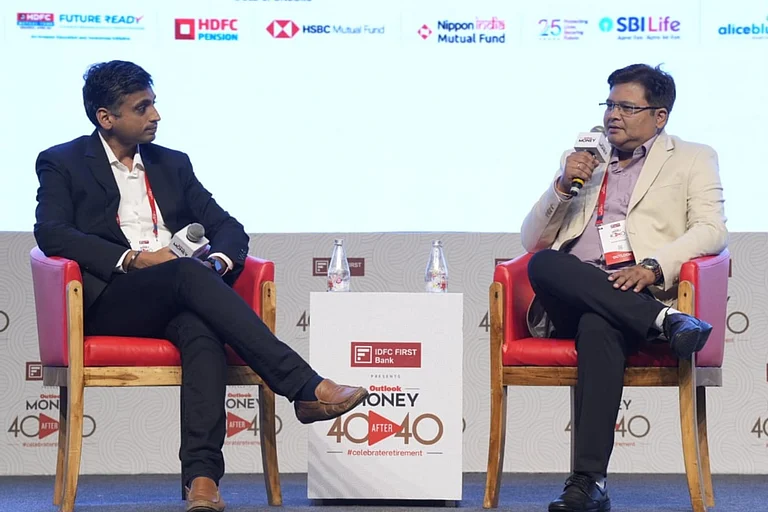
Author, TEDx speaker and founder, Punit Pania, addressed the audience at the Outlook Money 40After40 Retirement Expo in Mumbai, sharing insights on life, investments, and personal philosophy. Using humour and storytelling, he engaged attendees with reflections on career, property, family, and planning for the future.
Pania highlighted the ironies of adulthood and corporate life through humour to explore life and finance. He said, “Comedy comes from tragedy,” pointing to everyday absurdities, like paying 30 per cent tax to see roads built at right angles. He asked the audience who all were married and had children, and quipped: “That means you have real jobs. Because kids are expensive.”

Corporate Lessons
Drawing from his own corporate experience, he shared how the phrase “I will get back to you” becomes the magic answer to almost every question at work. Through anecdotes on office jargon, HR meetings, and early investments, he blended comedy with reflections on planning for the future that made the session both entertaining and thought-provoking for a 40+ audience.
Advertisement
Turning to corporate life, Pania shared his own experiences. “I used to work for a company I can’t mention for legal reasons. And after eight years in corporate life, I realised there is one right answer to every question in corporate life. I’ll get back to you.” He illustrated how this phrase becomes a catch-all solution, advising even for personal life not to rush into conflict.
He also took a dig at office jargon and HR protocols, remarking, “Seven long years I work, but I still don’t know what smart casuals means. A mystery for me even today.” On passive-aggressive communication, he observed, “People don’t even talk directly anymore. They just send gentle reminders. Passive aggressive. Very passive aggressive.” He added, “Let’s take this offline,” illustrating how even simple communication has become an art of euphemism in corporate life.
Pania reflected on his early career. “My first job was in a call centre and I didn’t even need the job.” He humorously noted his quick firing and added, “Then I learned that true MBA is when you join LinkedIn, isn’t it?” He also joked about professional networking, asking, “How is LinkedIn more fake than Instagram? Mercy without the filters.”
Advertisement
First Property Purchase
When discussing investments, Pania recounted his first property purchase: “My very first investment was directly a flat.”
He described buying in an upcoming area in Ahmedabad, navigating family approvals, and eventually selling the property years later. “Every city has an upcoming area. So I bought into the scheme. But we stayed in that flat for only one year. We didn’t put it up for rent either. So finally I let go of it last year.”
Ageing and Life Lessons
Family, ageing, and life lessons were central to his talk. Reflecting on witnessing old age firsthand and his personal experiences with family loss, he said, “Time is linear, but old age is contagious. Bua survived through miraculous overnight recovery, and I have to go through at least three funerals. At the end of the third funeral, I will come back to an empty apartment. It is sad, but at least then I will finally get a room for myself,” he said, blending reality with dark humour.
Advertisement
“The way I live my life is that I want to go bankrupt on the day I die, not even before it. Let even a funeral be the state expenditure. No more GST,” he said.
Planning for a Rainy Day
He said one also “needs to plan for a rainy day and even beyond that”.
He explained how he balanced frugal living with planning, adding, “there are only three real currencies in life, time, health, and peace.” He encouraged prioritising these over material accumulation. “If you can spend some money to buy any of these things, it is great, but most of us do the opposite,” he added.
Turning to practical lessons, Pania reflected on Mumbai life and expenses, “Until recently we were a family of four people. Our bua used to stay with us. The average age of my house was 70 years.” On witnessing family resilience, he added, “When people are that old in the house, death is not the elephant in the room. It is the wallpaper.”
Advertisement
On parental responsibilities, he reflected, “With both my parents in their 70s, we run a very risky enterprise because we do not have insurance. And I only wish that.”
Childhood Lessons for Life
Pania also shared observations on childhood and education. “Let the education system fail you. Let the job market fail you. You get a couple of divorces maybe, or at least one failed start-up. At least one thing to show on your CV,” he said.
On cultural habits, he quipped: “Gujus know they cannot participate in any activity which is not profitable immediately. Genetically incapable. Oh, you don’t do weight training. Ball Pepper. 90 boxing.
Reflecting on life priorities, he noted, “Even to spend money you need creativity. If you earn four times what you are earning today, you can finally get a business class ticket. Flight delay. You save money for years. You finally buy a bigger car. Then you get stuck in the same traffic.”
Advertisement
On family planning, he added, “Beautiful people will plan a vacation months in advance. They transport the entire family to Nanita. You need creativity, you know.”
Finally, closing on a personal note, he shared his reflections on mortality and meaning: “When I open a new bank account, I do investment. They ask you for nominee details. Makes no sense because she’s 70, she survived cancer already.” On the ultimate takeaway from life, he said, “There are only three real currencies in life, time, health and peace. If you can spend some money to buy any of these things it is great.”
Show comments
Published At: