Summary of this article
Government clarifies UPI MDR is not a new tax.
Eligible merchant payments above Rs 2,000 will attract MDR.
Customers and small merchants remain protected from additional charges.
The central government has clarified that the new Merchant Discount Rate (MDR) on selected Unified Payments Interface (UPI) transactions is not a tax, cess or surcharge. The clarification comes after the Centre introduced a new framework for charges on specified merchant payments above Rs 2,000.
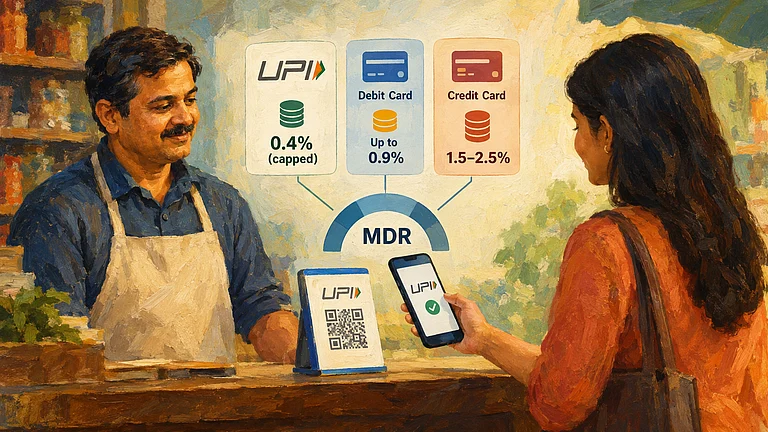
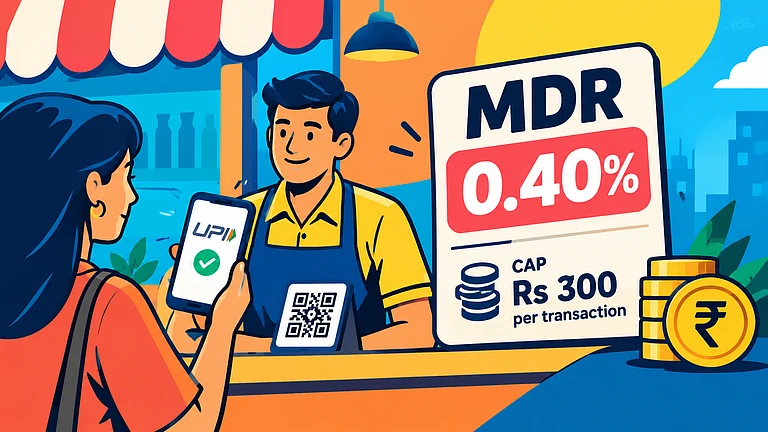
Under the framework, a 0.4 per cent MDR will apply to eligible Person-to-Merchant (P2M) transactions above Rs 2,000. The charge will be capped at Rs 300 for transactions of Rs 75,000 and above.

Centre Sets Out New UPI Payment Framework
Person-to-Person (P2P) UPI transactions will not attract any charge, irrespective of the amount transferred. Merchant payments of up to Rs 2,000 will also have zero MDR under the new framework.
The government has estimated that around 96 per cent of P2M transactions will not be affected. The charge will apply to only specified merchant transactions above the Rs 2,000 threshold.
Essential sectors such as railways, telecommunications, insurance, fuel and agricultural inputs will attract a flat MDR of Rs 5 on eligible transactions above Rs 2,000. Payments related to mutual funds (MFs), securities, stockbrokers and dealers will have a separate MDR of 0.02 per cent, capped at Rs 300 per transaction.
MDR Will Stay Within The Payment Ecosystem
The government has clarified that MDR is a payment-processing charge and not money collected by the Centre or the National Payments Corporation of India (NPCI) as tax revenue. The amount will instead be distributed among participants involved in processing UPI payments.
For eligible transactions, the money will be shared among banks, Payment Service Providers (PSPs), payment application providers and other participants in the UPI ecosystem. It will not be credited to the Consolidated Fund of India.
Customers Will Not Bear The New Charge
The MDR applies on the merchant side of eligible transactions. Banks have been advised to ensure that merchants do not pass the charge on to customers, while UPI application providers have been prohibited from imposing platform fees or hidden charges.
For example, on a Rs 5,000 eligible merchant payment, a 0.4 per cent MDR would work out to Rs 20. The customer's purchase price does not change because of this charge.
Government Links MDR To UPI's Growing Scale
The Centre has linked the new framework to the scale of India's digital payment network and the need for a sustainable model to support its infrastructure.
NPCI data shows that UPI processed 24,508.96 million transactions worth Rs 29.82 lakh crore in August 2026. The government has also highlighted the need to support the operation and expansion of the payment system.
Small Merchants Get Zero-MDR Protection
Small merchants receiving up to Rs 1 lakh a month through UPI QR codes under the Person-to-Person-Merchant (P2PM) category will have zero MDR on their transactions. This includes street vendors, neighbourhood shops and other small businesses covered by the framework.
The government has also kept these transactions outside the MDR structure to protect smaller businesses from additional payment costs. Five per cent of MDR collections will be directed towards a fund for expanding UPI acceptance among small merchants.