






Summary of this article
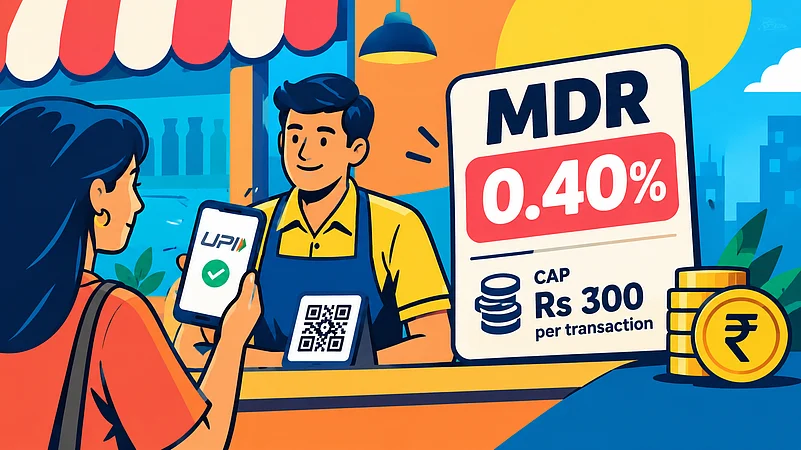
UPI will charge 0.40 per cent on eligible payments above Rs 2,000.
The MDR will be capped at Rs 300 per transaction.
Fuel, telecom, insurance and rail payments will have Rs 5 MDR.
The Unified Payments Interface (UPI) Steering Committee has fixed the merchant discount rate (MDR) at 0.40 per cent for merchant transactions above Rs 2,000. The new charges will come into effect from October 15, 2026.
The move creates a new revenue stream for banks, payment service providers and other players in the UPI ecosystem. At the same time, transactions up to Rs 2,000 will not attract charges, keeping small-value UPI payments outside the new MDR framework.

MDR Capped At Rs 300 Per Transaction
The MDR will be calculated at 0.40 per cent of the transaction value, with a maximum charge of Rs 300 per transaction. This means a payment of Rs 2,000 would attract Rs 8, while a payment of Rs 10,000 would attract Rs 40.
The Rs 300 ceiling will be reached at a transaction value of Rs 75,000. Any payment above Rs 75,000 will also have an MDR of Rs 300.
MDR is the fee paid by merchants to payment ecosystem participants for processing digital transactions. The charges apply to eligible merchant payments, rather than person-to-person (P2P) transfers.
Kunal Jhunjhunwala, founder, Airpay, highlighted the challenge for merchants as the new system takes effect. “For merchants, the immediate impact will be the 0.40 per cent MDR on P2M transactions above Rs 2,000. Larger businesses will likely absorb this with little friction, but for merchants operating on tight margins, even a small percentage can change how they think about accepting digital payments.”
He added: “The bigger challenge, though, is the timing. Fintechs now have roughly a month to explain the new cost to merchants, help them get comfortable with it, and make the backend changes needed to support it.”
Adhil Shetty, CEO, BankBazaar, and Chairman, FICCI Fintech Committee, noted that while transactions above Rs 2,000 accounted for only 4 per cent of P2M UPI payments by volume in 2025-26, these made up around two-thirds of UPI payments by value. “A fee here could impact higher-ticket merchant categories, while keeping the majority of daily low-value retail transactions completely free.”
He added: “MDR on larger UPI transactions could give fintechs a new revenue stream, but it may not cover everything since smaller transactions stay free, so it may not be enough on its own. Profitability could also depend on fintechs building other revenue lines, like credit and merchant services, on top of this.”
Telecom, Fuel And Insurance Get Special Rate
The new framework includes exemptions for certain categories. Telecom, railways, fuel, and insurance transactions will attract a flat MDR of Rs 5 per transaction instead of the 0.40 per cent rate.
Capital market transactions will have a much lower MDR of 0.02 per cent, given the typically higher value of such payments.
The government notification also specifies that banks cannot impose charges on UPI transactions up to Rs 2,000 or payments made through RuPay-powered debit cards.
How The MDR Revenue Will Be Shared
The MDR revenue will be distributed among account issuing banks, beneficiary banks, consumer-side PSP banks, merchant acquiring payment aggregators and the National Payments Corporation of India (NPCI).
UPI apps such as PhonePe, Google Pay and Paytm work with banks known as PSP banks to connect users and merchants to the UPI network. Large PSP banks include SBI, HDFC Bank, ICICI Bank, Axis Bank, and Yes Bank.
At a 40 basis points (bps) MDR, the ecosystem could generate up to Rs 16,000 crore in annual revenue.
Satyadarshi Kunal, partner, CMS INDUSLAW, described the framework as a shift in the regulatory structure for UPI. “The notification marks an important shift in the regulatory architecture for UPI. While consumers and person-to-person transactions remain insulated from charges, the framework now creates regulatory space for the introduction of MDR on certain higher-value merchant transactions,” he added.



The introduction of MDR will apply primarily to eligible higher-value merchant payments, while small-value transactions continue to remain insulated from charges.





