



By Viral Bhatt, Founder, Money Mantra
The EMI That Feels Fine — Until It Isn't
Ramesh is 38. He earns Rs 1.5 lakh a month. He owns a flat (home loan Rs 42,000/month), drives a good car (Rs 18,000/month), upgraded his phone on a consumer durable loan (Rs 3,500/month), and recently took a personal loan for his daughter's school admission fees (Rs 12,000/month).
Total EMI outgo: Rs 75,500 per month — 50.3 per cent of his income.
On paper, Ramesh looks successful. In reality, he is one salary disruption away from financial collapse.
This is not an extreme case. This is India's new middle-class normal.
The 40 per cent Rule — And Why Most Indians Are Breaking It
Financial planners use a simple benchmark: your total EMI obligations should never exceed 40 per cent of your net monthly income. Beyond that threshold, your ability to save, invest, build an emergency fund, and absorb life's surprises collapses rapidly.


Most people who come to financial advisors in distress are sitting between 50–70 per cent EMI-to-income ratio. They haven't made one catastrophic decision — they've made five reasonable-looking ones.
How Loans Stack Up — And Compound Against You
Here is a comparison of how Rs 10 lakh borrowed across different loan types actually costs you over the full tenure:
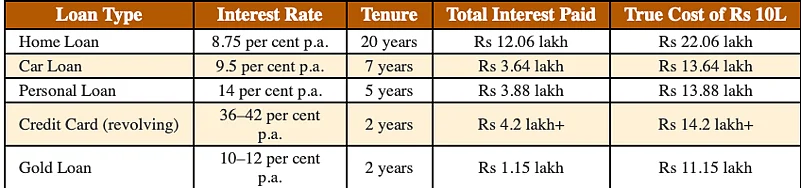
The trap is not any single loan — it is the layering. A home loan is rational. A home loan plus a car loan plus a personal loan plus a credit card rollover is a debt spiral.
The Invisible Cost: What You Stop Building
This is the number most people never calculate — the investment wealth destroyed by excess EMI. Assume two people, both earning Rs 1 lakh/month:

Person B didn't lose money — he just borrowed his future and spent it on today.
India's average household savings rate has declined from ~23 per cent of GDP in 2012 to approximately 18 per cent in recent years, and consumer credit growth has consistently outpaced income growth over the same period.
The Danger Signals Most People Miss
You are in a loan trap if:
Your EMI-to-income ratio exceeds 40 per cent — and has for more than 6 months
You are using one loan to repay another — including credit card minimum payments
You have no liquid emergency fund (3–6 months of expenses in an FD or liquid fund)
Your savings rate has dropped below 10 per cent — the bare minimum for long-term stability
Your net worth is negative — your liabilities exceed your assets
How Much Loan Is Actually Okay? A Simple Framework
Not all debt is bad. Here is how to think about it:
Good Debt
Creates an asset or income, rate is manageable — Home loan (asset appreciation + tax benefit), Education loan (skill building), Business loan (if ROI > interest rate).
Neutral Debt
Depreciating asset, but sometimes necessary — Car loan (keep tenure short), Two-wheeler loan for daily commute.
Dangerous Debt
No asset created, high interest, lifestyle funded by borrowing — Personal loans for vacations/weddings/gadgets, Credit card revolving balance, Buy Now Pay Later for discretionary spending.
The rule of thumb: If the loan is not building an asset or productive capacity, question it hard before signing.
A Recovery Roadmap: Getting Out When You're In Deep
If you are already over-leveraged, here is the sequence that works:
Stop the Bleeding
Close all credit card revolving balances first. At 36–42 per cent interest, nothing else makes financial sense until this is cleared. Even breaking an FD to close a credit card balance is rational.
Avalanche Method for Remaining Loans
List all loans by interest rate, highest first. Pay minimums on all, but throw every extra rupee at the highest-rate loan. The sequence typically is: Personal Loan → Car Loan → Home Loan.
Build a Rs 1 Lakh Emergency Buffer First
Even Rs 1 lakh in a liquid fund prevents the next crisis from becoming another loan.
Redirect EMI Savings to SIP
Once high-cost debt is cleared, redirect that same EMI amount to wealth creation. The habit of paying an EMI is already built in.
No New Non-Asset Debt for 24 Months
Recovery requires a hard reset on spending behaviour, not just math.
The Real Story of Recovery — In Numbers
Back to Ramesh. At 38, with Rs 75,500 in EMIs, he has very little financial flexibility. But over 4 years, with focused prepayment and no new loans:
Year 1: Clears personal loan → Rs 12,000 EMI freed
Year 2: Clears car loan → Rs 18,000 EMI freed (car is 5 years old anyway)
Year 3–4: Redirects Rs 30,000/month to SIP + prepays home loan
By age 42, his EMI-to-income ratio drops to 28 per cent, his SIP corpus begins to build, and he has a 6-month emergency fund. Same income. Completely different financial life.
The difference is not earning more. It is stopping the drain.
Final Thought
India's economic ambition is real. So is its credit access. Banks will lend. Apps will offer instant credit. The question is not whether you can borrow — it is whether you should.
Every EMI you pay is income you have already spent. Every SIP you do is income you are investing in your future. The ratio between these two numbers will determine your financial future more than your salary increment ever will.
Borrow with intention. Repay with urgency. Invest without fail.
(Disclaimer: Views expressed are the author’s own, and Outlook Money does not necessarily subscribe to them. Outlook Money shall not be responsible for any damage caused to any person/organisation directly or indirectly.)





