

Summary of this article
Traffic challans currently do not influence car insurance premium calculations.
Insurers rely on claims history, vehicle details, IDV, and location for pricing.
Irdai has not mandated challan-linked motor insurance premium rules yet.
Usage-based insurance may soon include driving behaviour and challan frequency.
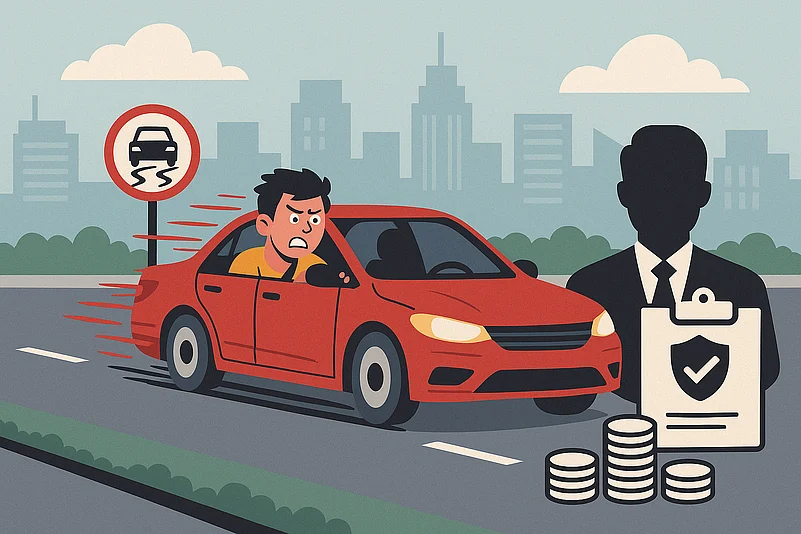
Let us say that there is a driver who is careful and rarely violates traffic laws. And there is another driver who is rash and has many traffic challans against his vehicle. Does the person who has more challans pay a higher premium on his car insurance?
If someone keeps getting challans for rash driving, speeding, signal jumping, or not wearing a helmet/seatbelt, it clearly shows risky behaviour. Risky behaviour usually means higher chances of accidents, which can lead to higher claims. When you get a challan, it gets recorded in your driving history. You can visit here, check your challans, and make a payment online.
“But here’s the important part. As of today, most Indian insurers are not using your e-challan history to decide premiums. So repeated challans suggest high-risk behaviour, but they don’t automatically raise your premium right now,” says Kunal Varma, founder and CEO, Freo.
Irdai Hasn’t Linked Pricing To Challans
The Insurance Regulatory Development Authority of India (Irdai) has not yet made traffic-violation–based pricing a standard practice.
A few insurers experimented with it earlier through the Irdai sandbox, but widespread adoption hasn’t happened.
“So when you renew your policy today, your insurer looks at your previous claims, your car’s age/model, your location, your insured declared value (IDV), but not your e-challans. No insurer will increase your premium solely because you have e-challans today,” says Varma.
Driving Behaviour May Soon Decide What You Pay
However, this may change going ahead. India is slowly moving towards usage-based insurance, powered by telematics and shared data. As this becomes mainstream, insurers will want a more detailed picture of how safely you drive. This could include your braking and acceleration patterns, how much you drive, where you drive, and how often you receive traffic challans.
In such a system, a clean challan record will work in your favour. “Think of it this way- low-risk drivers will get rewarded with lower premiums; high-risk drivers will pay slightly more. A clean record could become as valuable as a No-Claim Bonus (NCB). We’re not fully there yet, but India is clearly moving in that direction,” says Varma.
In short, today, e-challans do not affect premiums. However, as data-based pricing grows, they probably will. A clean record could mean cheaper insurance.