

Summary of this article
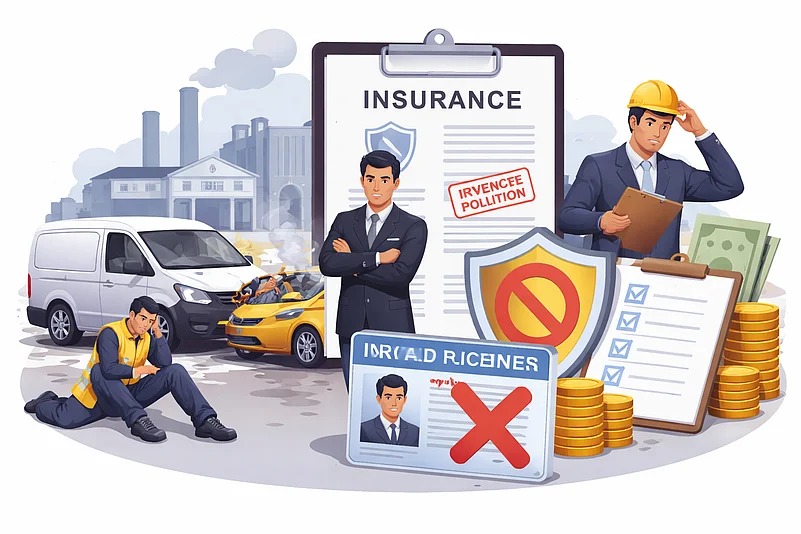
Karnataka HC held the insurer not liable when the driver lacked a valid licence.
Employers must verify licence validity continuously, not just at hiring.
Breach of policy conditions can shift accident compensation to the employer.
Ruling reinforces underwriting norms on compliance and liability.
The Karnataka High Court has held that an insurer cannot be compelled to pay compensation for an accident involving an employee if the employer failed to ensure that the driver possessed a valid licence at the time of the incident, according to a recent report by The Indian Express.
The ruling arose from a tragic school bus accident in Mangaluru in 2008, when the vehicle plunged into the Phalguni river during a spell of heavy rain. Several schoolchildren were killed in the mishap, and the driver also died. The legal dispute that followed was less about the facts of the accident and more about who would bear financial responsibility for compensation under the Workmen’s Compensation Act.
Court Examines Employer’s Duty Of Care
The Commissioner for Employees Compensation had earlier directed the management of the school to pay more than five lakh rupees with interest to the family of the deceased driver. The Commissioner’s reasoning turned on a crucial detail: the driver’s licence had expired approximately two months before the fatal incident. That lapse, though administrative, altered the insurance calculus.

1 January 2026
Get the latest issue of Outlook Money

When the school management appealed, the High Court took a close look at the insurance policy and its conditions. The bench noted that the policy expressly required that any person driving the vehicle must hold a valid licence. Without that condition being satisfied, the insurer could not be dragged in at the compensation stage. The Court also referred to earlier Supreme Court decisions that treat licence verification as an employer obligation, not an optional box-tick.
Implications Beyond The Case
The decision lands at a time when schools and companies often treat insurance as a catch-all in transport accidents. The Court’s view shifts the spotlight back on employers, who must now keep closer tabs on licence renewals and paperwork rather than assuming a one-time check at hiring will do.
Insurers, for their part, are likely to view the ruling as validation of long-standing underwriting norms. Policies are priced on the assumption that certain conditions—licences, fitness certificates, permits—are in order. When those conditions are breached, the risk shifts. The High Court’s view reinforces that breach of a fundamental term is not a technicality but a legitimate ground for declining liability.
What the ruling also exposes is a gap in routine compliance practices. Employers often assume that once a licence is checked at induction, the matter is settled. The Mangaluru case suggests otherwise. A lapse, even a short one, can leave the insurer out of the frame and the employer solely responsible for compensation.
More broadly, the decision reframes expectations about insurance and accountability. Workplace transport accidents may evoke sympathy, but liability ultimately hinges on who carried out their duties—and who did not.