





Summary of this article
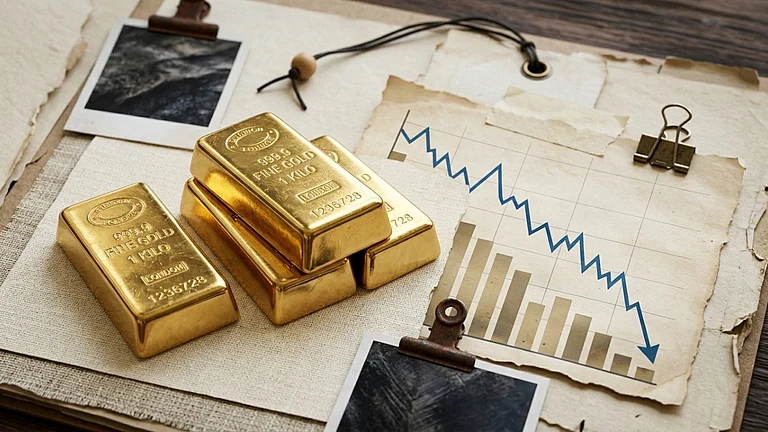
Gold futures with February 2026 expiry fell 3.83 per cent on MCX to Rs 1,35,080 following a record high of Rs 1,40,465.
Prices dropped today due to thin holiday liquidity as global markets like COMEX and LBMA remained closed for New Year.
Profit booking after a 75 per cent rally in 2025 and a firmer US Dollar further weighed on sentiment.
Gold Futures Fall: Gold Futures began 2026 on a slow note following a historic rally in 2025. The yellow metal’s price rose to fresh all-time highs in December 2025 as the year neared its close. However, on January 1, Gold Futures have fallen nearly 4 per cent from their record high.
Gold Futures with February 5, 2026, expiry have declined 3.83 per cent to Rs 1,35,080 per 10 grams from the record high of Rs 1,40,465 per 10 grams. In 2025, gold futures rallied nearly 75 per cent to Rs 1,32,640 per 10 grams, indicating the precious metal’s relentless rally. In the international market, gold prices saw their largest annual gain since 1979. The yellow metal touched its record high of $4,550 per troy ounce on December 26, 2025.
However, the international market remained closed on January 1. Gold Futures witnessed an intraday dip of 0.27 per cent to Rs 1,35,080 per gram. On the other hand, the price of physical gold of 24 karat purity inched marginally higher by 0.12 per cent to Rs 135060 per 10 grams.


Why Are Gold Futures Down Today
After a relentless rally fueled by a coming together of several domestic and international catalysts, the rally seems to have taken a pause on January 1. The decline in gold prices seen on the MCX follows reduced liquidity, a relatively firmer US Dollar, and probable portfolio rebalancing.
Low Holiday Liquidity
Global commodity markets such as COMEX (New York) and the London Bullion Market Association (LBMA) are closed on January 1 on the occasion of New Year’s Day. Thus, the trading volumes on the MCX are relatively thin. Typically, in low-volume environments, modest selling also leads to outsized price declines.
Firm U.S. Dollar Index
The US Dollar index is hovering around the 98.20 – 98.30 level, indicating firming of the currency against a basket of six currencies. With the strengthening of the index, the "value" of each dollar increases, since the precious metal is globally priced in dollars; a stronger dollar makes the metal more expensive for rupee-holders, leading to potentially lower demand.
Rotation to New-Year Equities
Typically, the beginning of the new year is a time associated with renewed participation across global and domestic markets. Notably, this means rebalancing of institutional portfolios and strategic investment in equities ahead of the upcoming earnings season. It is likely that the movement of capital from "defensive" assets like gold into equities is likely to have reduced the demand for gold and led to the price decline.
Profit Booking
On the other hand, several concurrent factors are also likely to have contributed to the price decline from the record high in the sessions following the record high hit on December 26, 2025. These include aggressive profit booking following the 75 per cent rally seen in 2025. Towards the end of the year, both institutional investors and traders are likely to have moved to lock in historic gains at the end of the fiscal year, with the sell-off creating significant downward pressure.
Higher Margin Requirements
Additionally, margin requirements for precious metals were also raised by major exchanges, including the Chicago Mercantile Exchange. The higher margins forced leveraged traders to liquidate positions in order to comply with the increased collateral demands, spilling over into the Indian domestic sentiment.
Lower Safe Haven Demand
Potential diplomatic breakthroughs in trade tensions and de-escalations in major global conflict zones are also expected to have slightly dampened the safe-haven urgency, which initially pushed gold to its peak.
China’s Export License Requirements
The new export license requirements announced by China, which are set to come into effect in 2026, are also expected to have created short-term liquidity uncertainty in the physical metals market, prompting a cautious "wait-and-see" approach from major industrial buyers.





