





Summary of this article
Ghaziabad has always been close to Delhi in theory. In practice, it rarely felt that way. Traffic could stretch a commute without warning, and that uncertainty shaped how people chose where to live.
There is no sudden exodus from Delhi, but there is a noticeable drift. Some professionals who once preferred to stay closer to their workplaces are beginning to explore Ghaziabad’s larger townships.
Markets usually move once behaviour changes. Along parts of the RRTS corridor, especially near NH-24 and Wave City, prices have moved up sharply over the past few years.
The full rollout of the Delhi–Ghaziabad–Meerut Namo Bharat Corridor in 2026 has begun to show up in places you wouldn’t immediately notice on a map. Not first in headline numbers, but in micro choices. Where people choose to rent. How far they are willing to travel. What they are willing to compromise on - or no longer accept.
For years, the choice was fairly rigid. Live in Delhi and manage with less space, or move out and spend hours commuting. That balance is shifting. The RRTS has not erased distance, but it has made it far less intimidating. What matters now is whether you can rely on the time it takes.
When Time Became Predictable
Ghaziabad has always been close to Delhi in theory. In practice, it rarely felt that way. Traffic could stretch a commute without warning, and that uncertainty shaped how people chose where to live.
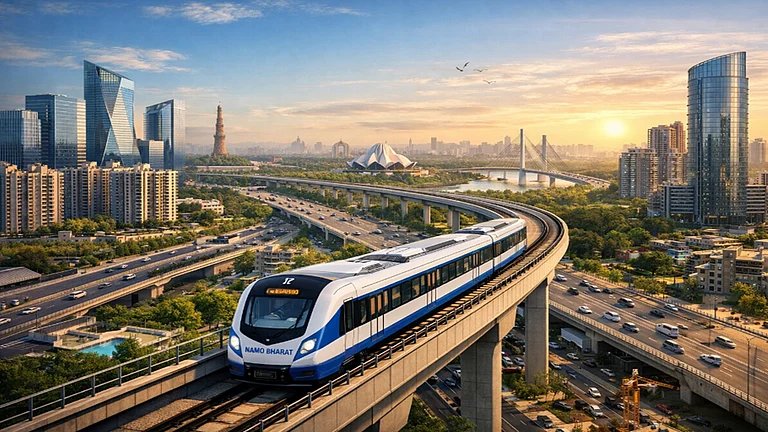
That uncertainty is easing. A 2025 study by Knight Frank found that more buyers across NCR are open to homes along high-speed transit routes, largely because commute times are becoming more dependable. The RRTS has brought that dependability into daily life. For many, that is enough to reconsider locations they would not have looked at earlier.
A Gradual Shift In Where People Live
There is no sudden exodus from Delhi, but there is a noticeable drift. Some professionals who once preferred to stay closer to their workplaces are beginning to explore Ghaziabad’s larger townships.
The reasons are practical. More space, newer developments, and now a commute that feels manageable. Areas around stations such as NH-24 and Wave City are part of this shift. These were not first-choice locations earlier. Now they are being evaluated differently.
Speaking about the changing preference, Varun Garg, Director of Karyan Group, says, “Six months ago, most of our enquiries were still price-driven. Today, the first question buyers ask is about travel time to Delhi and how far the nearest RRTS station is. That’s a big shift. People are more open to Ghaziabad now because the commute feels reliable. We are also seeing families - who were earlier renting in East Delhi - seriously consider moving here for larger homes.”
Ashish Agarwal, Director, AU Real Estate, says, "The Namo Bharat Corridor is redefining the housing market in Ghaziabad. Buyers are actively considering the city, not as a peripheral spillover of Delhi-NCR but as a strategic destination characterised by connectivity and accessibility. The corridor has facilitated seamless mobility and reduced commute uncertainty, thus appealing to the end users who regard strategic connectivity as a core tenet of luxurious living. The city is witnessing a steady shift in demand, where convenience, connectivity, and time efficiency are defining the new address."
Prices Catching Up
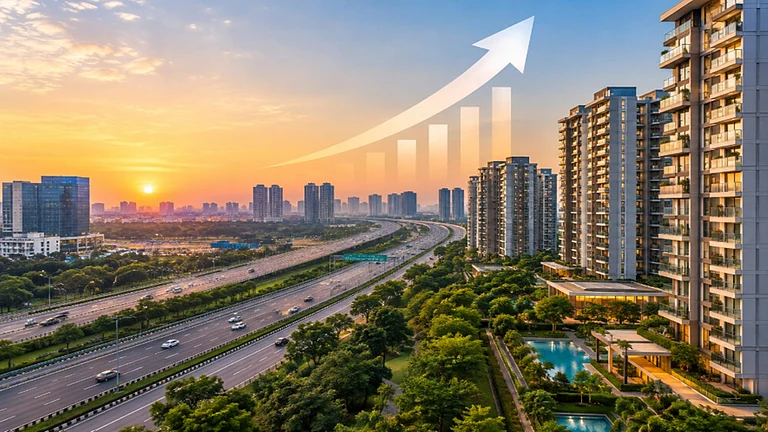
Markets usually move once behaviour changes. Along parts of the RRTS corridor, especially near NH-24 and Wave City, prices have moved up sharply over the past few years, with some estimates pointing to growth of over 130 per cent since early development began.
This is not just investor activity. It reflects a change in how these areas are being used. Buyers are not treating them as backup options anymore.
Across NCR, the same pattern is visible. Demand is moving toward locations that offer better connectivity, even if they sit outside traditional city centres, according to Knight Frank.
Building Around Transit
Developers have started adjusting to this new reality. Projects are increasingly being planned closer to RRTS stations, often within a couple of kilometres. The thinking is straightforward. If commute time is the key factor, proximity to transit becomes more valuable than anything else.
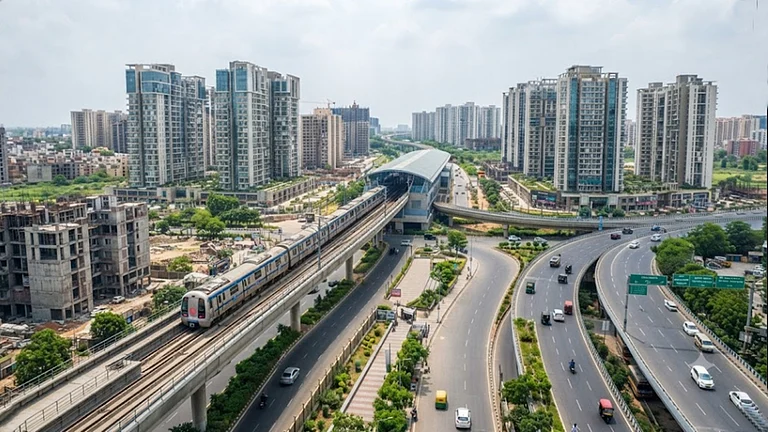
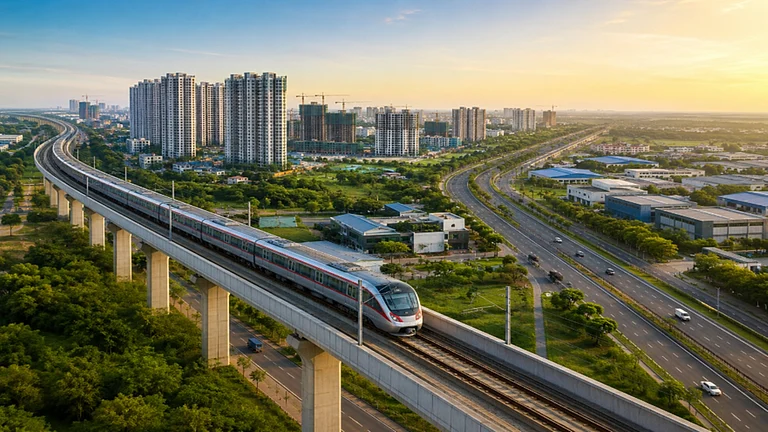
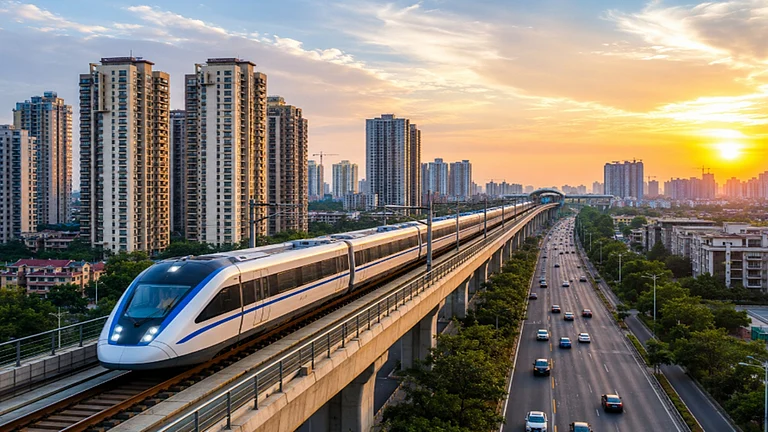
There is also a gradual shift in the kind of projects being built. Instead of building housing in isolation, developers are starting to think in terms of complete neighbourhoods. New projects are bringing together homes, small retail, and everyday conveniences within the same space. The idea is simple. Even if travel has become easier, people would still prefer not to step out for every small need. If daily errands can be managed within walking distance, the overall experience of living there improves.
Planning policy is backing this approach. Ghaziabad’s Master Plan 2031 allows denser development around transit corridors, making it easier to build in this way.
A Different Kind of Buyer
What is changing, quietly, is the profile of the buyer. This is not just someone looking for a cheaper home. It is someone weighing trade-offs more carefully. Space, commute, and everyday convenience are all part of the decision.
For this group, the RRTS is not just infrastructure. It is what makes the choice possible. It allows them to step away from older constraints without feeling cut off.
The broader impact will take time. Not every part of Ghaziabad will see the same pace of change, and commercial development around stations is still catching up. But one thing is already clear. The old compromise between space and distance is beginning to loosen.
And as that happens, Ghaziabad is not just absorbing demand from Delhi. In certain pockets, it is starting to stand on its own.
FAQs
1. Why are buyers looking at larger homes in Ghaziabad because of Namo Bharat Corridor?
Customers desire safe and speedy commute which makes them look at larger homes with better layouts in Ghaziabad.
2. Why are projects near RRTS stations in non-metros like Ghaziabad turning into buyers’ favourites?
Projects near Wave City, NH-24 and other upcoming RRTS stations offer buyers the perfect mix of connectivity, space, modern amenities.
3. Do investors driving speculation is the only factor causing housing prices to skyrocket along Namo Bharat corridor?
Homes buyers along the corridor are coming mainly from end-users and not investors. End-users see these locations as their primary choice of residence rather than the secondary option.





