





Summary of this article
Senior living in India is fast emerging as a holistic real estate sector that marries housing with healthcare, wellness and recreation as well as assistance with day-to-day activities for senior citizens.
Rising life expectancy, higher incomes, better retirement planning and growing awareness around health and wellness are changing how older Indians think about where and how they want to live after retirement.
Colliers estimates current demand for senior living at around 20-22 lakh units, compared with just about 25,000 organised units available today. This leaves considerable room for developers and operators to expand.
India’s senior living sector is evolving beyond the classic concept of retirement homes. Going beyond the conventional notion of age-specific housing, senior living in India is fast emerging as a holistic real estate sector that marries housing with healthcare, wellness and recreation as well as assistance with day-to-day activities for senior citizens.
The shift comes at a time when India’s ageing population is growing rapidly, families are becoming smaller and more seniors are looking for professionally-managed communities that can offer both independence and access to care. Developers, healthcare companies and institutional investors are also beginning to see the opportunity, leading to more projects and larger investments in the segment.
India’s senior living market is estimated to be worth about Rs 30,000 crore today, which is almost 70 per cent higher than in 2024. Rising demand and building investor interest could see the market reach Rs 1 lakh crore by 2030, quadrupling its current size, according to Colliers.
The opportunity is being driven by more than demographics. Rising life expectancy, higher incomes, better retirement planning and growing awareness around health and wellness are changing how older Indians think about where and how they want to live after retirement. The share of people aged 60 and above is expected to rise to around 21 per cent of India’s population by 2050, from about 11 per cent currently.
At the same time, the market remains significantly undersupplied. Colliers estimates current demand for senior living at around 20-22 lakh units, compared with just about 25,000 organised units available today. This leaves considerable room for developers and operators to expand.
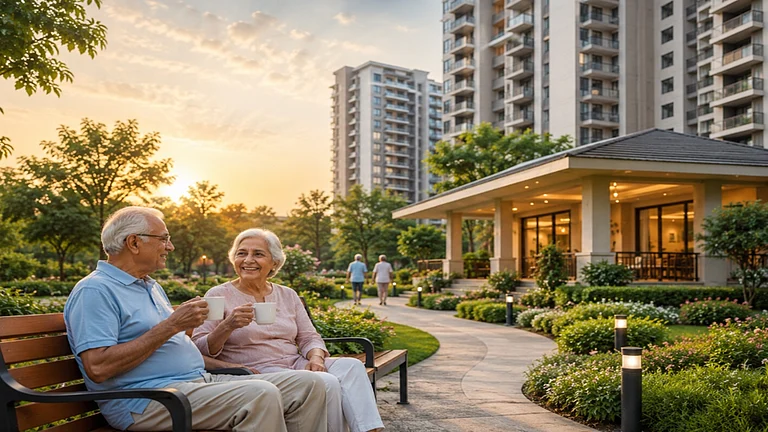
Senior Living Penetration Rate To Reach Almost 4 Per Cent By 2030
India’s elderly population is projected to double from around 170 million currently to more than 340 million by 2050. As more families look for reliable housing and care options for ageing parents and as seniors themselves become more comfortable with organised communities, demand for senior living is expected to rise sharply.
Colliers estimates demand could reach nearly 30 lakh units by 2030. Organised supply, meanwhile, is expected to increase to around 1 lakh units, taking the penetration rate from the current 1.3 per cent to nearly 4 per cent.
“India’s senior living market is entering a period of accelerated growth, driven by strong demographic shifts and evolving socio-economic dynamics. With a rapidly expanding elderly population and rising demand for professionally managed senior housing and care solutions, the market presents significant long-term growth opportunities,” said Badal Yagnik, Chief Executive Officer & Managing Director, Colliers India.
He added that organised senior living inventory could quadruple over the next three to four years, while rising policy support, investor participation and partnerships between developers and healthcare operators could reshape the sector.
Rs 13,000 Core Investment Pipeline
The expected expansion is already attracting substantial capital. More than Rs 13,000 crore of investments have been announced since 2025, according to Colliers, with much of this money likely to be deployed over the next three to four years.
The investment pipeline is expected to add close to 75,000 senior living units. Developers continue to account for a large share of the proposed investment, but partnerships between real estate companies and healthcare providers are becoming increasingly common.
Institutional investors are also showing greater interest, with some setting up joint venture platforms with developers to build senior living portfolios across multiple cities.
“Growing capital commitment towards senior living projects reflects the conviction of developers and investors in the segment’s long-term growth potential,” said Vimal Nadar, National Director and Head of Research, Colliers India.
According to him, the new investment is likely to accelerate development across both independent and assisted living formats and help the segment evolve into a more mature real estate asset class.
Tier II And III Cities Join The Senior Living Map
The senior living opportunity is no longer limited to major metropolitan cities. While Tier I cities currently account for most organised senior living stock, developers are increasingly looking at smaller cities where seniors can enjoy a lower cost of living, improving healthcare facilities and a quieter lifestyle.
Coimbatore, Puducherry, Dehradun and Vadodara are among the emerging markets, while spiritual destinations such as Tirupati, Vrindavan and Ayodhya are also attracting attention.
Colliers expects Tier II and III cities to account for around 30-40 per cent of new senior living project launches going forward. This could significantly widen the geographical footprint of the sector.
Commenting on the report, Aakash Ohri, MD and CBO, DLF Home Developers, said, “India’s changing demographics and increasing life expectancy are creating a demand for communities that help seniors stay independent, connected to family and urban life and provide them with an opportunity to lead active, purposeful lives. There is an opportunity to cater to this demographic by creating neighborhoods that are designed keeping in mind wellness, convenience, security and social engagements that allow residents to flourish at any stage of life.”


Rishabh Periwal, Senior Vice President, Pioneer Urban Land and Infrastructure Ltd, said, “India’s organised senior living sector is expanding North of Delhi. Dehradun has been attracting attention but now Gurugram is emerging as a market leader. Gurugram can leverage its popularity as a Fortune 500 hub by targeting HNI retirees and NRI parents looking to settle down in the city. Our research shows that 8 per cent of Gurugram’s population is already above the age of 60. Another key statistic: 37 per cent of the city’s population earns upwards of Rs 10 lakh per annum. This income filter screens the target audience who can afford premium-priced retirement homes.”
Developers say there has been a tectonic shift in the perception towards senior living in India. Senior housing was seen as need-based housing but now it is being perceived as aspirational lifestyle choice by seniors who seek independence, wellness and community living with a purpose.
“Today there is an increasing demand for planned communities that offer well-built homes along with healthcare facilities, parks, recreation and social connect. There is a need to reimagine housing for our senior citizens and offer them age friendly communities that help them lead a better quality of life. Senior living of the future will be characterized by Age integrated neighbourhoods that offer security with dignity and a sense of belonging, allowing the residents to lead healthy, independent and joyful lives,” said Anil Godara, Founder & Managing Director, J Estates.





