Summary of this article
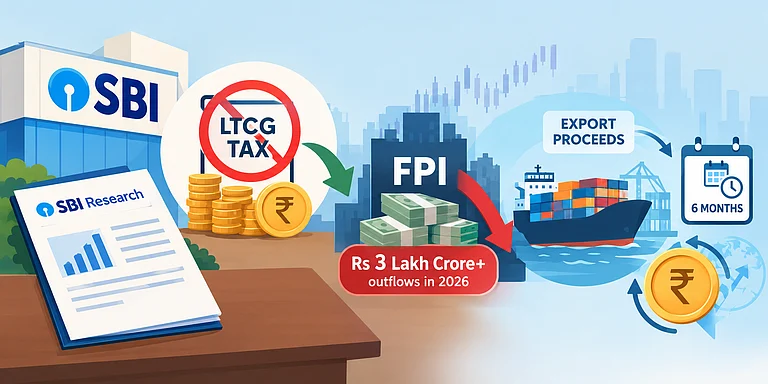
FPIs have withdrawn Rs 2.95 lakh crore from Indian equities in 2026 so far
A lower LTCG tax could improve post-tax returns for foreign investors
Weak rupee, high valuations and global interest rates still remain major concerns
The debate over a possible cut in long-term capital gains (LTCG) tax is gaining ground as foreign investors continue to sell Indian equities. There are concerns that the current tax burden is making the market less attractive at a time when foreign money is flowing out.
Foreign portfolio investors (FPIs) have withdrawn about Rs 2.95 lakh crore from Indian equities in 2026 so far, almost twice the Rs 1.66 lakh crore withdrawn in 2025. They sold shares worth about Rs 34,843 crore in October alone.
What Is LTCG Tax And The Concerns Around It
For the uninitiated, when an investor sells listed shares or equity mutual fund units after holding them for more than a year, the profit earned is called long-term capital gains (LTCG).
Until 2004, these gains were taxed at 20 per cent, but investors could use indexation to adjust their purchase cost for inflation. This reduced their taxable profits. The government later made LTCG on equities tax-free and introduced the Securities Transaction Tax (STT). Investors have to pay STT when they buy or sell shares, whether they make a profit or a loss. The broker or mutual fund house collects this tax and deposits it with the government.
However, in 2018, the government brought back LTCG tax at 10 per cent on annual gains above Rs 1 lakh. In the 2024 Union Budget, it raised the rate to 12.5 per cent and increased the exemption limit to Rs 1.25 lakh.
As of now, investors are paying both LTCG tax and STT. STT is charged at 0.1 per cent on both buying and selling shares in delivery trades and 0.025 per cent on the sell side in intraday trades. For derivatives, the tax is 0.05 per cent on selling futures and 0.15 per cent on selling options or exercising them. The charges may look miniscule individually, but they stack up when investors make multiple trades.
Why Is There A Fresh Debate Over LTCG Tax
The debate over LTCG tax has gained attention in recent weeks. On October 13, 2026, Finance Minister Nirmala Sitharaman said there was considerable discussion on LTCG tax, STT and whether different asset classes should be taxed equally. She added that the government was open to hearing different views.
State Bank of India (SBI) Research on October 13 called for scrapping LTCG tax on equities and increasing the holding period to two to three years. It believes these changes could attract more investment and improve investor sentiment at a time when FPIs are pulling money out of Indian stocks.
Jefferies has also said, in its India Strategy note dated October 29, that a cut in LTCG tax could make Indian stocks more attractive to foreign investors. The brokerage expects banks, energy companies and other large companies to benefit the most. It believes lower taxes could improve foreign investor sentiment and support both the stock market and the rupee.
Why A Cut Could Help
The returns foreign investors earn from Indian equities can look very different when calculated in dollars rather than rupees. Akshat Garg, head of research and product at Choice Wealth, says foreign investors have to look beyond the returns generated by Indian equities. Currency movements and taxes also determine how much money they actually take home.
The Nifty has declined about 8 per cent in rupee terms this year, while the rupee has weakened close to 7 per cent over the past 12 months, Garg notes. Foreign investors also have to account for LTCG tax and STT when calculating their returns.
US Treasury bonds, meanwhile, have been offering yields close to 5 per cent, after touching their highest level since 2002 earlier this month. Garg says that when currency depreciation, the 5 per cent dollar risk-free return and 12.5 per cent LTCG tax are factored in, Indian equities need to deliver annual returns of around 15 per cent in rupee terms to make them more attractive than US Treasuries. "India has not delivered that for two consecutive years," he says.
He believes taxation is one area where the government can make a difference. It cannot control the dollar, US bond yields or crude oil prices, but it can reduce the tax burden on foreign investors. “A rate cut improves the post-tax equation from day one and sends a credible signal on competitiveness,” he says.
Garg also argues that the government should examine the overall cost of investing in Indian equities rather than looking at LTCG tax in isolation.

Why A Tax Cut May Not Be Enough
Foreign investors do consider taxes when investing in Indian markets. However, a lower tax rate alone may not be enough to bring them back if other factors, such as the rupee, market valuations and global interest rates, remain unfavourable.
There are several other reasons at play for the recent selling. US Treasury yields crossed 5 per cent in recent weeks, although they have since fallen below that level. Higher US bond yields make them more attractive than riskier investments in emerging markets such as India.
The rupee fell close to 97 against the US dollar before recovering to around 95. A weaker rupee reduces the returns foreign investors earn in dollar terms. Indian equities also remain expensive compared with several other markets, making foreign investors less willing to invest fresh money.
Further, India's dependence on crude oil imports is another factor that is making domestic equities unattractive. The country imports more than 85 per cent of its crude oil needs. Uncertainty in West Asia and the resulting rise in oil prices have raised concerns about inflation, the current account deficit and further pressure on the rupee.
Harsh Gupta Madhusudan, chief India strategist at Ionic Asset, believes a reasonable reduction in LTCG tax would remove what he calls an “irritant for foreign investors, but would not address the other factors influencing their decisions. He calls it a “necessary but not sufficient condition.”
Manasvi Garg, founder of Moneyvesta, an investment advisory and wealth management firm, shares a similar view. He believes a tax cut would improve post-tax returns and send a positive signal to foreign investors. However, global economic conditions, currency movements, geopolitical uncertainty and valuations would continue to influence their investment decisions.
The Big Question: Will Foreign Investors Return
A lower LTCG rate could make Indian equities more attractive and remove one of the costs that foreign investors have to factor in. But it is unlikely to reverse the outflows on its own.
According to Garg, “A sustained return of FPI money will also depend on the rupee stabilizing, global interest rates becoming more favourable, oil prices cooling and Indian market valuations becoming more competitive.”
Unless these factors become more favourable, a tax cut is likely to have only a limited impact on foreign fund flows.
As Garg points out, policy can open the door, but earnings growth and a stable currency will determine whether foreign investors return and stay.