





Summary of this article
Mumbai has spent decades growing upward and becoming increasingly expensive. Now, the next phase of the city’s expansion is beginning to take shape beyond its traditional boundaries.
Called Mumbai 3.0, the large-scale urban development project spans around 324 sq km across 124 villages in Uran, Panvel and Pen talukas.
Over the longer term, successful execution could establish Mumbai 3.0 as an important residential and commercial growth corridor for the MMR.
Mumbai 3.0 is moving from an ambitious vision towards execution, with land acquisition, urban planning and infrastructure development beginning to take shape. For real estate, the opportunity is significant - but it is likely to play out over years rather than months.
Mumbai has spent decades growing upward and becoming increasingly expensive. Now, the next phase of the city’s expansion is beginning to take shape beyond its traditional boundaries.
Called Mumbai 3.0, the large-scale urban development project spans around 324 sq km across 124 villages in Uran, Panvel and Pen talukas. The project is being planned not merely as a residential extension of Mumbai but as a new, self-sustaining business and economic district within the Mumbai Metropolitan Region (MMR).
The project has moved beyond the announcement stage. The Mumbai Metropolitan Region Development Authority (MMRDA) is working on land acquisition, while Singapore-based urban planning and infrastructure consultancy Surbana Jurong has been appointed to prepare the vision document and concept plan.
For property buyers and investors, however, this is not a story of immediate price appreciation. It is a long-term urban expansion story in which infrastructure, jobs and housing will have to develop together.

From Land To A New Urban Ecosystem
According to Deepak Khandelwal, Chief Sales Officer, Square Yards, the planning framework for Mumbai 3.0 is becoming increasingly defined, although actual residential and commercial development will take time.
“Viewed through a real estate lens, Mumbai 3.0 is best understood as a long-term urban expansion story rather than an immediate housing market opportunity,” Khandelwal said.
That distinction is important for homebuyers. Large infrastructure projects can create excitement around surrounding land, but sustained housing demand usually comes only when people have a reason to live and work in the area.
Mumbai 3.0 has several advantages on that front. Its connectivity to the Atal Setu and Navi Mumbai International Airport, along with its proximity to JNPT port, gives the region a strong infrastructure and logistics foundation.
The bigger question is what comes next: jobs, commercial activity, social infrastructure and eventually, a population that wants to live there.
Jobs Could Determine The Real Estate Story
Rajkumar Singh, Senior Executive Director - Residential Sales (West), ANAROCK Group, said Mumbai 3.0 is being positioned as a major business district rather than simply a support ecosystem for existing urban centres.
“The planned development includes zones for education, data centres and global financial hubs, while logistics, warehousing and industrial activity could benefit from its proximity to JNPT, Navi Mumbai International Airport and the Mumbai Trans Harbour Link,” he added.
Data centres could become another important demand driver as India's digital economy expands.
This could create a familiar pattern in the MMR: employment centres emerge first, connectivity improves, and residential development follows.
Navi Mumbai offers a useful precedent. Locations that were once remote slowly turned into residential markets as connectivity, jobs and social infrastructure developed.
Mumbai 3.0 could follow a similar trajectory, although the scale and speed of development will determine how quickly that happens.
Panvel, Ulwe and Kharghar Could Gain From The Expansion
The impact will not be evenly distributed across the entire Mumbai 3.0 region.
Singh identifies Panvel, Ulwe, Kharghar and Taloja as key residential corridors around the development. These locations could benefit from their existing residential base as well as improving connectivity and proximity to new employment centres.
Khandelwal expects the expansion to gradually push residential demand towards Raigad, particularly as technology, logistics, financial services and other employment-led sectors establish themselves.
This could also give developers something Mumbai's established markets often struggle to provide: larger, more comprehensively planned residential communities.
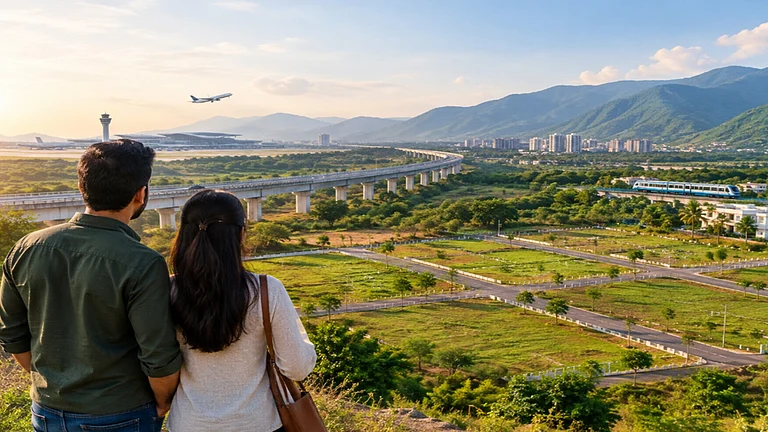



Instead of simply adding more housing to already congested neighbourhoods, new development corridors can potentially integrate homes with commercial spaces, schools, healthcare, recreation and transport infrastructure from the beginning.
But investors need to separate infrastructure hype from real demand.
The biggest mistake for property investors would be to assume that every parcel of land around Mumbai 3.0 will appreciate at the same pace.
Infrastructure announcements can push up expectations long before actual economic activity arrives. The more durable value creation, however, is likely to occur in locations where connectivity is accompanied by jobs, commercial development and social infrastructure.
“Property value appreciation is unlikely to be uniform across the region,” Khandelwal said. Locations that gain early access to major transport infrastructure and employment centres are likely to see stronger demand than areas where connectivity and social infrastructure are still developing.
For buyers, this means looking beyond a map showing a proposed road or transport link. The more important question is whether that infrastructure will make it easier for people to reach workplaces, schools, hospitals, airports and other daily necessities.
A Long-Term Housing Opportunity
Mumbai 3.0 could eventually help address one of the MMR's biggest challenges: the need to accommodate future population and housing demand without putting even more pressure on established parts of Mumbai.
Its success, however, will depend on execution.
If infrastructure arrives ahead of demand, businesses follow, and employment centres take root, residential development could gradually transform the region. Developers could then have the opportunity to build larger residential, commercial and mixed-use projects, while buyers could gain access to relatively newer and more planned urban communities.
For now, Mumbai 3.0 is best viewed as a long-duration real estate story.
The first signs are already visible in land acquisition, planning and infrastructure. The next - and more important - stage will be the creation of jobs and economic activity.
If that happens, Mumbai 3.0 may eventually become more than an extension of Mumbai. It could emerge as a new economic and residential centre in its own right, reshaping the geography of growth across the MMR.





