

Summary of this article
Data centres are primarily perceived as technology-driven infrastructure assets. However, the findings of the report suggest that in the long-term they spawn demand for residential spaces, create investment into infrastructure and push development of urban areas along growth corridors.
Today, India contributes almost 20 per cent of global data generation but holds merely 4 per cent of the world’s data centre space, pointing to significant scope in this space.
With artificial intelligence, cloud computing, and enterprise digitisation accelerating investments, India's installed data centre capacity is expected to grow significantly over the coming years.
India’s data centre boom may soon reshape not just the country’s digital economy, but also where millions of people live. As global technology companies pour billions into building massive server facilities across the country, the ripple effect is expected to extend far beyond warehouses filled with computers.
According to a report titled How India’s Data Centre Revolution Is Rewriting Real Estate by Square Yards, India’s proposed data centre pipeline of close to 9,030 MW could generate demand for more than 195 million sq ft of housing by 2030, as investments in power, roads, fibre networks and supporting businesses create entirely new residential growth corridors.
“It’s important to note that data centres don’t cannibalise demand from other sectors. Instead, they drive investments towards building power infrastructure, fibre connectivity, logistics facilities, commercial assets and associated services, such as establishments slowly developing adjacent areas into economic clusters,” said the report.
Data centres are primarily perceived as technology-driven infrastructure assets. However, the findings of the report suggest that in the long-term they spawn demand for residential spaces, create investment into infrastructure, and push development of urban areas along growth corridors.
Today, India contributes almost 20 per cent of global data generation, but holds merely 4 per cent of the world’s data centre space, pointing to significant scope in this space. With artificial intelligence (AI), cloud computing, and enterprise digitisation accelerating -investments, India’s installed data centre capacity is expected to grow significantly over the coming years, bringing with it a new wave of infrastructure-led real estate development.
Vivek Agarwal, co-founder and chief technology officer, Square Yards, said: “For decades, India’s real estate growth has been shaped by highways, industrial corridors, airports and IT parks. Data centres represent the next evolution of that story. While these facilities themselves employ relatively few people, they attract the critical infrastructure that enables long-term urban development. Investments in power, fibre connectivity, and logistics create confidence for businesses, developers and institutions, eventually driving residential and commercial growth around these emerging digital corridors. We believe data centres will increasingly serve as infrastructure anchors that redefine how cities expand in the coming years.”
One interesting observation made in the report is that impact is strongest outside of the data centre campuses themselves. There is a predicted 5-15 km ‘Golden Ring’ around Tier-1 facilities which will give rise to infrastructure build-outs, mixed-use developments, residential townships, retail hubs and civic institutions, the report said. With each supporting ecosystem establishing itself, there will be ongoing demand for housing stock driven by satellite employment, the report added.
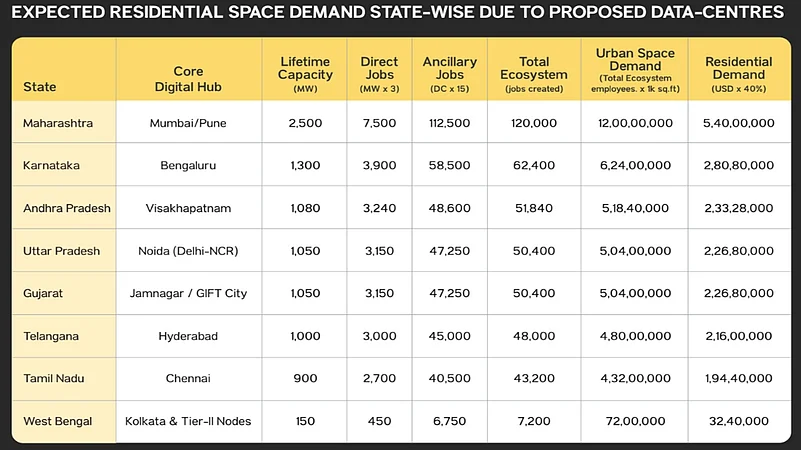

Among the major beneficiaries, Maharashtra is projected to generate over 54 million sq ft of residential demand, followed by Karnataka with nearly 28 million sq ft. Andhra Pradesh, Uttar Pradesh, Telangana and Tamil Nadu will also generate over 23, 22.70, 21.60 and 19.40 million sq ft of residential demand, respectively. These markets are expected to see increasing residential activity, as digital infrastructure investments accelerate alongside improvements in transport, utilities and commercial ecosystems.
The report added that emerging destinations, including Visakhapatnam, Noida, GIFT City and other infrastructure-rich locations, are expected to benefit from sustained economic activity, improved connectivity, and long-term institutional investment. In this evolving landscape, data centres are emerging not merely as technology assets, but as foundational infrastructure capable of reshaping land values, urban expansion and housing demand across India.
Sunita Mishra, vice president – research and insights, Square Yards, said: “Housing demand continuously chases areas that offer huge employment potential. Little wonder then that data centres in India are set to not only drive but shape the future of residential developments across the country. This growth will not be restricted to mega cities only. We expect tier-2 and tier-3 cities to benefit from this grand opportunity equally.”