34,600 tonnes Amount of gold held by Indian households*
15-16% India’s household gold as part of world’s total gold holdings*
$122.34 billion The estimated size of Indian jewellery market by 2031, up from $91.09 billion in 2025**
50-55% Proportion of bridal jewellery in overall jewellery sales**

1 July 2026
Get the latest issue of Outlook Money

Sources: *Morgan Stanley estimates as of October 2025; **Techsci analysis as of June 2025
Gold has been synonymous with wealth and prosperity for millennia, and the metal proved its worth in the recent rally. In the near 13-month period between January 1, 2025 and January 29, 2026, 24-karat gold prices rose 132 per cent from Rs 78,000 per 10 gram in January 2025 to a record high of Rs 1,80,779 in late January 2026.
Recent estimates by Morgan Stanley released in October 2025 suggest that Indian households hold around 34,600 tonnes cumulatively with a valuation close to $5 trillion. Based on the valuation, the household gold holdings exceed the International Monetary Fund’s (IMF’s) World Economic Outlook report estimates for India’s nominal GDP projected at $4.125 trillion for the current financial year.
This has been primarily driven by Indian women whose favourite investment asset happens to be the yellow metal. Recently, on social media platform X, Uday Kotak, non-executive director at Kotak Mahindra Bank, called Indian women the “smartest fund managers” as they quietly invested in a physical asset that does not lose value.
“The performance of gold over time highlights that the Indian housewife is the smartest fund manager in the world,” Kotak wrote. “Governments, central banks, economists... may need to take a leaf from India.”
But are Indian women making smart decisions? If not, here’s what they can do.
Physical Over Paper
The mega hoard of gold is not accidental; it is the result of a centuries-long deliberate, multi-generational savings project led almost exclusively by Indian women. India’s household gold hoard is almost 15-16 per cent of the world’s total gold, according to Morgan Stanley’s The India Opportunity: Financialization of Household Savings research note released in October 2025 and women have been its fund managers for decades. The hoard is significantly larger than the official reserves of the top five gold-holding nations combined.
The massive reserve has been accumulated through pan-India traditions such as Streedhan, where gold is passed within families from one generation to the next generation of women. In practice, it includes everything from buying a gold coin every Dhanteras and Akshay Tritiya to getting jewellery made for daughters when prices dip, indicating a staggered and disciplined approach.
According to Shaji Varghese, CEO of Muthoot FinCorp, gold in India is deeply rooted in culture, history, and family identity. “For women, gold is often an emotional inheritance passed down through generations—from mothers and grandmothers—and is viewed as much more than a commercial opportunity,” he says.
Women lead the purchase of physical gold primarily because the country’s gold market is structurally anchored in jewellery sales, an industry almost entirely focused on women consumers.
According to the World Gold Council (WGC), a significant part of physical gold demand is influenced by women in India. WGC mentioned in its report released in 2020 that 70 per cent of all physical gold purchases (by volume and value) in India are influenced or decided by women, even if the transaction is physically carried out by a male family member.
Things haven’t changed over the years. A recent market analysis (June 2025) by Techsci, a global market research and advisory firm, identifies women as the largest end-user segment by revenue. Further, their data show that bridal jewellery remains the single-largest product segment, controlling 50 per cent to 55 per cent of the entire gold jewellery market, effectively solidifying women’s role as the primary engine of physical gold demand in the country.
However, when it comes to investing in paper gold, women’s participation remains significantly low compared to their male counterparts. Paper gold includes gold exchange-traded funds (ETFs), Sovereign Gold Bonds (SGBs) that are now discontinued by the Reserve Bank of India (RBI) but available in the secondary market, and electronic gold receipts, among others.
According to the latest official data from the Association of Mutual Funds In India (Amfi), women’s share of the assets under management (AUM) in gold-related schemes was just 24.90 per cent compared to 75.10 per cent for men for financial year 2024-25.
The data further showed that gold ETF AUM hit Rs 1.84 lakh crore ($22 billion) for the first time in January 2026, but the share of women is lower than men.
However, Dilshad Billimoria, founder and managing director of Dilzer Consultants, a Bengaluru-based Sebi-registered investment advisory, sees a slight shift. “There’s definitely a shift from consumption-driven gold to allocation- or investment-driven gold. We can see this with the percentage allocations in the ETFs increasing towards gold, silver and other commodities. This is creating awareness in the minds of investors that gold is not just a traditional inheritance asset, but more of inflation-adjusted investment,” Billimoria says.
The Lure Of Physical Gold
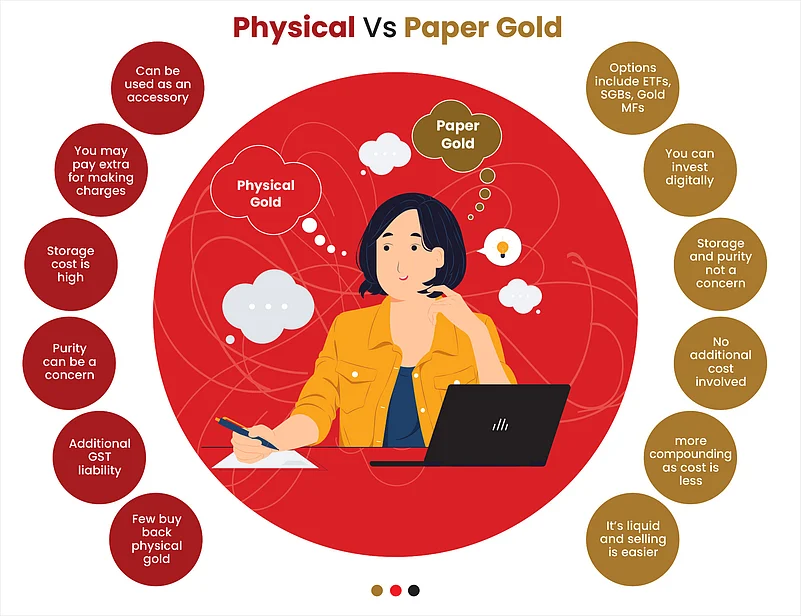
Gold remains a key asset that women buy, but are they looking at it as an investment asset? Their preference for physical gold seems to point otherwise and that’s despite the extra cost. The cost of physical gold is higher than any form of paper gold as physical gold, even bars and coins, entails making charges, taxes and the cost of safe storage like bank lockers.
A report by Kotak Institutional Equities released in December 2025, ‘Have Indian Households Been Overpaying For Their Gold?’, shows that the internal rate of return (IRR) on gold jewellery from FY11 to FY26 was 10.3 per cent, compared to 12.5 per cent for actual gold prices. This 2.20 percentage points gap is caused by making charges, goods and services tax (GST), and the used precious stones which, typically, do not appreciate in value.
The cost of physical gold is higher than any form of paper gold as physical gold, entails making charges, taxes and safe storage costs, such as bank locker fees
The slow adoption of paper gold is due to historical and current realities. Women often see gold jewellery as a dual-purpose asset: protection for emergencies and having social utility as an ornament. Paper gold strips away the latter appeal. Says Devina Mehra, founder and managing director of First Global, an investment management firm: “Women prefer physical gold because it is not just an investment. They get happiness out of it. The whole point is to live your life and get pleasure out of whatever money you have.”
The attachment to physical gold is obvious as most women don’t want to sell gold. Says Priya Sunder, director at PeakAlpha Investment Services, and a Securities and Exchange Board of India (Sebi) registered advisor: “With most physical assets, it is not that easy to make that mindset shift, from investment to consumption. Women stow away money for future contingencies. They don’t buy gold with the intent of selling as it is mostly a legacy thing.”
Varghese agrees and says women would rather take a loan against gold than selling it. “Women are determined not to let the asset go so they repay in 3-5 months.”
Trust and tangibility also play a role. Sebi’s public advisory released in November 2025, warned investors that digital gold or e-gold products sold by various online platforms and fintech apps operate entirely outside its regulatory purview. The regulator highlighted that such products are not protected by the same legal safeguards that cover stocks, mutual funds, or gold ETFs.
This announcement too led to a resurgence in physical gold. Says Prithviraj Kothari, managing director, at RiddiSiddhi Bullions, a Mumbai-based bullion trading company which specialises in the retail trading of physical gold, silver, and platinum bars and coins: “The Sebi 2025 advisory dented some confidence in unregulated digital gold platforms. This has driven a strong pivot back to physical bullion, particularly small bars and coins. Investors wait for platforms to move under a clear regulatory framework. Until then, women investors are likely to prefer more of what they can see, hold, and fully trust.”

Balancing Streedhan 2.0
Gold jewellery is unlikely to go out of favour anytime soon, but what women can do is strike a balance.
Sunder advises women to demarcate the purpose of their purchase. “Make it clear in your mind: are you buying this for an investment or for consumption? If you want to realise some value for it in the future, you would then make that leap from jewellery to a gold bar or a gold coin. At that point, you would have already had a mindset shift. Then you can (go a step further and) consider if you should buy an ETF.”
It is important for women to buy gold for investment purposes too. Sunder points out to a broader structural issue: “The overall issue is that women need to start getting more control over managing money and investments. When they start controlling money, they will think about using gold as an investment, and not just for consumption.”
It’s important to think about what you will lose if you buy physical gold as an investment. Sunder highlights the tax and cost benefits of digital gold: “Physical gold is taxed (as long term) at 12.5 per cent after two years, but for an ETF, long term is only one year. You have a 3 per cent GST on physical gold; you don’t have to pay GST when buying ETFs. You also don’t need to pay locker charges. Why do you want to hold gold if you don’t want to wear it? You can take out that same money later and buy jewellery, but it will grow better.”
Elaborating on the cost part, she adds: “If you bought an ETF today, your cost will be low. Imagine the compounding that will happen instead of spending money on GST and making charges. You are killing your growth by 8 per cent every time you buy jewellery. The path to getting there is better by doing it (digitally).”
Apart from gold ETFs, SGBs and electronic gold receipts, you can also invest in gold mutual funds and multi-asset funds, where the fund manager can increase the exposure to gold. “For someone who doesn’t want to swing along with the ups and downs of it, a multi-asset fund is a good choice,” says Sunder. Multi-asset funds also invest in gold.
By embracing paper gold in addition to traditional gold jewellery, the modern Indian woman can leverage the price rise in gold. This shift will ensure that Streedhan is no longer just a beautiful piece of jewellery, but also an active, compounding source of wealth.
ayushkhar@outlookindia.com