
Nearly a decade after its rollout, the Real Estate (Regulation and Development) Act, 2016 (Rera) has failed to meet the expectations of homebuyers, thanks to procedural gaps, weak enforcement, and lack of legal preparedness. Legal experts say Rera was introduced to be a game-changer for homebuyers, mandating builder disclosures, escrow accounts and 60-day dispute resolution in order to fix long-standing issues in real estate, such as delayed possession, misuse of buyers’ money, and lack of transparency, but it has fallen short on many counts.
Official data shows over 125,000 complaints against builders have been resolved and 130,000 real estate projects have been registered under Rera as on July 1, 2024, according to the Economic Survey 2023-24. “Many buyers, however, feel shortchanged. Deep bottlenecks in enforcement and new challenges have eroded confidence,” says Soumya Banerjee, partner, AQUILAW, a law firm.
As projects get larger, agreements more complex, and delays more nuanced, Rera is hitting several roadblocks. We list these, the way forward for this authority, and what you can do in this scenario.

1 October 2026
Get the latest issue of Outlook Money

The Gaps
No Guarantee Of Timely Possession: Rera registration is a pre-condition for developers to market or sell a project. This triggers disclosure about the builder, escrow accounts, and other aspects. However, these details cannot guarantee timely possession.
“Rera obliges promoters to adhere to declared timelines and imposes interest/compensation for delay with buyers entitled to interest/refund from the committed possession date if the developer defaults. But delivery risk remains. So, Rera registration should be treated as necessary, but not sufficient for timely possession,” says Manmeet Kaur, partner, Karanjawala & Co., a dispute resolution firm.
Problematic Clauses: Under Rera, builders cannot change sanctioned plans, layouts, or promised amenities without written consent of at least two-thirds of the buyers and required authority approvals. MahaRERA, for instance, has repeatedly ruled against developers making unilateral changes.
The dispute turns on one question whether the change is “material”?
Says Shankey Agarwal, partner, BMR Legal, a law firm: “Developers often label these changes as cosmetic or minor. However, buyers can challenge these changes in case there is any reduction in common areas, amenities, or it alters the project character. It is advisable that the buyers preserve brochures, sanctioned plans, and the agreement on record.”
Rera obliges promoters to adhere to declared timelines and imposes penalty for delay. But delivery risk remains. So, it is no guarantee for timely possession
However, buyers frequently encounter clauses that tilt risk back to them, such as force majeure overreach, and elastic grace periods contingent on routine approval delays or financing issues. Force majeure refers to unexpected events beyond the builder’s control, such as a natural calamity, war or government restrictions that make construction temporarily impossible. Ordinary delays like shortage of funds, contractor problems, or routine approval delays are usually not treated as force majeure.
Says Suresh Palav, partner, IndiaLaw LLP, a law firm: “Some builders include clauses that allow changes to layouts, seek blanket consents, or structure payments in ways that reduce buyer protection. Large projects are sometimes split into phases to avoid full scrutiny.”
While these agreements may look Rera-compliant on paper, buyers should always get the agreement reviewed carefully before signing in.
Recovering Refunds Is Long Drawn: Getting a favourable order is easier than actually recovering the money. Only about a third of recovery orders are successfully enforced. Many get delayed due to insolvency proceedings or slow action by district authorities.
“Although the law allows recovery like land revenue arrears, buyers often have to follow up for months or years. Recovery works better in some districts than others,” says Palav.
Kaur adds that the execution of orders also depends upon promoter solvency. Authorities (Rera/Rera Appellate Tribunal) can impose penalties, cancel registration, and order a refund with interest. There are options to file an appeal or initiate civil contempt proceedings in case of non-compliance.
In case of stalled projects, when insolvency proceedings start, certainty often vanishes for homebuyers. The insolvency process places control in the hands of the resolution professional. Buyers may gain the status of financial creditors. However, the actual recovery hinges on the contours of the final resolution plan, which is often a long and unpredictable journey.
“In such cases, it is important for buyers to act early and monitor insolvency filings closely to craft a coordinated strategy across both Rera and Insolvency and Bankrupty Code (IBC), 2016 forums,” says Agarwal.
The takeaway is clear. “If your developer goes insolvent, a favourable Rera order will not magically expedite delivery. You still need to align with IBC processes, claim your share with other creditors, and often wait for long to recover dues,” says Banerjee.
Updates Not Monitored: Under Rera, promoters are required to update quarterly construction progress on state portals, which are publicly accessible and meant to improve transparency. Rera/Rera Appellate Tribunal can penalise promoters for false reporting.
In many states, there is no automatic execution mechanism equivalent to a civil court decree. Homebuyers often have to initiate separate execution proceedings
Buyers can cross-check approvals and sanctions, including the status of commencement certificates (CC) and occupancy certificates (OC). “As mandated under the Act, 70 per cent of collections from buyers must be deposited into a designated escrow account, with withdrawals permitted only in proportion to certified construction progress,” says Kaur.
However, while compliance has improved, the information available on Rera portals is not always fully reliable, as quarterly construction and financial updates are uploaded by builders themselves. So, “site visits, checking approvals with local authorities, and reviewing architect or engineer certificates are important to get the real picture,” says Palav.
Unsatisfactory Dispute Resolution: Homebuyers often complain that Rera has been ineffective in resolving disputes. But is this perception accurate? According to legal experts, Rera tends to work well in straightforward cases involving project delays, but it struggles in more complex disputes.
Says Agarwal: “Many state Rera authorities take time to decide cases. Execution is an even bigger problem. Even after buyers win, they struggle to recover money or enforce directions. State-level differences, limited staff, and weak penalty recovery add to the perception that Rera is ineffective and does not deliver real relief.”
Crucially, winning a Rera case still doesn’t guarantee relief. Enforcement is weak. Appeals and stays compound the wait. Adds Banerjee: “Section 43(5) requires a builder to deposit 100 per cent of the award before appealing, but instead, many builders file appeals and drag the matter. In short, multiple studies and client stories underline that Rera’s 60-day promise has become a 1,600-day reality for many.”
The Issue With RERA
Structural Problem: Authorities under Rera are equipped with wide regulatory and adjudicatory powers.
Says Banerjee: “The issue is not the absence of authority, but the effectiveness of enforcement. In practice, execution of Rera orders often relies on external recovery mechanisms, institutional capacity varies across states, and procedural delays dilute the speed of relief.”
Additionally, factors such as fragmented state implementation and parallel proceedings, including under IBC, 2016, can affect outcomes.
“In many states, for instance, there is no automatic execution mechanism equivalent to a civil court decree or uniform revenue recovery process. Homebuyers often have to initiate separate execution proceedings, which slows enforcement and reduces deterrence,” says Adnan Siddiqui, partner, King Stubb & Kasiva, Advocates and Attorneys.
So, while Rera may be structurally robust on paper, its real impact depends on consistent, timely, and well-resourced implementation.
Issue Of Interpretation: While Rera establishes a comprehensive regulatory framework, the real estate sector—particularly issues relating to land rights, title structures, and development models—is inherently nuanced and cannot be exhaustively addressed through statutory drafting alone.
Says Banerjee: “The legislation sets out broad principles, but complex scenarios, such as projects developed on leasehold land where units may be transferred while the underlying land cannot, create practical questions around compliance with Section 17 of Rera relating to conveyance to the association of allottees.”
Similar interpretative challenges arise in areas, such as mixed-use developments, phased projects, maintenance obligations, force majeure extensions, use, allocation, and shared access to common facilities and amenities across multiple phases of a project. “As a result, while the framework is intentional in its flexibility, this also leaves room for varying interpretations by developers and stakeholders, which can lead to disputes and inconsistent regulatory outcomes unless supplemented by clear guidance and consistent regulatory practice,” adds Banerjee.
Are Rera Orders Binding?
According to legal experts, orders passed by authorities under Rera are legally binding on the parties. If a builder fails to comply, Rera provides a structured enforcement mechanism, including imposition of penalties, interest, and prosecution under Sections 63-68, along with recovery of amounts as arrears of land revenue through the machinery contemplated under Section 40.
“An aggrieved consumer may also pursue execution before the authority, file an appeal before the Real Estate Appellate Tribunal under Section 44, or approach the jurisdictional High Court in appropriate cases, particularly where enforcement is delayed. Importantly, remedies under Rera are supplemental, allowing consumers to simultaneously invoke protections under consumer law, ensuring multiple avenues of redress in cases of continued non-compliance,” says Banerjee.
Administrative Issues: It is often claimed that Rera is defunct in many states, but legal experts say this is not true. The framework under Rera is operational across almost all states and union territories (UTs), with rules notified and regulatory authorities constituted in the vast majority of jurisdictions. However, the degree of functionality varies.

“Rera is operational across most states and UTs, but functionality is uneven due to vacancies in authorities and appellate tribunals, and delays in enforcement. States such as Maharashtra, Uttar Pradesh, Gujarat, Karnataka, and Tamil Nadu are relatively more active in terms of registrations and order passing. The framework exists nationwide, but fully-staffed and consistently effective institutions are present in roughly two-thirds of jurisdictions at any given time,” says Siddiqui.
The issue, thus, is less about legal existence and more about operational capacity. Broadly, Rera can be said to be formally functional nationwide, but its practical performance depends on the institutional strength, resources, and administrative prioritisation within each state.
Limited Scope: Rera still lags behind in some ways. “New ownership models, such as co‑living facilities, rental-oriented projects or blockchain-based fractional investments typically fall outside its scope, leaving buyers in those schemes without Rera’s shield. Moreover, despite digital initiatives, enforcement machinery hasn’t caught up: many regulators still lack enough adjudicating officers,” says Banerjee.
Joint development or redevelopment projects, in which landowners, housing societies or special purpose vehicles (SPVs) partner with builders, have also exposed grey areas in Rera’s scope. In such projects, authorities such as Maharashtra Real Estate Appellate Tribunal and Karnataka Real Estate Regulatory Authority have treated landowners or housing societies as “promoters” under Rera, making them jointly liable for project obligations.
Filing a Rera complaint does not bar you from suing in a consumer court or the National Consumer Disputes Redressal Commission. So, many homebuyers file both
However, the Supreme Court has clarified that promoter status depends on contractual allocation of responsibility, and landowners need not always be classified as promoters.
In the Uttar Pradesh Real Estate Regulatory Authority v Larsen and Toubro (2025) case, the SC upheld an order letting L&T act as the sole promoter in a JV project, finding “no general interpretation of promoter”. It said that the landowner need not be named if the contract made the builder exclusively responsible.
“The net effect is mixed: regulators like MahaRERA, K-RERA, are expanding the promoter concept to prevent blame-shifting, but contractual structuring can leave a gap. In practice, homeowners in joint schemes often have to fight years to identify who (builder or landowner) will comply with a Rera order and sometimes find only the registered promoter on paper,” says Banerjee.
The Way Forward
Several states are rolling out new features, such as mandatory 5-year defect liability clauses and stricter escrow/audit rules, among others. There are proposals that RERA 2.0 will have built-in digital oversight. Indeed, new Rera rules promise online complaint filing, auto-tracking of cases, and even proactive regulatory notices. Under this upgraded regime, complaints can be submitted and tracked digitally, and must be resolved in 60-90 days.
However, some states are adopting these ideas piecemeal: a central Rera dashboard exists, and major authorities now publish project data online (plans, timelines, financials) for buyer review. Phased project registration allowing large sites to be developed in stages has eased compliance in a few jurisdictions.
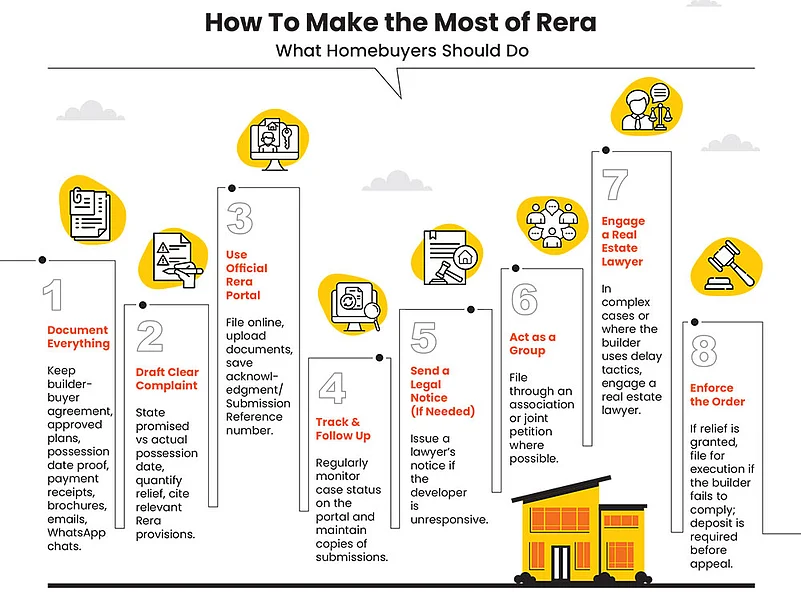
What Should You Do?
While you should be ready to pursue the case outside Rera if you don’t get a solution, remember that it’s also possible to pursue the case parallelly with other authorities.
The Supreme Court has made it clear that consumer forums remain available. In the Imperia Structures v. Anil Patni (2020) case, the court held that remedies under the Consumer Protection Act are “additional” to those under Rera. So, filing a Rera complaint does not bar you from approaching a consumer court or the National Consumer Disputes Redressal Commission (NCDRC). This “dual remedy” principle has been echoed by high courts.
Strategically, many buyers file both, a Rera case and a consumer complaint simultaneously.
However, Banerjee has a caveat. “Section 79 of Rera bars civil court suits on matters pending in Rera, and one often must withdraw from one forum to proceed in another. Practically, if Rera is dragging, a buyer might withdraw it and push a civil or consumer suit. Also note that Rera’s specialised relief (fixed interest formula, penalties) may differ from what a consumer or civil court grants. If the developer is insolvent, buyers should file claims with the insolvency professional and vote on any Corporate Insolvency Resolution Process (CIRP) plan (though, as mentioned above, recovery under IBC tends to be partial).”
In short, buyers should not feel locked into Rera. If a resolution seems stalled, consider consumer courts, civil suits for injunctions.
sanjeev.sinha@outlookindia.com